Son Goku Super Saiyan: The Story Behind Japan's Coca-Cola Dragon Ball Z Figure Collection

A Promotional Collectible Born from Japan’s Anime Boom
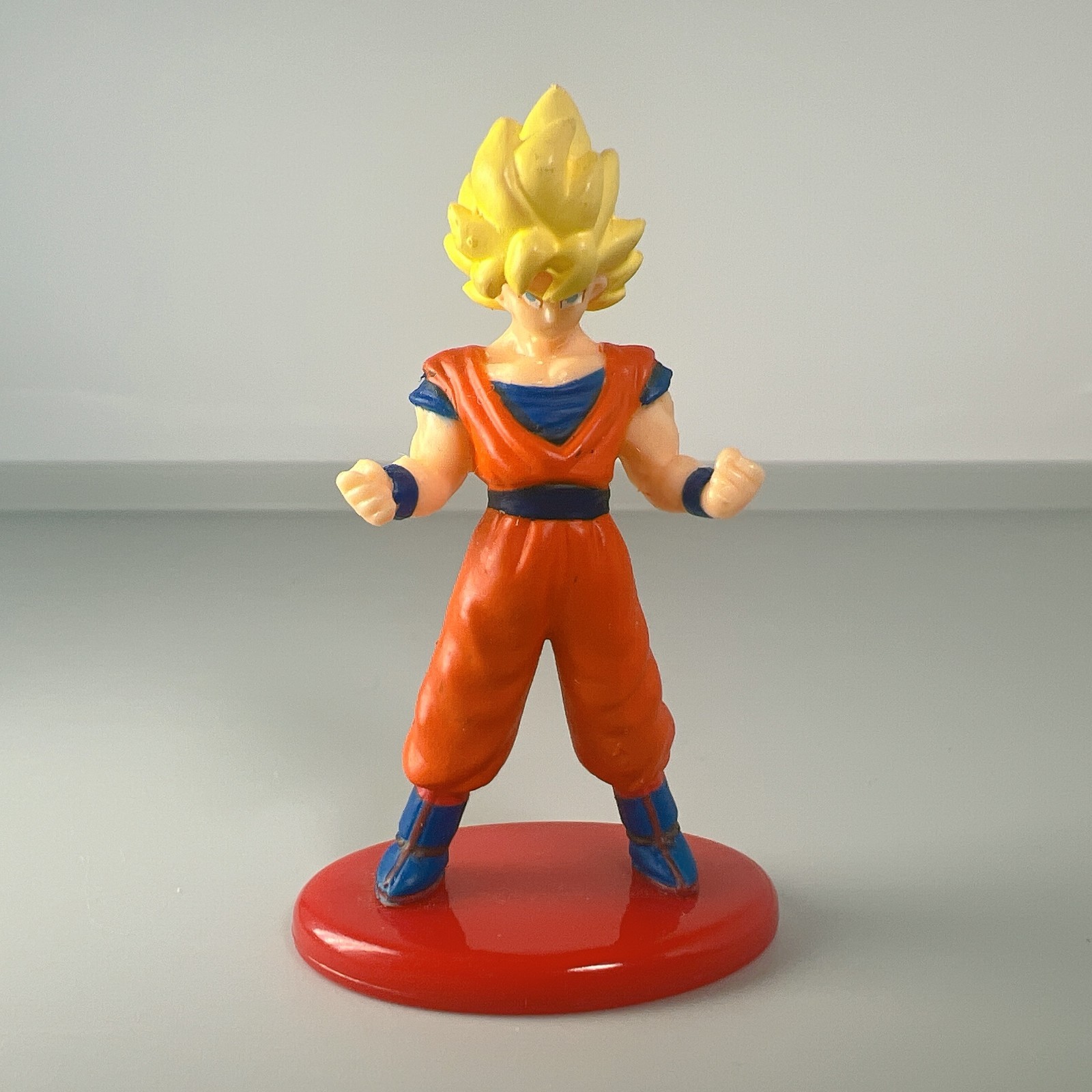
This small painted plastic figure of Son Goku — Dragon Ball Z’s iconic hero in his Super Saiyan transformation — originated as a Japanese market promotional item distributed through a Coca-Cola campaign. Rather than a toy sold at retail, it belongs to a category of Japanese collectible known as a novelty or omake figure: a bonus item tied to the purchase of a beverage or product. Coca-Cola Japan ran multiple anime and manga tie-up campaigns throughout the 1990s and early 2000s, and Dragon Ball Z was among the properties featured. The exact series name and release year cannot be confirmed from available information alone, but the production period most likely falls somewhere in the late 1990s to early 2000s, aligning with the peak years of DBZ merchandise in Japan.
The figure stands on a circular red base and depicts Goku in his recognizable orange gi with blue undershirt, belt, wristbands, and boots, fists clenched in a fighting stance — a pose that captures his Super Saiyan form, complete with the gold spiky hair the transformation is famous for. Whether the Kame (turtle school) emblem appears on the gi cannot be confirmed from the listing image alone, but the overall color scheme and proportions are consistent with how Goku is depicted in the original anime. The manufacturer of the figure itself is not confirmed; promotional figures of this type in the Japanese market were commonly produced under license by companies such as Bandai, Banpresto, or Furuta, though no definitive maker information is available for this particular piece.
Dragon Ball Z and the Super Saiyan Moment That Defined a Generation
Dragon Ball Z is the anime adaptation of Akira Toriyama’s manga, which ran in Weekly Shonen Jump from 1984 to 1995. The anime aired on Fuji TV from 1989 to 1996, spanning 291 episodes and covering the story from the Saiyan Saga through the Majin Buu arc. During the 1990s it was one of the most-watched television anime in Japan, and the licensed merchandise market expanded enormously as a result.
The Super Saiyan transformation — first shown in episode 95 in 1991, during the Frieza arc — became one of the most recognized moments in anime history. Triggered by Goku’s rage reaching a breaking point, the scene introduced the gold-haired, teal-eyed powered-up form that has since become inseparable from the character’s identity. It is widely cited as a landmark in Japanese pop culture, and figures depicting Goku in this form remain among the most sought-after subjects in Dragon Ball merchandise.
Why This Figure Matters to International Collectors
Dragon Ball Z has a broad international fanbase across North America, Europe, Latin America, and Asia, built through television broadcasts from the late 1990s onward. Promotional figures like this one were distributed exclusively within Japan — through convenience stores, supermarkets, and vending machine campaigns — and were never officially exported. That makes them genuinely difficult to source outside Japan, and pieces like this now reach overseas collectors only through the secondhand market.
For fans of vintage anime merchandise, Japan’s 1990s promotional figure culture — sitting alongside gashapon (capsule toys), Bandai HG series, and Furuta’s Choco Egg figures — represents a distinct era of miniature craftsmanship. These items were designed as sets spanning multiple characters, encouraging complete-set collecting. A single figure from such a series can carry both nostalgic appeal and historical interest for those documenting how Dragon Ball merchandise evolved during the franchise’s formative years.


Price: $13.76 | View on eBay