Super Mario Menko Card by Amada (1985): A Piece of Famicom History from Japan

What Is a Menko Card — and Why Does This One Matter?
Menko are a traditional form of Japanese playing card with roots stretching back to the Edo period. Made from thick, stiff cardboard, they were played by slamming one card down onto another: if the impact or air pressure flipped your opponent’s card over, you won it. By the Meiji era, advances in color printing had transformed menko into the vibrant, illustrated cards recognizable from mid-twentieth-century Japan. Through the 1970s and 1980s, a wave of character-licensed menko brought beloved anime, manga, and video game imagery to the format, turning them into some of the most sought-after artifacts of that era’s children’s culture. Kids picked them up at dagashi-ya — the small neighborhood candy and toy shops that were a fixture of Japanese childhood — to play, trade, and collect.
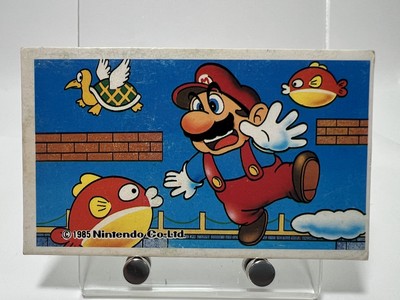
This particular card was produced by Amada, a manufacturer well known throughout the 1980s for licensed character menko, stickers, and cards covering major properties of the day, from Dragon Ball to Gundam to Nintendo’s Famicom lineup. The card carries a ® 1985 Nintendo Co., Ltd. copyright notice, confirming it is an officially licensed product, not a bootleg.
The Franchise Behind the Card: Super Mario Bros. in Its First Year
Super Mario Bros. was released for the Family Computer (Famicom) on September 13, 1985 — a side-scrolling action game that became one of the defining titles of its generation and sold more than 6.81 million copies in Japan alone. The copyright year on this card matches the game’s release year exactly, placing it among the earliest wave of Super Mario licensed merchandise ever produced, at a time when the franchise was still brand new.
The card depicts Mario himself — recognizable in his red cap, red overalls, and blue shirt, in poses consistent with the original Famicom-era art style. Also illustrated are Koopa Paratroopa (a winged Koopa Troopa, known in Japan as Patakuribo or “Para Nokonoko”), a flying enemy variant that appeared in the original 1985 game, and Cheep-Cheep (Pukupuku in Japanese), the red-and-yellow fish enemy found in underwater stages and in select above-ground levels. Background elements — brick blocks, blue sky or water, and a fence-like structure — echo the immediately recognizable visual language of World 1-1 and beyond. Card number #33 is visible on the piece, suggesting it was part of a numbered series, though the full scope of that set is not definitively documented.
Why This Card Appeals to Collectors Outside Japan
Menko were almost entirely a domestic product — they were rarely exported, so international buyers in the 1980s had virtually no access to them. That makes surviving examples genuinely uncommon outside Japan. For Nintendo and Super Mario collectors specifically, the 1985 copyright date places this card at the very origin point of one of the most recognized franchises in gaming history, predating or coinciding with the NES launch in North America (1985–1986). Items from this initial wave of Japanese Famicom merchandise never circulated in Western markets, giving them a distinct character as Japan-only artifacts of early Nintendo history. The confirmed official licensing, the multi-character illustration capturing the world of the original game, and the physical evidence of roughly four decades of age together make this card a tangible document of where Super Mario began.

Price: $7.67 | View on eBay