Laputa: Castle in the Sky — The 1986 Animage Playing Card That Captured Ghibli's First Chapter

A Single Card from a Landmark Moment in Anime History
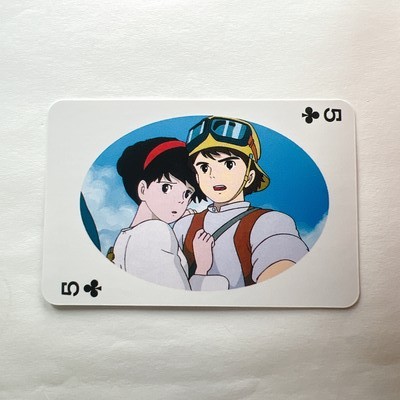
This is the Five of Clubs from a character playing card set — a kiャracter trump (character trump card), as this genre is known in Japan — produced in connection with Animage magazine in the summer of 1986. Animage was published by Tokuma Shoten, one of Japan’s most influential anime publications since its founding in 1978, and it had deep institutional ties to what became Studio Ghibli. The card follows the standard playing card format, with the suit and number framing a full illustration at its center. That illustration features Pazu and Sheeta, the two leads of Laputa: Castle in the Sky (Tenkuu no Shiro Laputa), shown side by side against a sky backdrop — Pazu in his signature goggled pilot’s cap, Sheeta with her red hairband. The timing of the set’s release aligns directly with the film’s theatrical debut on August 2, 1986, distributed by Toho.
The Film Behind the Card
Castle in the Sky holds a specific place in animation history: it was the first theatrical feature produced and released under the Studio Ghibli name, which had only been established in 1985. Directed, written, and conceived by Hayao Miyazaki, the film follows Pazu, a boy raised in a mining town who is determined to prove the existence of the flying island Laputa — a quest his late father photographed but was never believed. He meets Sheeta, a girl who carries a glowing relic called the Flying Stone, a crystal of ancient technology tied to Laputa’s royal lineage. Their story is one of aerial adventure and discovery, which makes the image of the two characters set against an open sky a natural visual shorthand for what the film is about. Tokuma Shoten’s involvement in Ghibli’s early financing meant that Animage was closely connected to the studio from the start; Miyazaki’s previous film, Nausicaa of the Valley of the Wind (1984), had originated as a manga serialized in Animage itself.
Character Trump Cards and the Animage Collectible Tradition
Character playing card sets have been a durable category of Japanese licensed merchandise for decades, produced alongside film and television releases and distributed through multiple channels. Animage magazine had a long-running tradition of offering readers small goods — sometimes as bound-in supplements, sometimes through mail-order or reader campaigns. Whether this particular set reached buyers as a magazine supplement, an event item, or a direct-sale product is not confirmed by available records, and that uncertainty is worth noting. What is clear is that goods tied to a specific magazine issue occupied a narrow distribution window. A reader had to be engaged with Animage at exactly that moment in the summer of 1986 to encounter it. Playing cards are also practical objects, meaning complete sets were often used rather than preserved, and individual cards occasionally surface separately from the rest. For fans of the film, Pazu and Sheeta sharing a single card — two characters who carry the emotional core of the story — makes this a visually coherent piece of the broader 1986 release moment. For those interested in early Ghibli history, the card exists as a contemporary artifact from the studio’s very first year as a theatrical production house.


Price: $8.63 | View on eBay