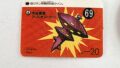
Alien Baltan Vintage Menko Card from 1960s Japan: A Piece of Original Ultraman History

What Is a Menko Card — and Who Is Alien Baltan?
This card is a menko, a traditional Japanese game piece with roots stretching back to the Edo period. Originally made from clay, menko evolved into thick, illustrated cardboard cards by the Meiji era, and by the postwar decades they had become one of the most popular cheap toys a child could buy at a neighborhood candy store (dagashiya). The game itself was simple and physical: players would slap their card against a stack on the ground, using the force and air pressure to flip opponents’ cards face-up and claim them. The printed face was the prize — and in the 1960s, that face increasingly belonged to a kaiju or a superhero.
The character printed on this card is Alien Baltan, one of the most immediately recognizable figures in the entire Ultraman universe. He made his debut in Episode 2 of the original Ultraman series — “Shoot the Invader,” broadcast in 1966 — and his design is impossible to forget: enormous lobster-like claws, compound insect eyes, a V-shaped crest on his head, and a signature echoing laugh that became as iconic as the character itself. Unlike the lumbering monster-of-the-week kaiju of the era, Alien Baltan was written as an intelligent invader with shapeshifting and duplication abilities, which made him a more unsettling kind of threat and gave him a lasting place in the series mythology.
The Franchise Behind the Card: Ultraman and the First Tokusatsu Boom
Ultraman was produced by Tsuburaya Productions, the studio founded by Eiji Tsuburaya — the special effects director responsible for the original Godzilla films at Toho. The series aired on TBS from July 1966 through April 1967, running 39 episodes, and it defined what tokusatsu (live-action special effects) television could be. Japan was in the middle of a television boom, and character merchandise flooded the market to meet the demand from young viewers: soft vinyl figures, bromide photo cards, stickers, and menko cards like this one were all produced in large numbers and sold at low prices so children could afford them with pocket money.
The 1960s were the origin era of the Ultraman franchise — everything that followed, across more than five decades of sequels and spin-offs running to the present day, traces back to this moment. Alien Baltan himself has reappeared across dozens of subsequent series, from Ultraseven to Ultraman Taro and beyond, cementing his status as the franchise’s defining antagonist.
Why Collectors Around the World Take Notice
Ultraman has been broadcast and distributed across Southeast Asia, North America, Europe, and Latin America, and the series has found a new generation of international fans through streaming platforms. For many of those fans, Alien Baltan is the face they associate most strongly with the show — his claw-armed silhouette still appears regularly on contemporary merchandise worldwide.
Menko cards, however, are far less familiar to non-Japanese collectors than figures or trading cards, which gives them a particular cultural distinctiveness. The format is entirely Japanese, the halftone printing technique is typical of mass-produced 1960s toy ephemera, and the wear visible on surviving examples — softened corners, slight color fading — reflects actual use by the children who originally played with them. A card like this one sits at the intersection of Japanese toy history and one of the country’s most enduring pop culture exports, from the very years the franchise was born.


Price: $15.99 | View on eBay