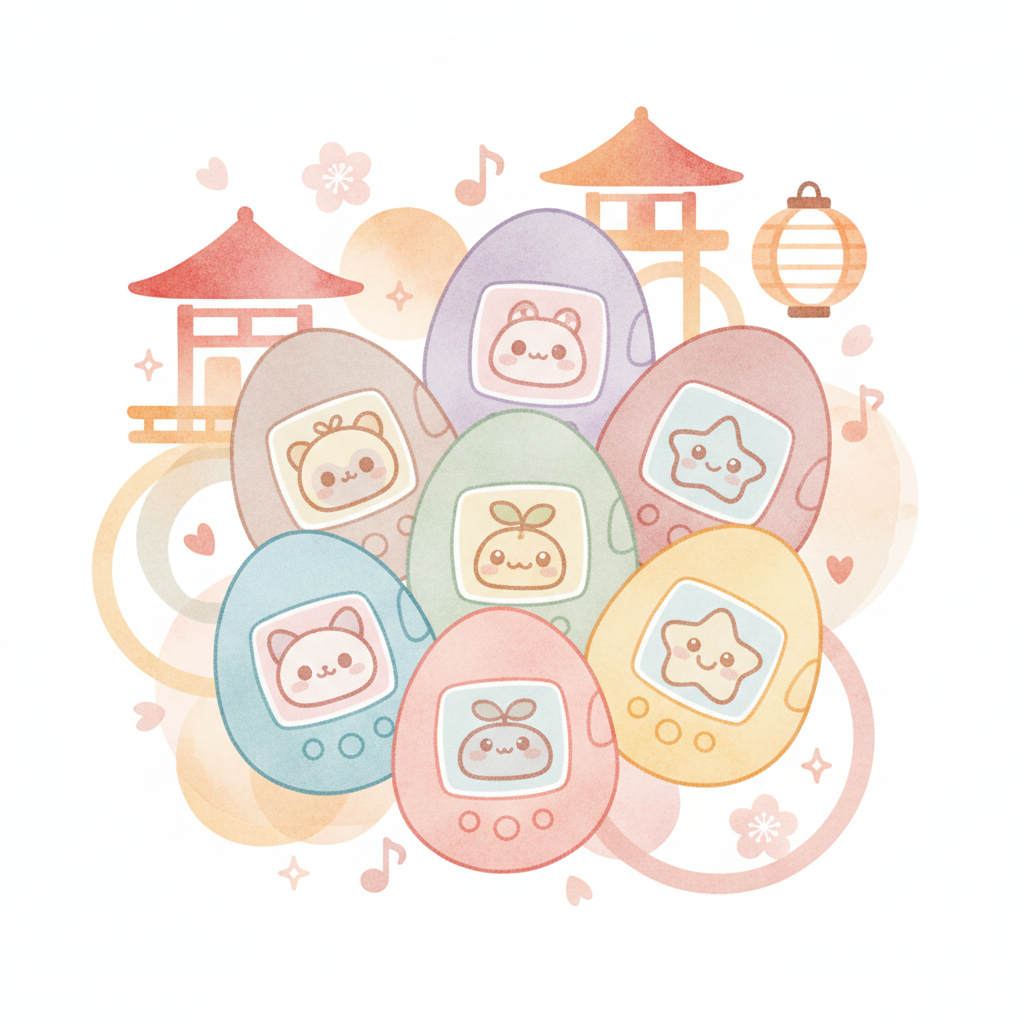
Picture a plastic egg roughly the size of a large key fob: tiny LCD screen, three small buttons, and inside it, a creature waiting for you to take care of it. Feed it, play with it, clean up after it — or neglect it, and it dies. That’s Tamagotchi, a handheld electronic pet launched by Bandai in Japan on November 23, 1996. At the time it sold for pocket change. Today, authentic examples in good condition regularly fetch several hundred dollars on eBay, with the rarest sealed units pushing well beyond that. Here’s everything you need to know about what it is, why it matters, and why collectors pay serious money for one.
A Toy That Became a Cultural Moment
Tamagotchi was created by Akihiro Yokoi of WiZ and Aki Maita, who was a Bandai employee at the time. The name blends “tamago” (egg) with “uocchi” (watch) — a pocket watch you raise. The hardware was deliberately minimal: egg-shaped plastic shell, monochrome LCD screen, three buttons. What made it radical was the gameplay loop. You raised a virtual creature from birth, making daily choices about feeding, play, and hygiene. The outcome wasn’t fixed — your decisions shaped what your Tamagotchi became. That non-deterministic design felt genuinely fresh in 1996 Japan.
Demand instantly outpaced supply. By late 1997, Bandai had shipped more than 10 million units within Japan, and English-language versions had already landed in North America and Europe. Schools across Japan banned the device outright — children were sneaking them into class to keep their pets alive during lessons. That frantic, under-the-desk button-pressing became the defining image of the phenomenon. Critics debated whether a toy should introduce children to the concept of death; the fact that debate happened at all tells you how seriously people took it. Tamagotchi didn’t just sell — it caused a social conversation. Three decades on, it stands as a cornerstone of late-Showa and Heisei-era nostalgia, not just a toy but a cultural artifact, and that status is a significant part of what makes collecting it meaningful.
The Models Worth Knowing
The Tamagotchi line has never stopped. What began as a single black-and-white egg in 1996 now spans dozens of generations, regional variants, and limited editions. Collectors navigate this landscape by generation and rarity.
The original Gen 1 and Gen 2 units from 1996–1997 are the most iconic and remain the benchmark for value. A 1997 spin-off, Angelgotchi, introduced angel-themed characters with some Japan-only color variants. Then in 1998 came two models that are now genuine collector grails: Devilgotchi, a limited devil-themed variant, and Santaclautchi, a seasonal Christmas release with very few surviving examples. Both are exceptionally scarce and surface only occasionally on the secondary market.
The mid-2000s brought the Connection series (V1–V6), which added infrared communication between units. The V6 — marketed as the Music Star in English — introduced a music theme and is particularly sought-after in unopened condition. Later, the m!x (Japan) and Meets / On line introduced a character genetics system where two Tamagotchi parents pass traits to offspring; the Fantasy and Fairy versions are especially popular with collectors. The current flagship, Tamagotchi Uni (2023), adds Wi-Fi and a full color screen, with limited editions like the Monster Festival version already drawing serious attention.
Regional differences matter more than casual buyers expect. Japanese and international releases often differ in color options, included characters, and app compatibility. The Japanese Meets and North American On are the same hardware at heart, but different companion apps with language restrictions mean the Japanese version isn’t fully usable for overseas buyers — a practical consideration worth knowing before you bid.
Why Collectors Pay Real Money — and What to Watch For
Tamagotchi checks nearly every box that drives collectible value: a mass-market object from a specific window in time, produced across many distinct variants, with dramatic differences in surviving quantities, and condition that degrades predictably with age. Authentic examples in solid shape typically sell in the $497–$644 range on eBay, with meaningful outliers in both directions depending on model and state.
Model rarity is the foundation. Devilgotchi and Santaclautchi were low-volume releases; comparatively few exist, and fewer still survived nearly three decades intact. First-generation units and the specialized Ocean, Morino, and Yasashii variants from 1997–1998 occupy the upper tier for the same reason. These were made to be played with by children — finding one that wasn’t is unusual, and that’s exactly what makes it valuable.
New-in-box (NIB) and sealed condition is perhaps the single biggest price multiplier. A used working Tamagotchi and a sealed example of the same model can differ in price by an order of magnitude. Dead-stock from the 1990s that was never opened is genuinely rare, and when it appears, collectors compete hard for it.
Completeness is the next lever. The original box, instruction manual, keychain strap, and any paper inserts directly affect value. A unit with everything intact is categorically different from the same model sold loose — and sold prices reflect that gap clearly.
Japan-exclusive and region-limited variants carry a built-in premium on international markets. Certain color combinations and character sets were only sold through specific Japanese retailers or during limited windows, making them inherently scarce for overseas buyers who want them.
Confirmed working condition is non-negotiable for serious purchases. Ask for video of the unit powering on and displaying correctly — no dead pixels, no display glitches, buttons responding cleanly. Battery contacts are a common failure point in units stored for years; corrosion there is a meaningful red flag. For color-screen models (iD generation onward), pixel integrity matters especially and is worth verifying from multiple angles.
One more thing beginners should know: counterfeit Gen 1-style shells exist, primarily sold through budget online marketplaces. Genuine Bandai units have noticeably crisper logo stamping and a sharper boot screen. If the LCD resolution or the Bandai mark looks slightly soft or off, trust your instincts. On high-value models like Devilgotchi, even the battery compartment screws are worth examining — replaced screws indicate the unit has been opened, which factors into grading and, for some collectors, into price.
If you’re ready to start looking, a selection of authentic, tested Tamagotchi — including Japan-exclusive and vintage models — is available in our eBay store, with detailed condition notes on each listing so you know exactly what you’re getting.