Showa-Era Round Menko Card from GeGeGe no Kitaro

Menko: Japan’s Cardboard Street Game
Before video games took over Japanese playgrounds, menko were everywhere. These thick cardboard cards — sold for just a few yen at dagashiya, the candy-and-toy shops of Showa-era Japan — were the currency of childhood competition. The game was physical: players slammed their cards against the ground to generate force and flip an opponent’s card over. Whoever managed the flip won the card.
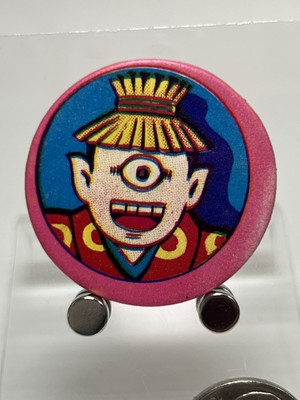
Menko come in two forms: rectangular (kaku-menko) and round (maru-menko). This card is the round variety, with a pink border — a format that stands out in any display collection. From the mid-1960s through the 1970s, manufacturers produced large quantities of cards featuring anime characters for dagashiya shelves. The halftone dot printing visible on this card — tiny ink dots composing the color image — is characteristic of the budget toy printing methods used across this era. By the late 1970s, video games had pushed menko largely out of street culture.
GeGeGe no Kitaro and Shigeru Mizuki
GeGeGe no Kitaro began in 1959 as a rental manga, moved to Shonen Magazine in 1965, and launched its first anime on Fuji Television in January 1968. The franchise follows Kitaro, a ghost boy who mediates between the human world and the realm of yokai — supernatural beings drawn from Japanese folklore. Anime adaptations followed in 1971, 1985, 1996, 2007, and 2018, making it one of Japan’s most enduring pop culture properties. Creator Shigeru Mizuki, who passed away in 2015 at 93, received international recognition including honors at France’s Angouleme International Comics Festival. Menko featuring Kitaro characters were most likely produced to coincide with the first two anime series, suggesting manufacture in the late 1960s to early 1970s.
Hitotsumekozo: A Yokai Far Older Than the Anime
The character on this card is Hitotsumekozo — the one-eyed boy monk — depicted in a yellow straw hat, a red kimono with yellow circular patterns, against a blue background. This design aligns with the visual style used in Showa-era Kitaro anime merchandise.
What makes Hitotsumekozo a particularly compelling subject is that Mizuki did not invent him. He is a documented figure from traditional Japanese folklore — typically depicted as a child-shaped being with a single large eye in the forehead — with legends spread across Japan. Many accounts tie his appearances to specific calendar days: February 8 and December 8, known as koto no hi. Mizuki’s approach was to bring existing yokai into popular fiction rather than fabricate his own, and a significant part of his lasting influence is how widely he spread awareness of genuine pre-modern folk belief.
This overlap — Showa anime nostalgia, authentic Japanese folklore, and the legacy of a mangaka with international standing — is central to why GeGeGe no Kitaro merchandise draws collectors worldwide. Anime character menko from this period were produced for the domestic Japanese market and rarely left the country.


Shipped directly from Japan by a small shop
$7.86
Ships worldwide from Japan • Full photos and details on the listing