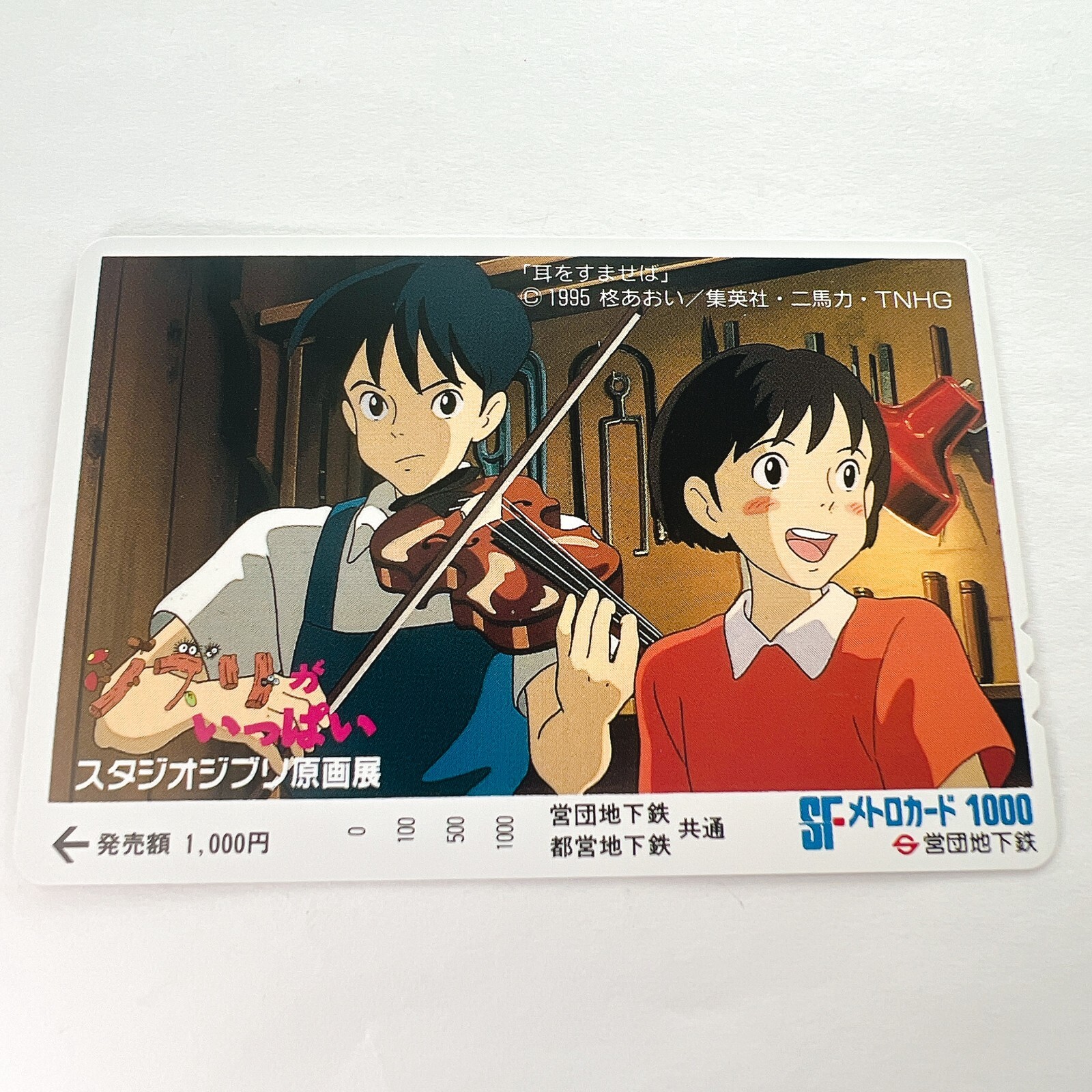
Whisper of the Heart SF Metro Card, 1995 (Studio Ghibli)

What the SF Metro Card Actually Was
The SF Metro Card was a magnetic prepaid transit card — “SF” standing for Stored Fare. This card is a 1000-yen denomination issued for use across Tokyo’s subway network: both the Eidan (the Teito Rapid Transit Authority, which operated what is now Tokyo Metro) and Toei subway lines accepted it, making it compatible across the two separate systems that served the city. On the reverse, a printed row of balance markers showed the remaining fare; each time the card passed through a turnstile, the machine would progressively mark off the strip. An unspent card was therefore immediately identifiable as such, with all markers intact.
Based on the card’s imagery and copyright notice, this example was issued in connection with the Studio Ghibli Original Art Exhibition, giving it a dual identity: functional commuter card and licensed Ghibli promotional item. The copyright line includes the name Nibariki Co., Ltd. — the rights-management company affiliated with Studio Ghibli that administered licensing for official Ghibli merchandise throughout this era, and a name that Ghibli collectors recognize as a marker of authorized product.
The Film and the People Behind It
Whisper of the Heart opened in Japanese theaters on July 15, 1995, distributed by Toho. The screenplay was written by Miyazaki Hayao, who also served as producer. The director was Kondo Yoshifumi, a longtime key animator at Ghibli who was taking on his first solo feature. Kondo died in early 1998; this film remains his only directorial work. The original manga — written and drawn by Hiiragi Aoi and published in Shueisha’s Ribon magazine in 1989 — is why the card’s copyright notice includes both Hiiragi Aoi and Shueisha alongside the Ghibli and Nibariki credits.
The film follows two middle schoolers: Tsukishima Shizuku, a bookish girl who realizes she wants to write her own stories, and Amasawa Seiji, who is about to leave for Italy to apprentice with a violin-making craftsman. The card artwork appears to depict a scene set in the Chikyuya, a fictional antique shop that serves as the narrative’s emotional center — the same space where Seiji plays violin for Shizuku in one of the film’s most recognized sequences. The small figures in the lower left corner are likely characters or decorative elements associated with the Chikyuya setting, though the image does not allow for a definitive identification.
Magnetic Cards as Collectibles in 1990s Japan
From the late 1980s through the 1990s, Japan developed a widespread culture around collecting printed magnetic cards. NTT telephone cards, bus passes, and transit cards were all produced in limited runs bearing anime, film, and celebrity imagery. Transit cards occupied their own niche: the visible balance gauge on the reverse made it immediately clear whether a card had ever been used, so condition was transparent at a glance. Cards kept fully unspent were recognized among collectors as the baseline worth preserving.
The Eidan brand itself became historical when the Teito Rapid Transit Authority was dissolved and reorganized as Tokyo Metro in 2004. That transition, alongside the rollout of IC card systems like Suica and PASMO, ended the magnetic prepaid format entirely. A 1995 card printed with the Eidan name and Ghibli artwork sits at the intersection of a transit infrastructure that no longer exists and a film promotional campaign from thirty years ago — two pieces of the same moment, held together in a single piece of coated card stock.

Comes straight from Japan — no middleman
$14.07
Ships internationally • More photos on the eBay listing