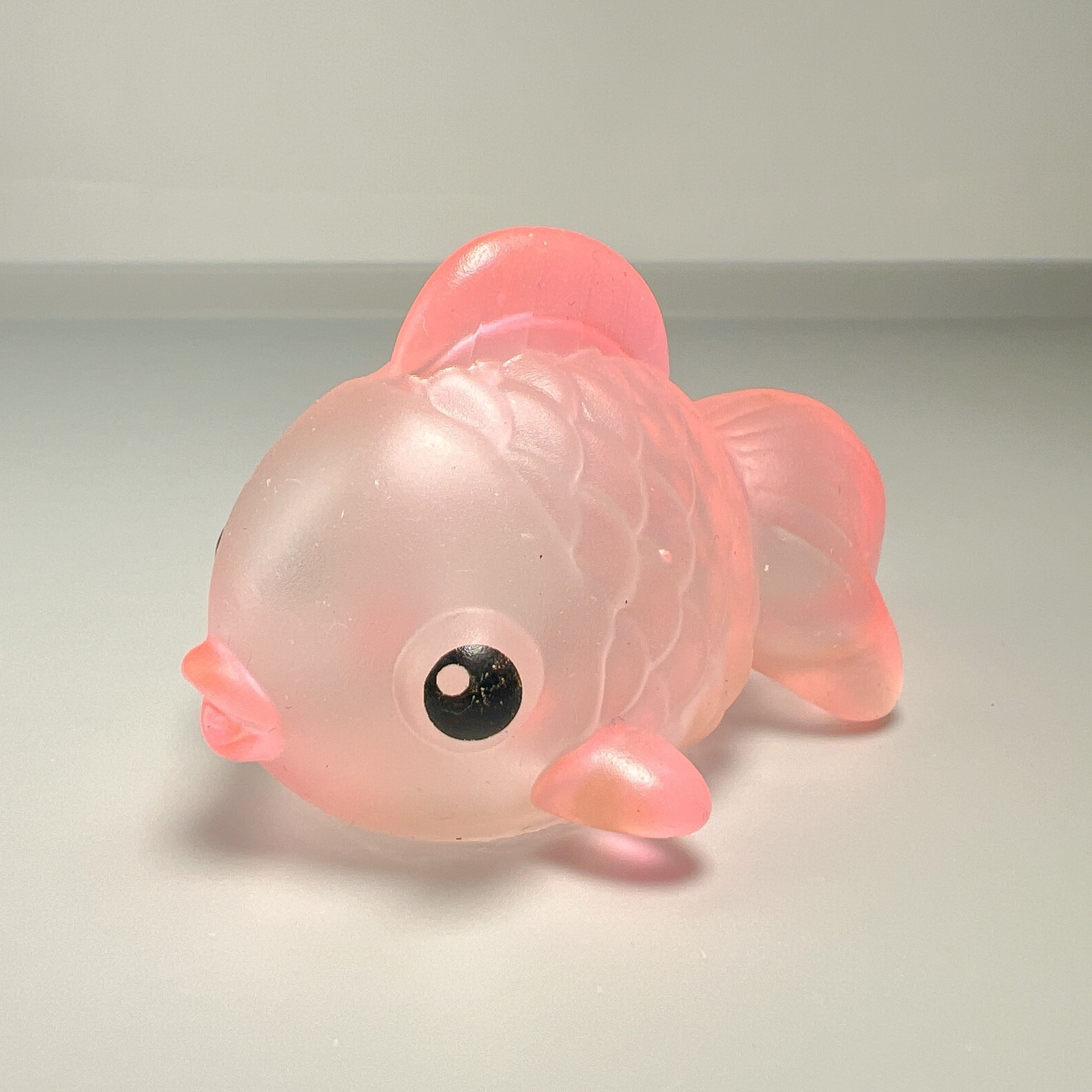
Clear Pink Goldfish Sofubi Figure

Goldfish, Summer Festivals, and Japan’s Ennichi Culture
Goldfish — kingyo in Japanese — arrived in Japan from China sometime in the sixteenth or seventeenth century, during the late Muromachi and early Edo periods. By the height of the Edo era they had woven themselves into everyday life, becoming one of the defining images of a Japanese summer. That association was reinforced in popular art: ukiyo-e artist Utagawa Kuniyoshi produced a celebrated series of anthropomorphized goldfish figures that placed them squarely in the visual vocabulary of the period.
The most recognizable descendant of that tradition is kingyo sukui, the goldfish-scooping game played at summer festival stalls during ennichi — the open-air markets held at shrines and temples. Players use a thin paper scoop called a poi to catch small goldfish from an open tank, a simple seasonal ritual that remains a fixture at outdoor festivals today. This figure’s rounded, bubble-shaped body and wide eyes read as a kawaii interpretation of ryukin-type goldfish, the chubby, short-tailed variety common at festival stalls and garden ponds across Japan. It is not tied to any specific anime, game, or manga franchise; it draws instead on goldfish as a standalone cultural motif, one that has sustained Japanese art, craft, and play for centuries.
What Makes Sofubi Different from Ordinary Plastic Toys
Sofubi is the Japanese abbreviation for “soft vinyl,” a manufacturing method in which plasticized PVC resin is poured into molds, then cooled and extracted by hand. Japan industrialized sofubi production in the 1960s, initially for the kaiju and tokusatsu hero figures that dominated that decade’s toy market. The technique requires handcrafted molds and careful manual removal from the tooling, giving finished pieces a tactile warmth that mass-produced injection-molded plastic does not replicate.
Clear-color sofubi — translucent pieces cast from see-through or semi-transparent vinyl — became an established variant format among collectors from the 2000s onward. Rather than reflecting light like a standard painted figure, clear vinyl transmits it, which changes how the piece reads under display lighting. This figure’s semi-transparent pink achieves exactly that luminous effect. The specific manufacturer is not identified on the item, and the research behind this listing could not confirm whether it originates from an indie artist studio, a festival wholesale supplier, or another source. Items made for Japan’s ennichi market are frequently produced by small makers concentrated in Tokyo’s Taito district or Osaka’s Matsuyamachi wholesale neighborhood, and many carry no visible branding at all.
Multiple Points of Entry for International Collectors
The goldfish-and-festival combination gives this sofubi several distinct angles of appeal for collectors outside Japan. For those interested in Japanese seasonal and folk culture, it functions as a tangible representation of ennichi — a side of Japanese life that rarely surfaces in mainstream pop-culture exports. For kawaii aesthetic collectors, the oversized eyes and simplified silhouette fit squarely within the yuru-kawaii (“loosely cute”) design language that has built a dedicated following in Europe and North America. And for the sofubi collector community specifically, the translucent pink vinyl is its own draw, independent of subject matter — clear versions of a figure are treated as a recognized category by enthusiasts who seek out the particular way the material handles light.
No franchise knowledge is required to appreciate it. It works equally as a desk ornament, a piece of Japanese folk-culture material, or an entry point into the broader world of Japanese soft vinyl collecting.


Boxed and cushioned for the trip from Japan
$10.65
Worldwide delivery from Japan • See the listing for condition and size