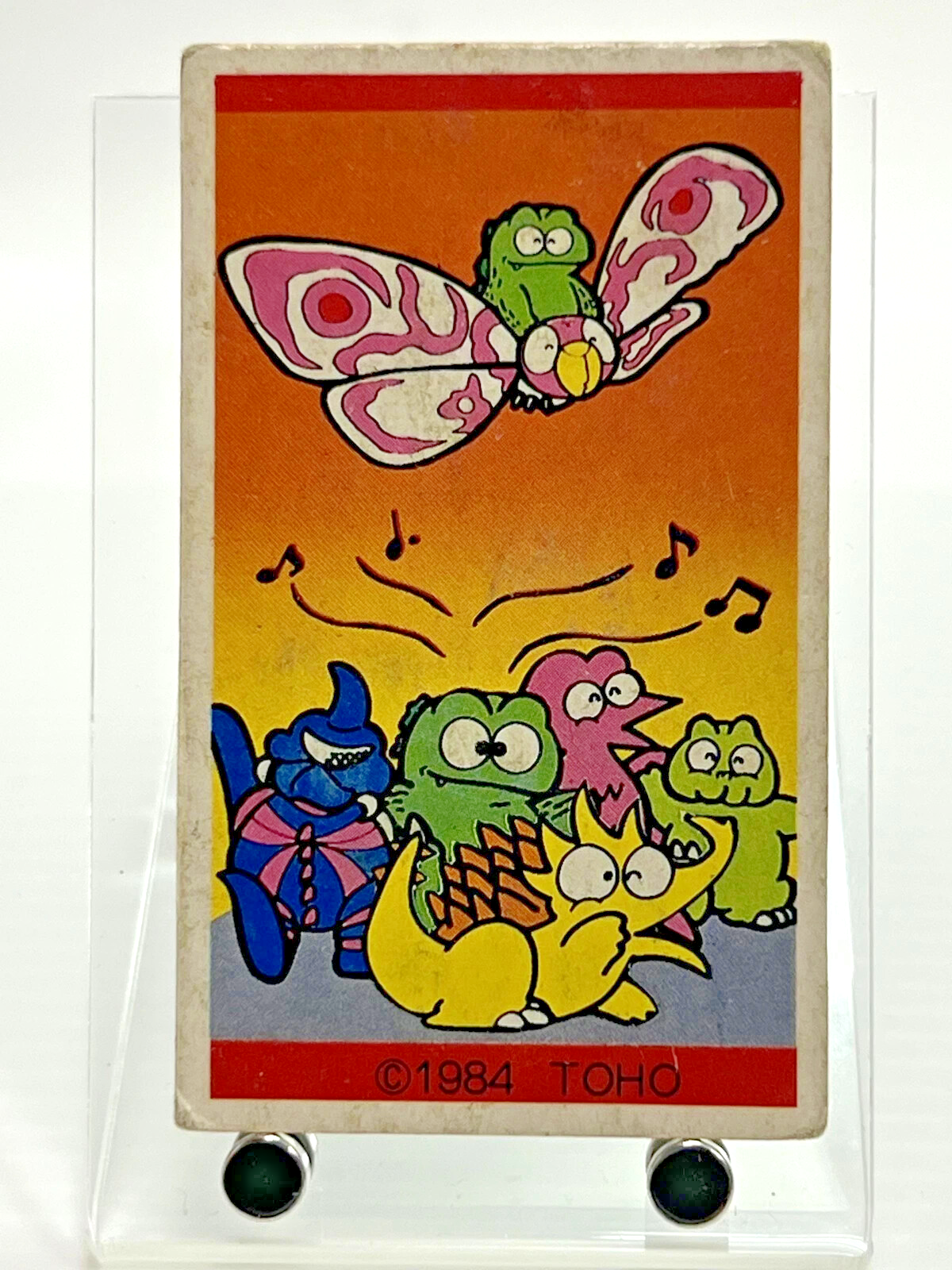
A 1984 Toho-Licensed Menko Card Featuring Mothra and Friends

Japan’s Original Card Game: Understanding Menko
Long before trading card games became a global phenomenon, Japanese children were playing menko — a tradition rooted in the Edo period. The rules are simple and physical: players slam their cards onto a hard surface, trying to flip their opponent’s cards face-up. Whoever flips a card wins it and keeps it.
By the postwar decades, manufacturers began printing popular characters on these thick cardboard pieces. Baseball players, wrestlers, anime heroes, and monsters all made their way onto rectangular and round menko alike. In the 1970s and 1980s, major licensed franchises — Godzilla, Ultraman, Kamen Rider — flooded the market. Sold at dagashiya (Japan’s neighborhood penny candy shops) for just a few yen each, menko were designed to be played with, not preserved. That disposability is exactly why surviving examples attract attention today.
Mothra, Toho Kaiju, and the Story on the Card
This menko bears the copyright mark ©1984 TOHO, identifying it as a product licensed by Toho Co., Ltd., the studio behind Japan’s most enduring monster franchise. The Toho Kaiju universe began with the original 1954 Godzilla film and expanded over the following decades to include Mothra (introduced in her own 1961 film), Rodan, King Ghidorah, and others.
The year 1984 carries particular weight in the franchise’s history. Toho released a new Godzilla film that December — known in English as The Return of Godzilla, and released in North America the following year as Godzilla 1985 — ending a nine-year gap and marking the franchise’s cinematic revival.
The card’s artwork, however, sits in a very different register from that film’s serious tone. Mothra appears in her adult, winged form, carrying on her back a green frog-like character whose exact identity is difficult to determine with certainty. Along the bottom of the card, a row of chibi-style monsters in various colors appear to be singing, surrounded by musical notes. This playful, super-deformed aesthetic reflects a parallel strand of Toho’s licensing activity in the 1980s: child-friendly character merchandise that ran alongside the theatrical franchise. Whether this card ties directly to a specific children’s anime or picture book series remains unclear. The actual manufacturer is also unconfirmed — licensed menko of the era were produced by a range of companies, including Amada and Epoch as well as smaller regional printers.
Why Kaiju Fans and Card Collectors Find This Interesting
For international collectors, Godzilla and Mothra are among the most recognized names in Japanese pop culture, with established fan communities across North America, Europe, and beyond. The 1984 copyright connects this card to a pivotal year in the franchise’s timeline, one that fans often cite as the start of Godzilla’s modern era.
The menko format itself adds a separate layer of interest. This style of card game is virtually unknown outside Japan, and these thick cardboard pieces represent a strand of toy culture that predates the trading card era entirely. Physical signs of wear on surviving examples mark them as objects that were genuinely played with by children in 1980s Japan — not display pieces, but artifacts from everyday life.
The chibi interpretation of creatures normally portrayed as city-crushing giants also documents something researchers and enthusiasts find worth noting: in the 1980s, the Toho Kaiju brand was flexible enough to support a serious, horror-inflected film franchise and a cheerful, song-and-dance children’s character world at the same time.


Found in Japan, packed by hand, sent worldwide
$9.75
Worldwide delivery from Japan • See the listing for condition and size