Godzilland No.82: Toho's 1984 SD Kaiju Sticker

From the Silver Screen to the Sticker Sheet
In 1984, after nearly a decade away from Japanese cinemas, Godzilla returned in a major new Toho production — the film that opened what collectors now call the Heisei Godzilla era. That release triggered a wave of officially licensed merchandise. Manufacturers rushed to put Toho’s kaiju on vinyl figures, gashapon capsules, and sticker sets aimed at children across Japan, making 1984 one of the busiest years in Godzilla merchandise history.
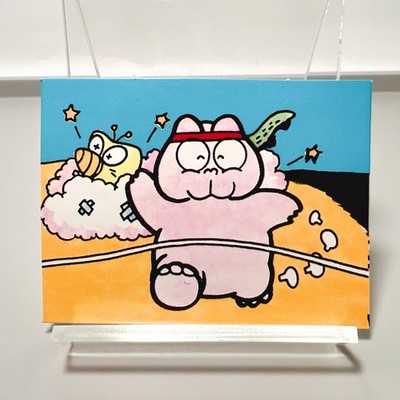
This sticker belongs to the Godzilland line — Toho’s own sub-brand that reimagined Godzilla and other Toho monsters as SD (super-deformed) chibi characters: compact, rounded, and deliberately approachable rather than fearsome. The concept translated kaiju into small mascot designs built for a younger audience, producing a visual identity distinct from anything seen in the theatrical films. The central figure here is a pink, SD-proportioned character wearing a red hachimaki headband — the Godzilla-kun type mascot at the heart of the Godzilland line. Alongside him, a yellow bandaged insect character appears, most likely a chibi interpretation of Mothra’s larva, though the research notes stop short of a firm identification. A green scaled tail in the background suggests a second kaiju presence in the composition. The whole image is rendered in the bold, thick-outlined style of 1980s Japanese animation: saturated block colors and strong black borders designed to read clearly at a small scale.
No.82 and the Numbered Sticker Tradition
The number printed on this sticker places it inside a much larger serialized set. Numbered sticker collecting was a genuine cultural force in 1980s Japan. Sets were distributed as confectionery extras and sold individually, and tracking down every number in a series was a common childhood pursuit. The Bikkuri Man sticker line, which launched in 1985 and became a national phenomenon, is the most famous example of the format — but Toho’s Godzilland stickers were already part of that same collector culture when this piece was produced. A series running at least to No.82 implies a substantial lineup, with each individual number representing its own piece for collectors to locate.
The sticker is printed on a flat paper or thin plastic base. In the listing photos it is displayed upright in a clear acrylic stand, which appears to be a later addition by a collector for storage or display purposes rather than original packaging.
What Draws International Collectors to Godzilland
Godzilla is among the most widely recognized characters in Japanese popular culture, with dedicated fan communities across North America, Europe, and Asia. For overseas collectors, merchandise from the 1984 revival carries particular interest: it marks the transition between the Showa-era films (1954–1975) and the Heisei series, giving the period its own identity in Godzilla history.
The Godzilland aesthetic — SD monsters, primary colors, a child-friendly tone — represents a side of Godzilla fandom with no direct equivalent in Western adaptations or the modern MonsterVerse. It is a specifically Japanese interpretation, rooted in the country’s long tradition of recasting powerful characters as cute mascots. For collectors interested in kaiju history and 1980s Japanese pop culture, a numbered sticker from this line offers a tangible connection to how the franchise was experienced by Japanese children at the very moment Godzilla came back.


Shipped directly from Japan by a small shop
$8.82
Ships worldwide from Japan • Full photos and details on the listing