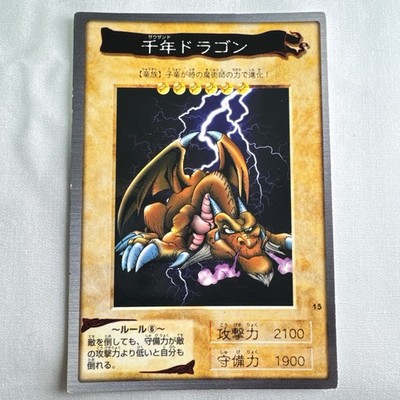
Thousand Dragon — Bandai Carddass Yu-Gi-Oh Card No.15 (1998)

Thousand Dragon: Joey Wheeler’s Time-Shifted Monster
In the Yu-Gi-Oh story — both the original manga by Kazuki Takahashi and its animated adaptations — certain monsters carry more narrative weight than their stats suggest. Thousand Dragon is one of them. The card exists because of a fusion mechanic: Time Wizard’s effect accelerates Baby Dragon through centuries of evolution, producing this Level 6 Dragon-type monster with 2100 ATK and 1900 DEF. It belongs to the deck of Katsuya Jonouchi, known internationally as Joey Wheeler, giving it a genuine role in the story rather than existing as a stat block alone.
On this Bandai card, the artwork depicts Thousand Dragon as a large orange-scaled dragon with blue claws and purple breath — a design consistent with its appearances in the original series.
Carddass: Japan’s Vending Machine Card Tradition
To understand this card, it helps to understand Carddass itself. Bandai launched the Carddass system in 1988: collectible cards sold through coin-operated vending machines installed in candy stores, game centers, and supermarket entrances across Japan. Insert 100 yen, receive a card. The format suited the collecting culture of 1990s Japanese children well, and it hosted major franchises of the era — Dragon Ball, Saint Seiya, SD Gundam, Kamen Rider. Yu-Gi-Oh joined that lineup in 1998, when Bandai held a license to produce cards tied to the Toei Animation television series that had begun airing that year.
That 1998 Toei series — sometimes called “Season 0” by Western fans — ran for 27 episodes and predates the better-known Duel Monsters anime that aired on TV Tokyo from 2000 to 2004. The Bandai Carddass line was a licensed product connected to that earlier, shorter series, which places these cards at the very beginning of Yu-Gi-Oh as a multimedia franchise.
A Snapshot of Yu-Gi-Oh Before Konami’s OCG
Konami’s Official Card Game launched in February 1999. This Bandai card predates it. The two products operated under entirely different rule systems — Bandai’s cards reference their own proprietary rules, and they are completely incompatible with the Konami OCG. After Konami secured an exclusive license for the Yu-Gi-Oh card game, Bandai exited the market. The exact scope of the Bandai release — how many series were produced and what each contained — is not comprehensively documented in official sources, which reflects how briefly this format existed before being overtaken by the Konami system.
Thousand Dragon was later issued in the Konami OCG as well, so both versions of the card exist. For anyone interested in distinguishing them, the Bandai edition carries the Carddass format, Bandai’s logo, Japanese text throughout, and its own rule references — markers that place it firmly in a distinct, pre-OCG chapter of the game’s history.


Sleeved and rigid-mailed before it leaves Japan
$8.82
Ships worldwide from Japan • Full photos and details on the listing