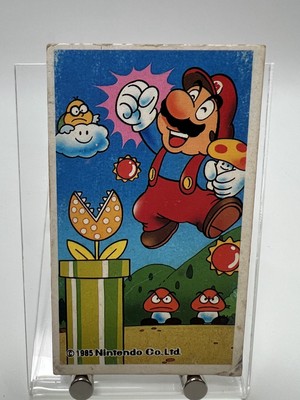
Super Mario Bros. Menko Card by Amada, 1985 (No. 44)

This is a rectangular menko card published by Amada in 1985, printed with Nintendo’s official copyright mark (© 1985 Nintendo Co. Ltd). The number 44 marks its position within a numbered series.
Japan’s Menko Tradition and the Famicom Boom
Menko are a form of game card with roots reaching back to the Edo period in Japan. The gameplay is physical: a player slaps their card down onto one lying on the ground and tries to flip it over by force or air displacement. Whoever flips the most cards wins. From the 1950s onward, menko shifted toward illustrated character subjects — baseball players and pro wrestlers first, then tokusatsu heroes. By the early 1980s, anime and video game franchises had become the dominant subject matter.
Amada was one of the leading manufacturers in this space, holding legitimate licenses from Nintendo and other IP holders throughout the decade. The company produced menko, stickers, and cards across multiple Super Mario Bros. series. The white-bordered rectangular format here is typical of kaku menko from the period. Because menko were paper and cardboard goods genuinely used in play, surviving examples from this era tend to show edge wear and surface aging — the natural result of a toy that was never built to last indefinitely. The dagashi-ya, small neighborhood candy-and-toy shops where Japanese children spent pocket money, were the primary point of sale, alongside conventional toy retailers.
Super Mario Bros. at the Moment of Its Birth
Nintendo’s Family Computer (Famicom) first reached Japan in July 1983. Super Mario Bros. followed on September 13, 1985, and transformed the hardware from a popular toy into a national phenomenon. Designed by Shigeru Miyamoto and Gunpei Yokoi, the game placed players in control of Mario — a plumber in a red cap and blue overalls — navigating platform levels to rescue Princess Peach from Bowser. Its reception was immediate and decisive; it defined the Famicom era and launched a franchise that has sold well over 500 million units across its history (figures vary by source).
The 1985 copyright on this card aligns exactly with the game’s release year, placing it among the earliest wave of officially licensed Super Mario Bros. merchandise ever produced. The franchise’s visual identity was still freshly introduced to Japanese children’s daily culture at that moment, which gives goods from this specific year a distinct character: they document the Mario aesthetic before it had decades of refinement behind it.
Six Characters Across a Single Card
The artwork on card 44 is notably dense with characters. Mario appears in his foundational design. Lakitu — Jugem in Japanese — floats on his cloud, the Koopa-clan enemy who pelts players with Spinies from above. A Piranha Plant rises from its pipe, an enemy silhouette that has persisted across every subsequent generation of the franchise. Two Goombas, the mushroom-shaped enemies that function as the game’s most fundamental obstacle, appear alongside a Super Mushroom, the item that grows small Mario into his powered-up form. Two star-shaped objects are also depicted, most likely Super Stars (the invincibility power-up), though the card’s art does not make that identification definitive.
The visual style is specific to 1985: bold, slightly flat illustration set against blue sky, green hills, and brown ground — the early Famicom aesthetic, distinct from the character designs Mario would accumulate across subsequent decades. Serial number 44 indicates this card belongs to a numbered Amada set; the complete count of the series is not fully documented, but Amada regularly structured menko releases as large numbered runs, a format that naturally appeals to collectors focused on completing sets.

Shipped from Japan, tested where noted in the listing
$7.86
Ships worldwide from Japan • Full photos and details on the listing