Meowth Metal Charm — Vintage Pokémon Character Goods from Japan

Meowth: The Talking Cat at the Core of the Series
Meowth — Pokédex No. 052, known in Japan as Nyarth — is one of the original 151 Pokémon, introduced in Pocket Monsters Red and Green for the Game Boy in February 1996. A bipedal cat with a coin-shaped mark on its forehead, Meowth became one of the most recognizable characters in the franchise through the anime, which began airing on TV Tokyo in April 1997. The show’s version of Meowth travels with Team Rocket’s Jessie and James and — uniquely among Pokémon in the series — has learned to speak human language, an ability the anime treats as specific to this individual character. The three appear throughout the run as comic foils, and that speaking role carried over intact into the English-dubbed version, giving international audiences the same character that Japanese viewers knew.
Metal Charms and Japan’s Character Goods Market in the Late 1990s
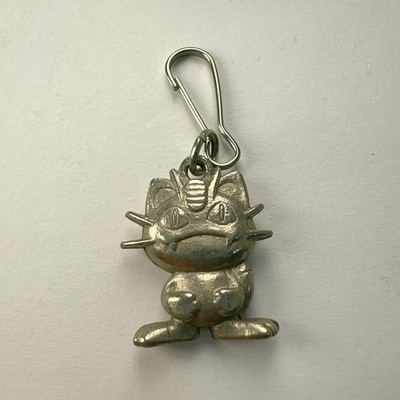
This charm is a small metal piece fitted with a spring-gate snap hook, usable as a keychain fob, a bag charm, or an add-on to an existing keyring. The body is likely silver-colored die-cast alloy or a comparable metal — the exact material can’t be confirmed — with no painted color detail, just the molded form of the character rendered in metal.
Metal keychains and character charms have been a standard part of Japan’s licensed goods market since at least the 1980s. During the Pokémon boom of the late 1990s, they were one of dozens of categories that manufacturers filled with franchise characters. Items like this moved through toy shops and variety stores, but also through gashapon — the capsule-toy vending machines that became widespread in Japan in the 1970s — and through shokugan releases, where a small collectible came packaged with candy or snacks. The specific distribution format for this piece isn’t confirmed from available information, but any of those routes would have been typical for the era. Pokémon sat at the peak of Japan’s licensed goods industry from roughly 1997 onward, alongside franchises like Dragon Ball and Sailor Moon, with major licensees such as TOMY and Bandai producing goods across every category alongside a number of smaller manufacturers. The maker of this particular item can’t be identified from what’s visible, but the simple spring-gate design is consistent with mass-market character goods of that period.
What Draws Collectors to Early Japanese Pokémon Merchandise
Meowth belongs to the Kanto generation — the first 151 — and carries strong recognition among fans who encountered Pokémon in the late 1990s through either the games or the anime. Items produced during the 1997–2001 window circulated almost entirely within Japan, with no meaningful export or international retail presence at the time. For collectors outside Japan, that makes them goods that were simply out of reach through normal channels. Metal construction also gives pieces like this a physical quality different from the paper and plastic that dominated most Pokémon merchandise of the era — a distinction that still matters to Gen 1 collectors when building out a collection from that period.


Found in Japan, packed by hand, sent worldwide
$14.07
Worldwide delivery from Japan • See the listing for condition and size