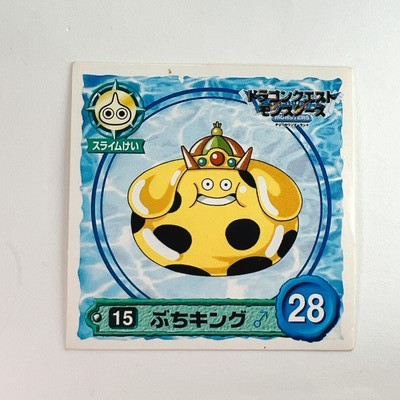
Mottle King No. 015, a Dragon Quest Monsters Sticker from Enix, 1998

A 1998 Spin-Off Launch and Its Sticker Set
This square collectible sticker was produced by Enix in 1998 to coincide with the Japanese launch of Dragon Quest Monsters: Terry’s Wonderland. Released on January 25, 1998 for the Game Boy Color, Terry’s Wonderland introduced a monster-catching and breeding system to the Dragon Quest universe: players recruited monsters, then combined pairs to produce stronger hybrid creatures. The game arrived at the peak of Japan’s monster-raising boom, which had been building since Pocket Monsters debuted in 1996.
The sticker’s design reflects the game’s internal logic. Against a light blue water-texture background with a blue border, Mottle King appears at center. In the upper left, a circular emblem marks the character as “Slime-type” — the same family classification system used inside the game. The series title runs across the upper right, and sticker number 015 appears in the lower left beside the character name. The “B” in the product reference may indicate a print run or visual variant, but its precise meaning is not confirmed.
Mottle King and the Toriyama Legacy
Mottle King — Buchi King in Japanese — belongs to the Slime family, the most recognizable monster group in Dragon Quest. “Buchi” is a Japanese word for mottled or spotted, describing the character’s yellow body with black spots and a royal crown. Within the breeding system of Dragon Quest Monsters, Slime-family variants like Mottle King represented higher-tier or combination forms of the series’ signature creature.
Every Dragon Quest monster, including those in the Monsters spin-off, was designed by Akira Toriyama — the artist internationally known for creating Dragon Ball. Toriyama contributed character and monster designs to Dragon Quest from the series’ earliest installments and continued that role through the DQM era. He passed away in March 2024, and global interest in his full body of work, including merchandise from the games he shaped, has grown considerably since.
Where This Sticker Fits in Japanese Collectible Culture
Numbered collectible sticker sets were a fixture of Japanese retail from the 1980s through the early 2000s. Sold through candy shops, toy stores, and vending machines, they operated on the same completionist logic as trading cards — each piece numbered, character-classified, and tied to a specific franchise. Bikkuri Man and Bandai’s Carddas line represent the wider format this sticker belongs to.
Because sticker sets of this type circulated primarily within Japan, they reached overseas buyers far less frequently than contemporary trading cards did. Enix, which held the Dragon Quest intellectual property at the time, merged with Square in 2003 to form Square Enix. Stickers bearing the Enix name date from before that merger, placing this piece among the earliest Dragon Quest Monsters merchandise — released in the same year the franchise began.


Comes straight from Japan — no middleman
$7.86
Ships internationally • More photos on the eBay listing