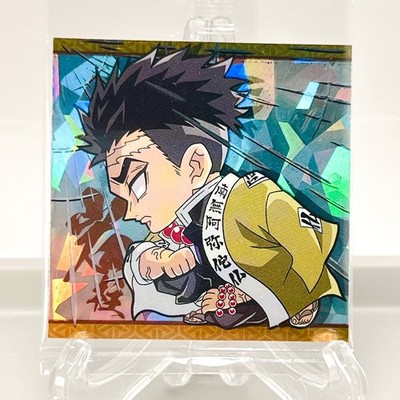
Bandai Niformation Deformed Sticker — Gyomei Himejima (Demon Slayer, 6-14)

The Niformation Format and What Makes It Collectible
Bandai’s Niformation line produces small collectible stickers featuring anime characters rendered in a deformed — or chibi — style, printed on square cards with holographic or prismatic backgrounds. The number 6-14 in the product title likely places this sticker as the fourteenth entry in a sixth wave of releases, though the precise structure of that numbering hasn’t been officially confirmed in available sources.
In Japan, Niformation stickers are sold blind-packed: you don’t know which character is inside until the packaging is opened. That uncertainty drives repeat purchases and trading among collectors, and it places the format in the same cultural tradition as Gashapon capsule toys and shokugan candy-toy inserts — small, randomized collectibles designed to reward persistence and encourage completion of a set. A sticker sold individually, as this one is, lets fans bypass the lottery and go straight to the character they want.
The holographic finish isn’t incidental. Japan has a long history of prismatic collectible stickers going back to products like Bikkuriman in the 1980s, and the shimmering background has remained a marker of visual quality in the format ever since. Niformation inherits that tradition directly.
Demon Slayer and the Stone Hashira
Demon Slayer (Kimetsu no Yaiba) is a manga by Koyoharu Gotouge, serialized in Weekly Shonen Jump from 2016 until its conclusion in 2020. The anime adaptation, produced by ufotable, began in 2019, and the 2020 theatrical film Mugen Train broke Japanese box office records at the time of its release. The story is set in Taisho-era Japan and follows Tanjiro Kamado, a boy who joins a corps of demon-hunters after his family is killed and his sister Nezuko is transformed into a demon. The series has built large audiences across Asia, North America, and Europe under the English title Demon Slayer.
Gyomei Himejima holds the rank of Stone Hashira — one of the nine elite swordsmen who form the upper tier of the Demon Slayer Corps — and is described within the story as its most powerful active member. His appearance is immediately distinctive: a large, shaved-headed figure with unseeing eyes, wearing a haori inscribed with the Buddhist phrase “Namu Amida Butsu.” He fights with a chain-connected axe and flail rather than a conventional blade, and wears a rosary on his left wrist alongside a red beaded necklace. The chibi sticker captures these details clearly — the lettered robe and prayer beads are recognizable even in simplified form, leaving no ambiguity about who the character is.
Behind Gyomei’s composed, monk-like bearing is a character defined by grief: he carries guilt over his inability to protect children in his past and is frequently shown weeping quietly as he prays. That contrast — overwhelming physical power paired with visible, unguarded sorrow — is a significant part of what has drawn fans to him.
Why This Character Resonates Beyond Japan
Gyomei’s visual design communicates something distinct even without prior knowledge of the series. The combination of Buddhist iconography, an imposing physique, and openly expressed emotion reads as unusual across most action-oriented anime, and the specific imagery — inscribed robes, prayer beads, sightless eyes — carries cultural weight that international fans find genuinely distinctive rather than decorative.
Niformation stickers were distributed primarily through Japanese domestic channels: toy shops, convenience stores, and candy stores. They were not developed with international retail in mind, which means individual stickers reaching collectors outside Japan offer a direct connection to a part of Demon Slayer merchandise culture that doesn’t travel far from its home market. For fans of the series who have exhausted what’s available locally, that specificity is part of the appeal.


Listed in our eBay store and sent from Japan
$9.65
International shipping available • Ask us anything before you buy