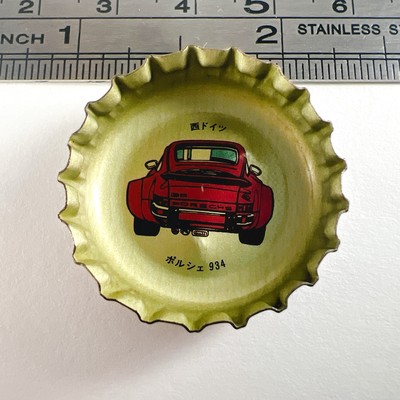
Coca-Cola Japan Porsche 934 Supercar Crown Cap, Series #3

A Bottle Cap Built to Be Collected
In the late 1970s, opening a glass bottle of Coca-Cola in Japan came with a small bonus: a metal crown cap printed with a vivid illustration of a European supercar. These were not incidental decoration. Coca-Cola Japan produced them as a numbered series, designed to be saved, traded, and completed one purchase at a time. This cap carries the number three, marking its place in that sequence, and depicts the Porsche 934 in a wide-body rear-view livery with Japanese text identifying the car and its country of origin.
The cap itself is a standard 26mm crimped metal crown — the same format used to seal glass soda bottles around the world — with a full-color printed face and its original yellowish-green liner still intact on the inside. What the exact series name was, or how many different designs it contained, is not fully documented, but the numbered format makes clear that Coca-Cola Japan intended buyers to chase the complete set.
The Porsche 934: Thirty-One Cars, One Le Mans Victory
The car chosen for this cap has a concise but well-documented racing record. The Porsche 934 was built in 1976 and 1977 to satisfy FIA Group 4 regulations, derived directly from the road-going Porsche 930 — the model most people know as the 911 Turbo. Porsche produced only around 31 examples, a remarkably small number even for a dedicated competition car.
Despite those limited numbers, the 934 competed at the highest level of GT racing in Europe. In 1976, it won the GT class at the Le Mans 24 Hours, one of the most demanding events in motorsport. It raced alongside its close relative, the Porsche 935, which was built to the looser Group 5 regulations and became equally prominent during the same period. Both cars were widely covered in Japanese magazines and at touring supercar exhibitions throughout the boom years.
The text on this cap reads “West Germany” — the country name that disappeared when Germany reunified in October 1990. That single detail is hard evidence that this item was manufactured before that date, placing it squarely within the Supercar Boom window of roughly 1976 to 1980, when the 934 was actively racing and at the center of Japanese automotive enthusiasm.
Crown Cap Collecting and the Boom That Made It Possible
Japan’s Supercar Boom ran from approximately 1975 to 1979. Lamborghinis, Ferraris, and Porsches flooded the pages of specialty magazines, appeared at traveling exhibitions held in department store parking lots, and featured regularly on television. The audience was largely school-age children, and consumer brands moved quickly to meet the demand. Food and beverage companies released Supercar-themed bottle caps, trading cards, stickers, and badges, turning everyday purchases into steps toward a complete collection.
Crown cap collecting — oukan atsume in Japanese — was already a natural children’s pastime before any brand got involved. Glass-bottle soft drinks were the standard format, so every purchase produced a cap, and makers including Coca-Cola, Mitsuya Cider, and Fanta had long used illustrated cap designs as a low-friction way to build brand loyalty. The Supercar series simply gave that existing habit a stronger reason to keep going.
Today, glass bottle caps of any kind are effectively gone from everyday life, replaced by cans and PET bottles decades ago. That shift turns surviving pieces from these series into something the original buyers never imagined: direct physical evidence of how Japanese pop culture, motorsport history, and ordinary consumer habits all converged in one compressed, enthusiastic decade.


Listed in our eBay store and sent from Japan
$17.01
International shipping available • Ask us anything before you buy