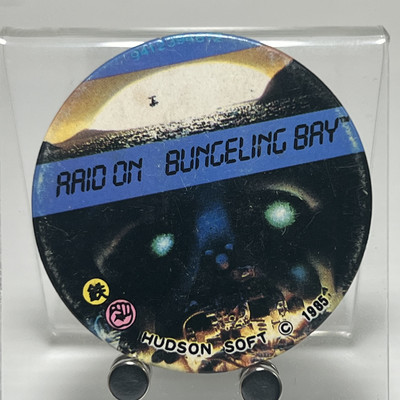
Raid on Bungeling Bay Round Menko Card, Hudson Soft (c. 1985)

What Menko Are and How This Card Fits the Era
This circular cardboard disc is a menko — a traditional Japanese game piece with roots stretching back to the Edo period. The rules are simple: players slap their cards against the ground, and whoever’s card flips their opponent’s wins it. By the 1980s, menko had absorbed the full sweep of Japanese pop culture. Baseball players and professional wrestlers gave way to anime heroes, tokusatsu monsters, and eventually video game characters. During the early Famicom years — roughly 1984 to 1987 — game-licensed menko were a fixture at candy shops, toy stores, and festival stalls, priced at just a few yen each and sold to be played with, not saved.
This particular card carries the full English title “RAID ON BUNGELING BAY” across its face, along with the Hudson Soft name, a 1985 copyright notice, and game-inspired artwork: aircraft, island terrain, and explosive lighting effects that call the game’s action to mind. A serial number along the top suggests it was one card in a broader series. Two small circular icons — one yellow, bearing the kanji for “iron,” one pink, showing a clenched fist — are printed on the face as standard menko scoring symbols used to decide a match winner. They are part of the menko system, unrelated to the game’s content. Round menko, as opposed to the more common rectangular format, were a minority shape even within this category.
The American Game That Became a Famicom Launch-Window Title
Raid on Bungeling Bay began its life far from Japan. Will Wright — who would go on to create SimCity and The Sims — designed it for Broderbund Software, which released it on the Commodore 64 in 1984. Players pilot an attack helicopter with orders to bomb enemy factories scattered across a network of islands. Wright has said directly that building the map editor for this game was the direct spark for SimCity: the editing tool proved more engaging than the game itself, and he followed that instinct.
Hudson Soft acquired the Japanese license and brought the title to the Family Computer in late 1984 or early 1985, making it one of that platform’s early releases. The English title appearing prominently on the card’s face was unusual for licensed merchandise of the period and reflects how squarely the game’s American identity was kept intact even in the Japanese market.
Where Video Game History and Japanese Toy Culture Intersect
Several threads converge on a card like this. Hudson Soft was a defining presence in the Famicom’s formative years — the company behind Bomberman and Momotaro Dentetsu, among many others — before being absorbed into Konami in 2012. Its earliest Famicom-era merchandise now represents a closed chapter in Japanese gaming history. Raid on Bungeling Bay sits at a specific and well-documented junction: it is both one of Hudson’s first Famicom titles and the game Will Wright has cited as the direct creative predecessor to SimCity.
Game-licensed menko from this period were produced to be handled roughly and discarded. Because preservation was never the point, well-kept examples are less common than the original print runs would imply. A card featuring game-screen visuals rather than a single character also functions as a small piece of game art — a snapshot of how Raid on Bungeling Bay was presented to Japanese children at the exact moment the Famicom was establishing itself as a cultural force.


Shipped from Japan, tested where noted in the listing
$9.75
Worldwide delivery from Japan • See the listing for condition and size