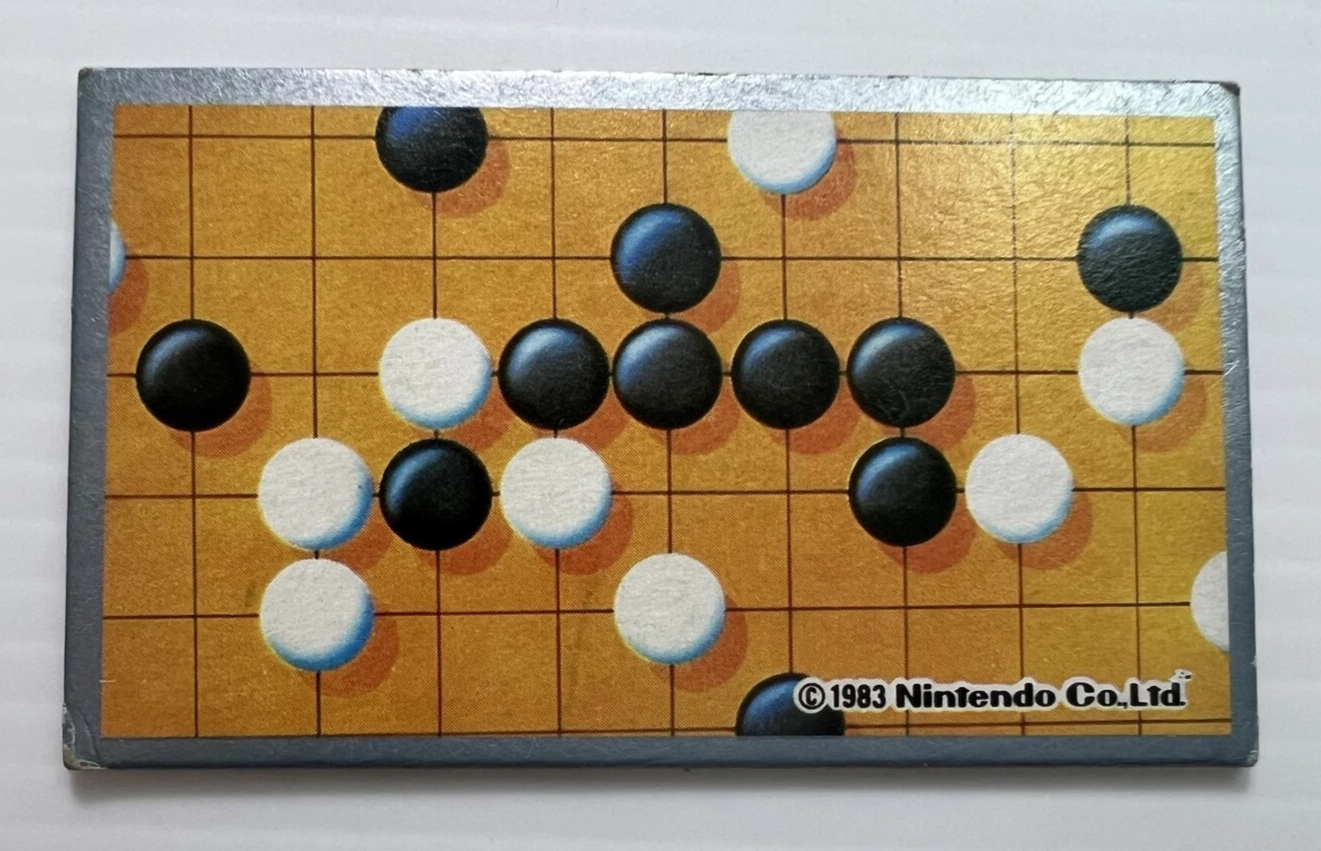
Nintendo's 1983 Go Game Menko Card

What Is a Menko Card?
Menko are a distinctly Japanese form of heavy cardstock playing piece that trace their origins to at least the mid-Edo period. Rather than a conventional card game, menko were used in a physical contest: players would slap their cards against the ground, using the gust of air generated on impact to flip an opponent’s card and claim it. The format flourished during Japan’s postwar boom of the 1950s and 1960s, when manufacturers printed them with baseball players, pro wrestlers, and anime characters in huge numbers. By the 1970s, newer collectible formats began to displace menko from schoolyards, but they never disappeared entirely. Today they are widely recognized as a forerunner to Japan’s modern trading-card culture, and surviving examples from identifiable manufacturers are sought by collectors of vintage Japanese printed ephemera.
Nintendo Before the Famicom
Founded in Kyoto in 1889 as a maker of Hanafuda — the traditional Japanese flower-matching cards — Nintendo spent its first century producing physical games of all kinds: playing cards, mahjong tiles, board games, and children’s card sets. Menko were part of that catalog; other Nintendo menko sets featuring baseball players and professional wrestlers have been documented, evidence of how broadly the company engaged with Japan’s paper-game market throughout the 1960s and 1970s.
The copyright printed on this card reads © 1983 Nintendo Co., Ltd., and that date carries considerable weight. July 15, 1983 was the day Nintendo launched the Family Computer — the Famicom — in Japan, beginning the pivot that would redefine the company as a global video game maker. A menko card themed around the ancient strategy game of Go, produced in that same year, sits at the precise boundary between Nintendo’s old identity and its new one. Whether this specific product line continued after 1983 is not certain, but its timing makes it a tangible document of the company’s transition.
Go, the Game Depicted — and Who It Draws In
The card’s face shows a Go board — a goban — with black and white stones arranged across its grid, rendered with shading that gives each stone a convincing sense of depth. Go originated in China more than 2,500 years ago and reached Japan no later than the 8th century. During the Edo period, professional players were organized into shogunate-sanctioned schools, giving the game an enduring cultural prestige. By the early 1980s, Japan’s Go-playing population was estimated in the millions, meaning the game was firmly mainstream at exactly the time this card was made.
International awareness of Go expanded considerably after 2016, when matches between Google’s AlphaGo and top professionals drew worldwide attention across the gaming and technology press. That broader recognition has widened the audience for Go-related artifacts well beyond Japan. A menko card combining Nintendo’s name with one of Asia’s oldest strategy games occupies an unusual crossroads: it appeals to students of Nintendo’s pre-digital corporate history, to collectors of traditional Japanese games, and to enthusiasts of menko as a format in its own right. Those three communities do not often converge on a single small piece of cardstock from 1983.

Shipped from Japan, tested where noted in the listing
$7.86
Ships internationally • More photos on the eBay listing