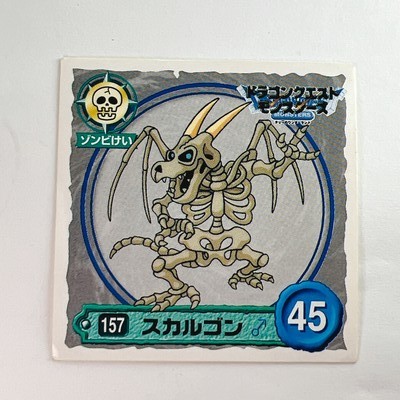
Skullgon No. 157, Dragon Quest Monsters Sticker (Enix, 1998)

A Game Boy Release and Its Collectible Tie-Ins
This is an officially licensed square collectible sticker published by Enix in 1998. It features Skullgon, printed with the monster’s name, its zombie-type classification, and the number 157. A blue circular stamp bearing the number 45 also appears on the sticker; this most likely marks a position within the sticker series — either a set serial number or a lot identifier — though the exact meaning cannot be confirmed from the sticker alone. Enix produced and distributed this item within Japan as a licensed character good.
The release it ties to is Dragon Quest Monsters: Terry’s Wonderland, published by Enix on January 28, 1998, for the Game Boy Color. The game was a spin-off from the main Dragon Quest series — Japan’s foundational RPG franchise, which began in 1986 and was marketed in North America under the name Dragon Warrior. Terry’s Wonderland built its gameplay around catching, raising, and breeding monsters: players combined creatures to produce new ones with inherited traits. It stands as one of the early examples of the monster-collection RPG genre that defined late-1990s portable gaming in Japan, and this sticker was produced in the same year as the game’s launch, almost certainly as a promotional tie-in.
Skullgon — A Toriyama Monster in Zombie-Type Territory
The name Skullgon combines “skull” and “dragon,” and the design delivers on both: a skeletal dragon with bony wings, depicted in a dynamic, animated pose. It belongs to the zombie-type classification, one of Dragon Quest’s long-running monster categories grouping undead, skeletal, and decayed creatures. The number 157 places Skullgon within either the game’s monster compendium or the sticker set’s own internal numbering — the sticker alone does not confirm which.
The visual language behind Skullgon belongs to Akira Toriyama, who served as character and monster designer across the entire Dragon Quest series. Toriyama was also the creator of Dragon Ball, and his style — kinetic figures, expressive anatomy, clean outlines — is recognized by fans across the world. He passed away in March 2024, drawing renewed attention to the full scope of his creative output, including his decades of work shaping Dragon Quest’s monster roster.
Japan’s Sticker Era and the Pre-Merger Enix Brand
In late-1990s Japan, character stickers circulated through two main channels: bundled inside snack packs (a category of candy or wafer products that included a toy or sticker, known as shokugan), and sold as standalone numbered sticker sets designed for completion. This sticker’s two numbering systems — 157 and 45 — reflect the systematic, catalog-driven design that defined the era’s collectible releases. Which specific format applied to this sticker is not confirmed by available information, but both were standard routes for Enix character merchandise during this period.
The Enix name on the sticker is itself a fixed point in time. In 2003, Enix merged with Square to form Square Enix, and the standalone Enix brand ceased to appear on new products. Everything carrying the original Enix label dates to before that consolidation. This sticker, manufactured in 1998, comes from a period when Enix was still an independent company managing the Dragon Quest franchise directly — making the logo as much a part of the item’s identity as the monster printed on its face.


Found in Japan, packed by hand, sent worldwide
$7.86
Worldwide delivery from Japan • See the listing for condition and size