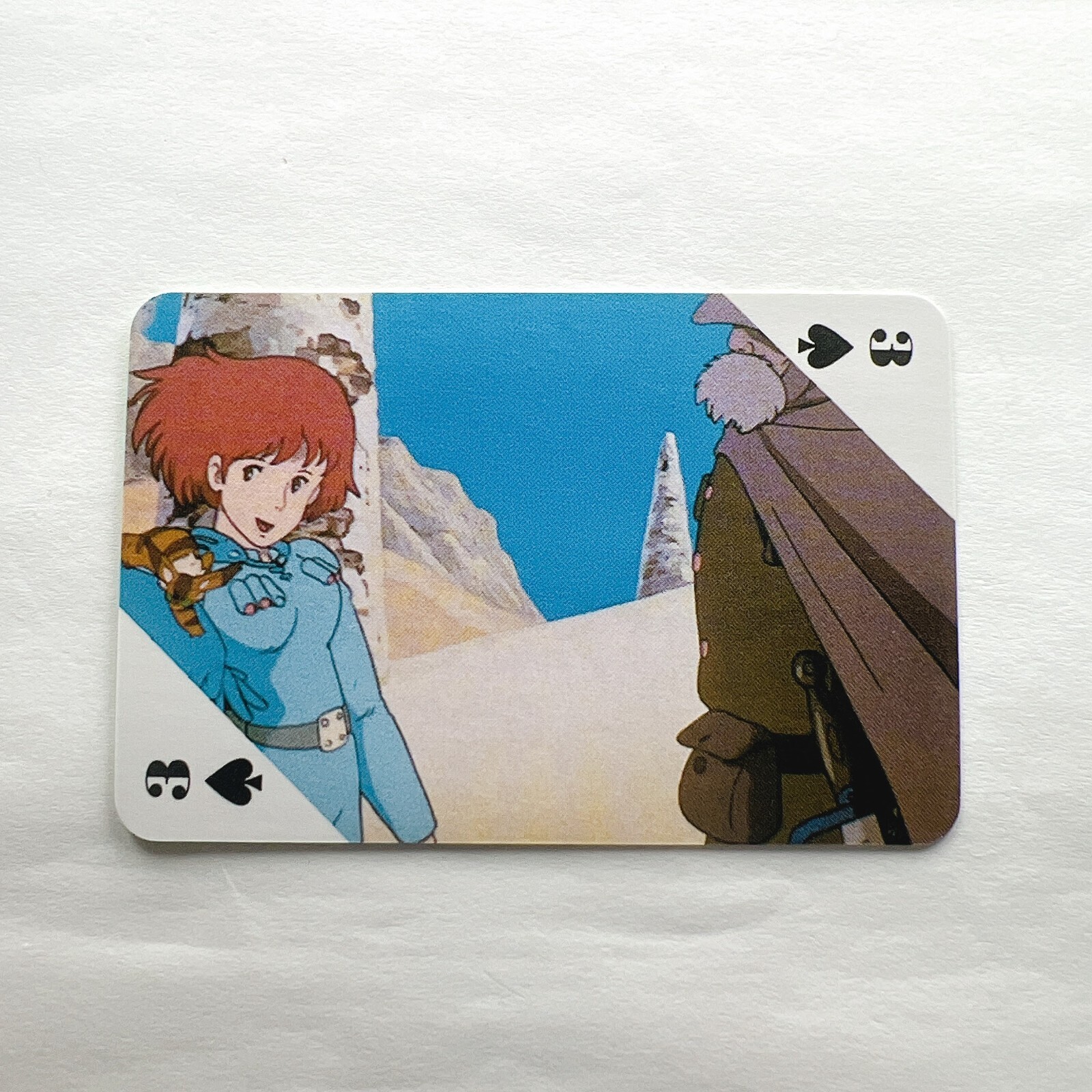
Nausicaä of the Valley of the Wind Playing Card — Spades 3, Animage, 1984

Nausicaä, Teto, and Yupa Together in One Frame
This is a single card from a Nausicaä of the Valley of the Wind playing-card set produced in Japan in 1984. It conforms to standard Western card dimensions with rounded corners and a full-colour animation illustration on the face. The suit and rank — Spades 3 — appear in the corner triangles in the conventional way. The Animage name is printed on the card, placing it among the official or authorised merchandise released to coincide with the film’s theatrical run.
The artwork brings together three of the story’s central figures. Nausicaä, the young princess of the Valley of the Wind and the film’s protagonist, is shown in her blue flight suit — the outfit she wears throughout the film. Teto, her fox-squirrel companion, a small invented animal with round ears, accompanies her, as he does in most of the film’s memorable scenes. In the background, recognisable by his brown travelling cloak, stands Yupa Miralda: the roving swordsman who served as Nausicaä’s sword master. The setting suggests a dry, open landscape under a clear sky, reflecting the world of the film — a civilisation-scarred future where a vast toxic forest, the Sea of Decay, has overtaken much of the land.
Anime Playing Cards and Animage’s Role in 1980s Japan
Character playing cards were a well-established category of anime merchandise in Japan from the late 1970s onward. Unlike food-toy premiums built around a single purchase, a playing-card set was practical — usable in actual card games — while still functioning as a character item. Sets circulated through toy shops, bookshops, and anime specialty stores, typically timed to film or television releases. Animage, published by Tokuma Shoten and in print since 1978, was one of the leading anime magazines in Japan during this period. Notably, it is also the publication that serialised Miyazaki’s Nausicaä manga from 1982 to 1994, which gives its name on this card particular significance: Animage was not simply a licensee — it was the magazine where the property first appeared in print, and its editorial team oversaw licensing and merchandise for the titles it carried. The precise manufacturer of the card set is not confirmed by available information, though specialist playing-card producers regularly handled commissions of this kind throughout the era.
Before Ghibli: Miyazaki’s 1984 Landmark
Nausicaä of the Valley of the Wind premiered in Japanese cinemas on March 11, 1984 — a full year before Studio Ghibli was founded. The film was produced by Topcraft, a studio frequently described as a creative forerunner to Ghibli, with Isao Takahata producing and Toei handling distribution. Miyazaki wrote, directed, and drew the source manga. Because this work predates Ghibli, it occupies an unusual position in his filmography: the point at which the visual language and thematic concerns of what would become Ghibli first took clear shape.
Miyazaki became widely known internationally after his Academy Award for Spirited Away in 2003, which brought significant new attention to his earlier films. Among those, Nausicaä has long held a particular place, widely regarded as foundational to everything that followed. For fans outside Japan, merchandise from 1984 — especially items connected to Animage, the magazine that carried the manga from its first chapter — represents a tangible link to the earliest chapter of that history. Teto in particular has remained one of the more beloved figures in the franchise’s visual identity, which makes his presence on the card an additional point of interest for those familiar with the property.


Shipped directly from Japan by a small shop
$8.82
Ships worldwide from Japan • Full photos and details on the listing

