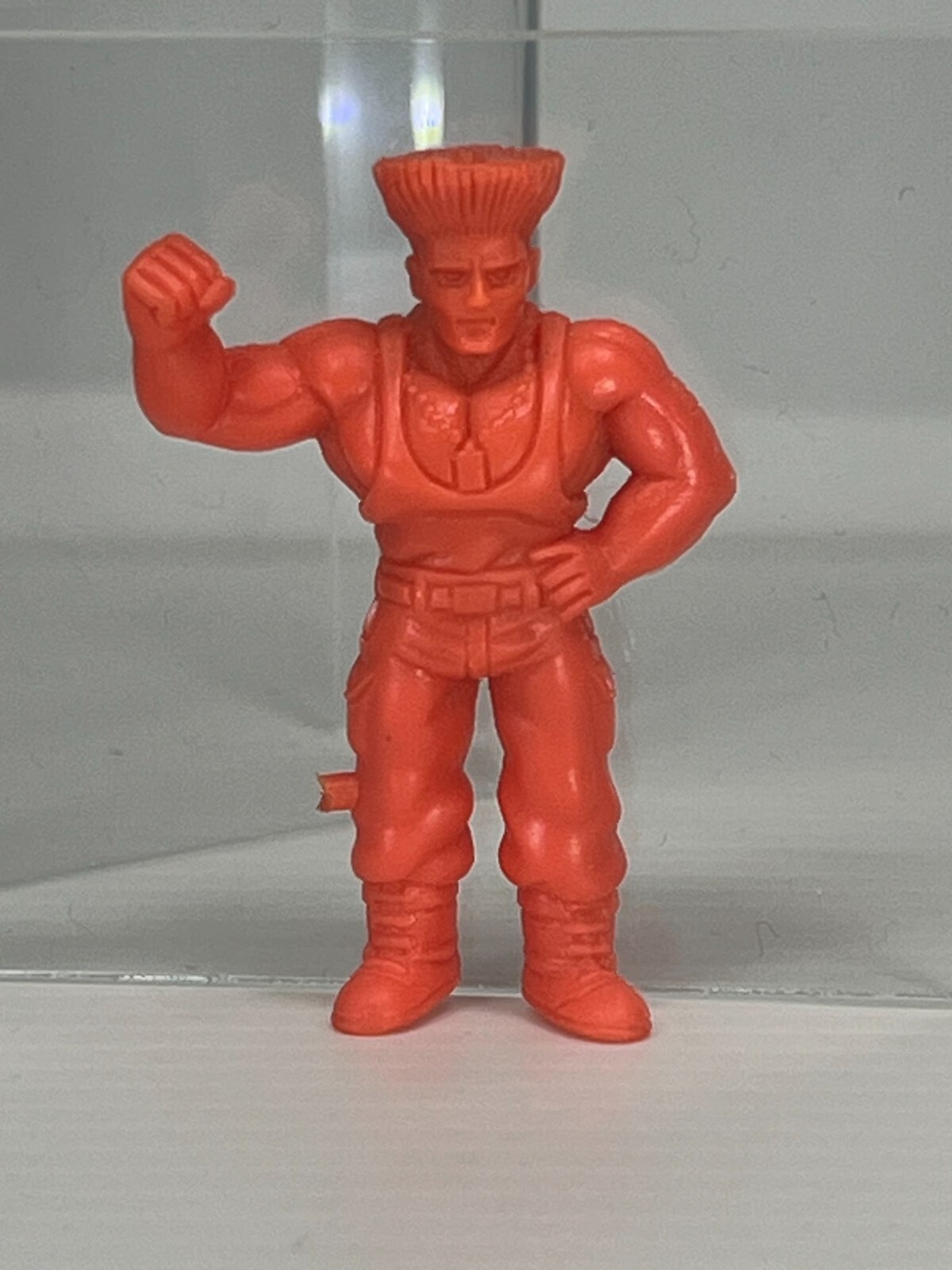
Vintage Guile Street Fighter Keshi Rubber Mascot Figure

What Is a Keshi Figure?
This small piece belongs to a category of Japanese toy called a keshi figure — short for “keshigomu,” the Japanese word for eraser. Made from soft, single-color rubber, keshi figures were sold in enormous quantities through the 1980s and 1990s via gashapon (capsule vending machines), stationery shops, and small toy counters. One color, no paint, no moving parts, small enough to fit in a pocket. The orange molding of this particular piece is characteristic of the format. Despite being technically functional as erasers, they were almost never used that way — they were collected, traded, and arranged.
Guile and the Street Fighter II Boom
Guile — William F. Guile within the game’s fiction — debuted in Street Fighter II when it reached arcades in 1991. Developed by Capcom, Street Fighter II became one of the defining entertainment events of the early 1990s. The 1992 Super Famicom port brought the arcade experience into homes worldwide and triggered a major expansion in licensed merchandise. Keshi figures of Street Fighter II characters were part of that wave, produced in parallel with similar items for Dragon Ball, Yu Yu Hakusho, Fist of the North Star, and other franchises dominating Japanese youth culture at the time.
Guile’s visual design is immediately recognizable: flat-top haircut, sleeveless top, camouflage military pants, combat boots. His Sonic Boom projectile and Somersault Kick anti-air technique defined a distinctive play style, and he has appeared in nearly every mainline entry in the series since, right through Street Fighter 6. Even at keshi scale and in a single molded color, that flat-top silhouette makes the character identifiable at a glance. His in-game theme music later became a widely circulated internet meme — a measure of how deeply embedded the character is in global pop culture decades after his debut.
A Window Into Japanese Gaming Culture of the 1990s
The manufacturer of this specific piece cannot be confirmed without examining physical markings. Bandai, Takara, and Tomy all produced Street Fighter keshi merchandise during this period, as did smaller manufacturers whose names rarely appeared on the products themselves. A small trace of a broken attachment point on the figure’s left thigh may indicate it was once retained inside a gashapon capsule or connected to a secondary component, though this cannot be stated with certainty.
What is clear is that items like this rarely made it beyond Japan’s borders at the time of release. The keshi format was distributed through domestic retail channels with no meaningful international reach, meaning fans in Europe, North America, and elsewhere who grew up playing Street Fighter II had little access to this layer of its merchandise. The format also carries particular appeal for Western vintage toy collectors through a tradition that traces back to the North American success of M.U.S.C.L.E. — the US release of Kinnikuman keshigomu in the mid-1980s. Guile’s American military character design gives him strong recognition among Western players specifically. A figure from the height of the Street Fighter II era sits at the intersection of a globally beloved franchise and a distinctly Japanese mode of toy production that most of the world never experienced in real time.

Boxed and cushioned for the trip from Japan
$12.54
Ships worldwide from Japan • Full photos and details on the listing