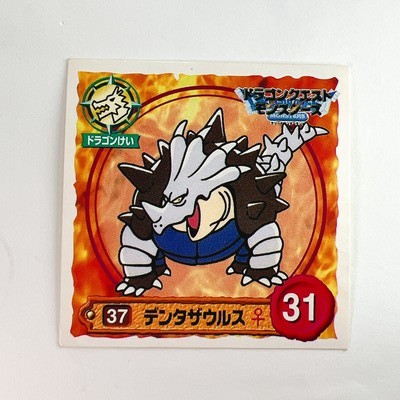
Dragon Quest Monsters Numbered Sticker No. 037, Dentasaurus

A Numbered Sticker from the Launch Year of Terry’s Wonderland
This rectangular sticker, numbered 037 within its series, belongs to a licensed collectible set released around 1998 — the same year Enix launched Dragon Quest Monsters: Terry’s Wonderland on the Game Boy Color in Japan. The design follows a format that was instantly recognizable to Japanese kids at the time: a bold red frame, a blazing orange flame background, and a central character illustration. The lower left identifies the subject clearly — monster number 37, the name Dentasaurus, and a female symbol. A green emblem in the upper left marks her as a Dragon-type monster. A red circle in the lower right displays the number 31, which appears to represent an in-game stat, though the exact meaning isn’t confirmed.
The manufacturer isn’t identifiable from the card face alone. Amada, a prominent producer of wafer stickers for major franchises including Dragon Ball and Sailor Moon throughout the 1980s and 90s, fits the format closely, but that remains unconfirmed without examining the back of the card. What is clear is that it carries an official Enix license, placing it in the pre-merger era before Enix became Square Enix in 2003.
Dentasaurus, Dragon Quest Monsters, and Toriyama’s Design World
Dragon Quest Monsters was Enix’s spin-off RPG series built around recruiting, raising, and combining monsters — a concept that found a ready audience during the monster-taming boom of the late 1990s. Terry’s Wonderland, the first entry in the series, launched on September 25, 1998, and was a major hit in Japan. Every monster in that game came from the broader Dragon Quest universe, all designed by Akira Toriyama, whose work on Dragon Ball had already made him one of the most recognized character artists in the world.
Dentasaurus is a Dragon-type monster, and this sticker notes her gender as female. Her design — a bipedal armored figure combining a turtle’s shell with the spiked silhouette of a ceratopsian dinosaur and a bluish underside — is a characteristic Toriyama creation: playful anatomy, bold outlines, an almost cartoon-fossil quality. The name likely blends “dental” (suggesting tooth or skeletal structure) with “saurus,” the Greek suffix for lizard or dinosaur, though that etymology is inferred rather than documented. She’s a background-roster monster rather than a lead, but numbered series like this were specifically designed to document the full cast, not just the familiar faces.
Shokugan Stickers and the Numbered-Series Collecting Culture
This sticker belongs to a category of Japanese collectible that was everywhere in the 1990s: numbered series packaged with candy or wafers, sold at toy shops, convenience stores, and dagashi-ya (old-style candy stores). The format’s appeal was built around completing the full set — each piece was numbered, the total count wasn’t advertised upfront, and you never knew which one you’d get.
This series runs at least to 037, but the full total remains unknown. The attribute classification, monster number, and stat-like figure printed on each card doubled as a way for kids to engage with the game’s systems off-screen — a media-mix approach that tied the physical collectible directly to the Game Boy experience. For collectors today, these stickers fall into the broader Heisei-era retro toy category: Japan-only items from the 1990s that rarely circulated internationally at the time. The game itself reached global audiences when it launched in North America as Dragon Warrior Monsters in 2000, building a fanbase that still follows the series. Toriyama’s death in March 2024 has since drawn renewed international attention to his licensed work across all eras.


Found in Japan, packed by hand, sent worldwide
$7.86
Worldwide delivery from Japan • See the listing for condition and size