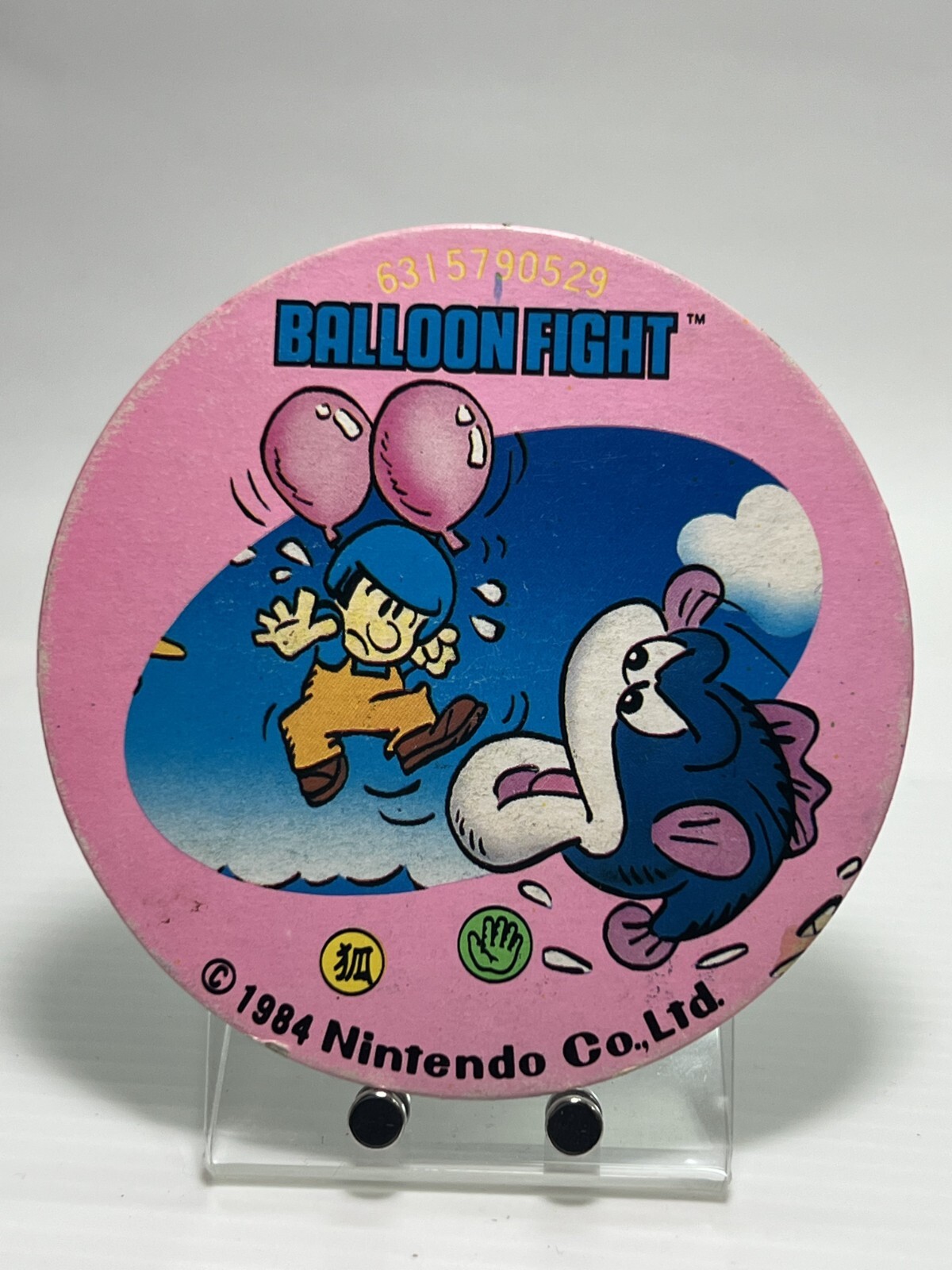
Balloon Fight Menko Card (Nintendo, 1984)

A Traditional Game Meets the Famicom Boom
This card is a menko — specifically a maru-menko, a circular format — rooted in a game with Edo-period origins. Traditional menko is played by slapping cards against the ground in an attempt to flip an opponent’s cards over. The format long predates video games, but by the early 1980s, toy and stationery manufacturers had begun printing licensed characters on them, and when Nintendo’s Family Computer launched in July 1983, character menko flooded the market almost immediately.
The card carries a copyright mark reading “Nintendo Co., Ltd. 1984,” matching the year Balloon Fight launched on the Famicom. That copyright belongs to Nintendo, but the manufacturer was almost certainly a licensed toy or stationery company — a standard arrangement of the era, when firms such as Bandai, Tomy, and Takara all produced Nintendo character goods under license. The specific maker cannot be confirmed from the card itself.
Balloon Fight and the Characters Depicted
Balloon Fight is an action game released by Nintendo on the Famicom in Japan on January 22, 1984, with a North American NES release following in 1986. The player controls the Balloon Fighter — a small character who carries two balloons and takes to the air — taking on airborne enemies across successive stages. The game has often been compared to Atari’s Joust (1982) for its floating movement mechanics, though it follows its own rules in practice.
The card depicts both of the game’s recognizable figures: the Balloon Fighter rendered in the compact visual shorthand of early Famicom-era character goods, and the Flippers — the large blue fish that surfaces from the water below to pop the player’s balloons. Symbols printed near the card’s edge likely serve the traditional menko purpose of indicating turn order or scoring outcomes, though whether they function as play markers or represent a manufacturer’s mark is not conclusively clear from the card alone.
One well-documented piece of industry history adds to the game’s standing: Satoru Iwata, who later became Nintendo’s president, is widely credited with having programmed the Balloon Trip mode while working at HAL Laboratory. Multiple industry sources record this connection, giving Balloon Fight a small but meaningful footnote in the history of Nintendo itself — a detail that has raised the game’s profile well beyond its position as an early-era title.
The First Wave of Famicom Character Goods
Menko cards like this one occupied a specific place in 1980s Japanese toy culture. Sold at dagashi-ya — the small neighborhood shops where children spent pocket money — they stood alongside Bikkuriman stickers and gachapon capsule toys as the defining low-cost collectibles of the decade. Menko kept one foot in tradition as a playable game and the other in the new character goods market that the Famicom era created.
A card dated to 1984 sits in the very first layer of Famicom-era licensed merchandise. The console launched in mid-1983; by early 1984, goods based on its launch-window titles were already reaching dagashi-ya shelves. Balloon Fight, released at the start of that year, was among those first-generation games. For collectors interested in both retro gaming history and Japanese vintage toy culture, a menko card tied to that precise moment spans both worlds at once.


Shipped from Japan, tested where noted in the listing
$16.80
International shipping available • Ask us anything before you buy