Super Mushroom Dot Bottle Cap Figure by Pepsi Japan

A Mushroom and a Block From Gaming’s Most Iconic Franchise
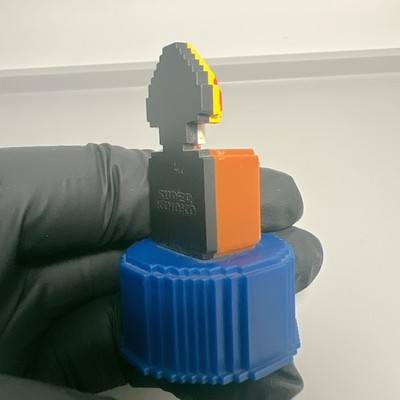
The Super Mushroom — the red-spotted yellow fungus that transforms small Mario into Super Mario — is one of the most recognized symbols in video game history. This Pepsi Dot Bottle Cap Figure renders it in a form faithful to the 1985 Famicom original: eight-bit pixel geometry translated into a small three-dimensional object, with no smoothing or modern reinterpretation. The series also includes a Question Block figure — the yellow “?” block that releases coins or mushrooms when struck — and together the two pieces represent the most fundamental interaction in the game: hit the block, receive the mushroom, grow larger.
Super Mario Bros. was released by Nintendo in 1985 and sold more than 58 million copies on the Famicom alone. The franchise has remained active ever since; the 2023 film adaptation grossed over $1.3 billion worldwide. In the early 2000s, when this figure was produced, Mario licensing was one of the most active in Japanese merchandising, with food and beverage companies among its most consistent partners.
Japan’s Drink Premium Culture in the Early 2000s
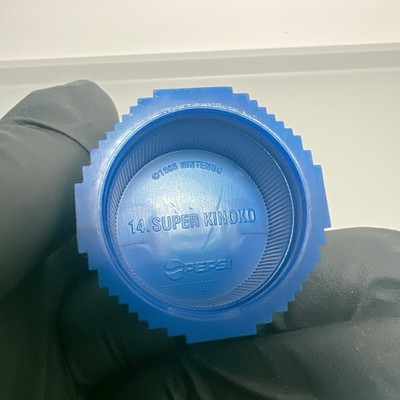
This figure was a promotional premium tied to Pepsi Twist — Pepsi’s lemon-flavored variant, distributed in Japan during the early 2000s, roughly 2002 to 2004, though the exact dates are not fully established. In Japan, Pepsi products were manufactured and sold by Suntory, and the Super Mario Bros. license came directly from Nintendo, making this an officially authorized piece of merchandise. The “dot” in the product line’s name references the design philosophy: each figure begins from the original pixel grid and translates that flat, blocky geometry into sculptural form rather than reimagining it.
Japan’s beverage companies developed a competitive market for these promotional figures throughout this era. Coca-Cola Japan had pioneered the format using anime and game franchises, and Pepsi followed with campaigns of its own. These items belong to the category of Japanese drink premiums — distinct from shokugan (food toy candy) by origin but circulating in the same collector markets. The genuine bottle cap forms the figure’s base, retrieved from the product itself and connecting the object directly to its promotional origins.
Where Retro Gaming and Pepsi Collecting Meet
For collectors outside Japan, several things distinguish this figure from standard licensed merchandise. It was produced for a domestic Japanese campaign with no official foreign distribution, a detail that Japanese pop culture collectors tend to value. The pixel art treatment appeals to retro gaming enthusiasts specifically: this is not a contemporary redesign of the Super Mushroom but an attempt to materialize the 8-bit graphic as directly as a physical object allows. The nostalgia angle was deliberate — the early 2000s was precisely the moment when the Famicom generation of the 1980s was entering their twenties and thirties.
The figure also sits at the crossroads of two separate communities. Mario merchandise draws one audience; Pepsi-branded promotional items draw another, with dedicated collector groups in the English-speaking world focused specifically on Pepsi memorabilia. An item that serves both interests occupies a distinct niche, and the compact scale of the bottle cap format makes it straightforward to display on a desk or shelf alongside other small collectibles.




Boxed and cushioned for the trip from Japan
$14.07
International shipping available • Ask us anything before you buy