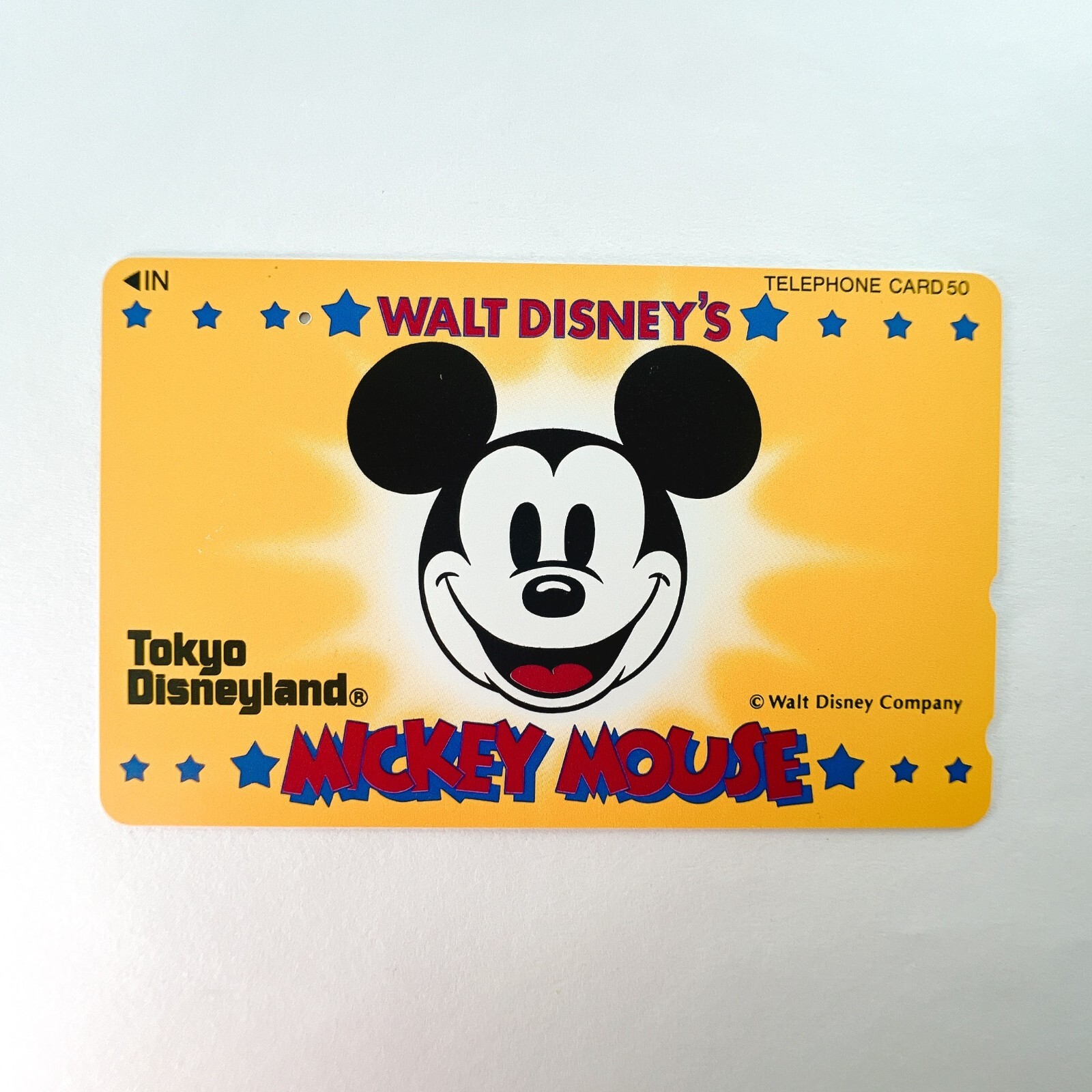
Mickey Mouse Classic Design Telephone Card from Tokyo Disneyland

What Is a Japanese Telephone Card?
Before smartphones rendered public phones obsolete, Japan had one of the world’s most developed public telephone networks — and the prepaid card system that powered it quietly became a cultural phenomenon of its own. NTT (Nippon Telegraph and Telephone Corporation) introduced telephone cards in December 1982. These small PVC cards, identical in size to a standard credit card, were inserted into public phone terminals to pay for calls. The “TELEPHONE CARD 50” marking on this card identifies it as a 50-unit type, the most common denomination for everyday use.
Two small details encode its history. The “IN→” arrow on the left edge guided users on how to slot the card into the machine. The notch punched into the right corner is a physical marker that the card’s units were spent — this one is used, as the listing states. For collectors, that notch is simply part of the object’s biography.
Mickey Mouse, Walt Disney, and Tokyo Disneyland’s Early Years
Tokyo Disneyland opened on April 15, 1983, in Urayasu, Chiba, becoming the first Disney theme park in Asia. Operated by Oriental Land Co. under license from The Walt Disney Company, the park launched an era of Japanese Disney merchandise that drew heavily on the classic characters — Mickey chief among them.
Mickey Mouse himself debuted in 1928 in Steamboat Willie, the short film created by Walt Disney and Ub Iwerks that became one of the earliest synchronized-sound cartoons. He has anchored Disney’s identity ever since. The “WALT DISNEY’S MICKEY MOUSE” credit visible on merchandise from this period reflects the standard licensing attribution the company applied throughout the 1980s and 1990s.
The graphic design on this card is a clear product of that decade: Mickey’s face large and centered, set against a yellow background with a white starburst radiating behind him, framed by red and blue text and star motifs. It is the festive, high-energy visual language Disney consistently applied to merchandise during those years. Based on the card’s graphic style and NTT’s older magnetic format, it was most likely produced in the late 1980s to early 1990s, though an exact date cannot be confirmed.
The Telephone Card Collecting Boom in Japan
Japan’s bubble economy years, roughly 1986 to 1991, transformed the telephone card from a practical item into a collector’s passion. Theme parks, corporations, pop idols, anime studios, and railway companies all issued branded cards in enormous variety. Specialist shops, collector magazines, and dedicated trade shows grew up around the hobby. Unused, mint-condition cards were the most sought after, while used examples, though carrying evidence of actual calls placed, retain their graphic and historical interest as physical artifacts of the era.
The hobby faded as mobile phone adoption accelerated in the late 1990s, sending public phone usage into sharp decline. Today, Japanese telephone cards from the bubble period are treated as nostalgic cultural documents — compact, flat windows into a very particular moment in Japanese consumer history.
For overseas Disney collectors, this kind of item sits at an unusual crossroads: one of the world’s most recognized characters rendered in a format that was distinctly Japanese, produced for a theme park with its own place in Disney’s global story. Asian Disney merchandise has historically circulated in small quantities in Western markets, and the telephone card format was never part of collecting culture outside Japan — which gives pieces like this a specific context that general Disney merchandise simply does not carry.

Listed in our eBay store and sent from Japan
$14.07
International shipping available • Ask us anything before you buy