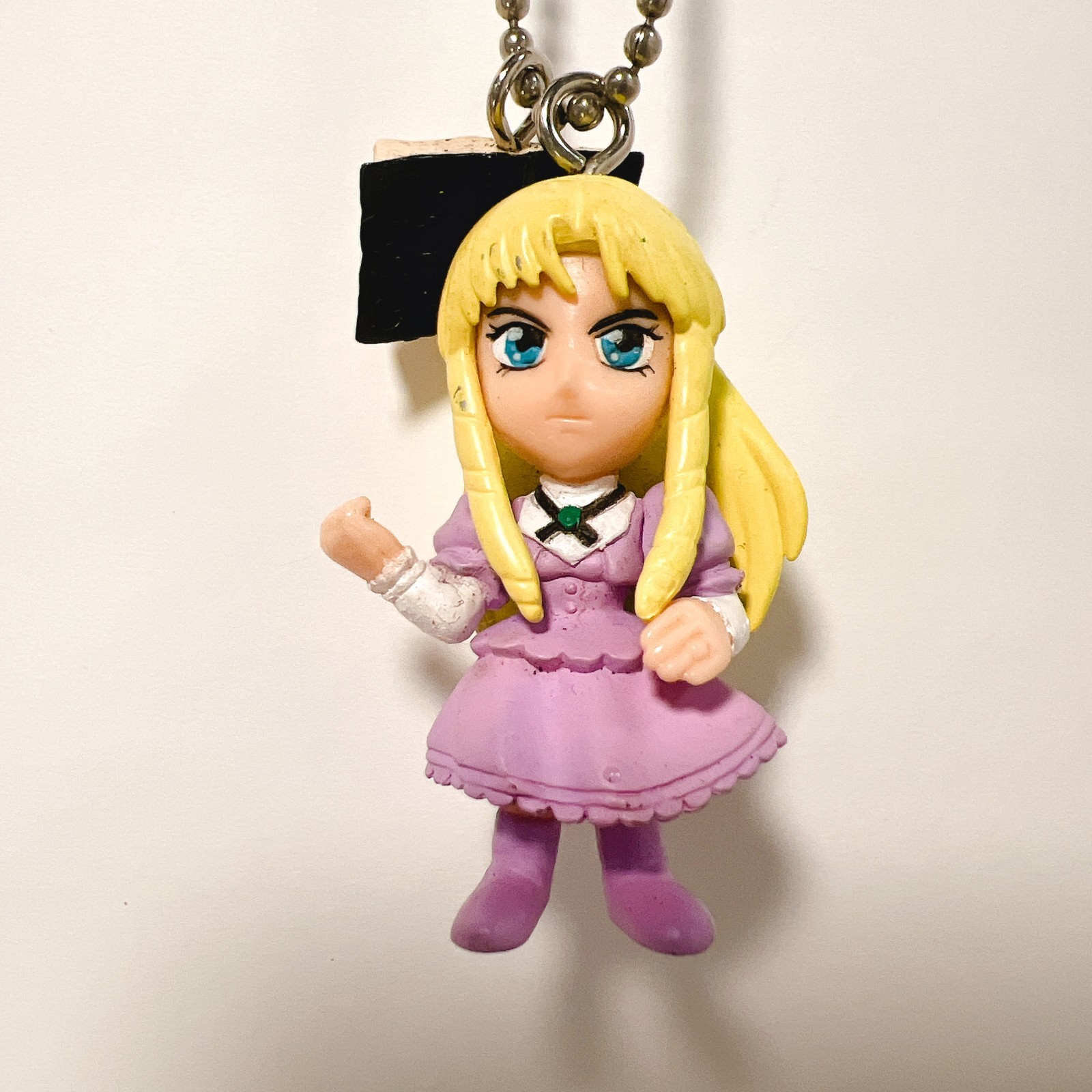
Sherry Belmondo — Gash Bell Swing 2 Keychain Figure by Bandai

Zatch Bell! and the Franchise Behind This Figure
Kiniro no Gash!! — released internationally as Zatch Bell! — is a manga by Makoto Raiku that ran in Weekly Shonen Sunday from 2001 to 2008, published by Shogakukan. Its story follows a battle royale with an unusual emotional core: one hundred pairs, each made up of a human partner and a demon child from another world, fight until a single pair remains — and the surviving demon child becomes king of the demon world. The anime adaptation, produced by Toei Animation and broadcast on the Fuji TV network, ran from 2003 to 2006 across 150 episodes plus specials. VIZ Media published the English-language manga under the Zatch Bell! title, and the anime reached audiences across North America, Europe, and Latin America. During the mid-2000s, the series held its ground in Weekly Shonen Sunday alongside Detective Conan and Inuyasha, two of the magazine’s other flagship titles at the time.
Who Is Sherry Belmondo?
Sherry Belmondo is the human partner of Brago, a demon child whose abilities revolve around stone and gravity-based spells. Where the main protagonist pair drives the story forward, Sherry and Brago occupy a cooler, more adversarial space — composed where others are emotional, deliberate where others are impulsive. Sherry comes from a wealthy European family, and her character design reflects that background clearly: long blonde hair, blue eyes, a purple dress with white sleeves and collar, and a green jewel as part of her look. That palette carries over faithfully into the figure’s chibi proportions, where the color contrasts are strong enough to make the character immediately recognizable at a glance. Her composure and force of will — the pose may show her with both fists clenched, reflecting that quality — give her an identity that stands apart from the broader cast and reads well in small-scale collectible form.
Gashapon Swing Figures and Japan’s Strap Culture
The word “Swing” in Gash Bell Swing 2 is not decorative — it describes how the figure was designed to be used. A silver ball chain attaches near the head, so the piece can hang from a bag or a mobile phone, which was a widespread daily accessory habit in Japan during the early 2000s. The gashapon (GASHAPON is a Bandai registered trademark) distribution model works through coin-operated vending machines — typically in the 100–300 yen range — placed in toy stores, convenience stores, and game centers across Japan. Multiple characters were released in the same wave, with collecting the full roster a built-in motivation of the format. The “Swing 2” designation marks this as the second wave, following an earlier release; a follow-up series generally indicates the first generated enough interest to continue. Because these products were made for the domestic Japanese market and not intended for export, international availability has always depended on routes outside the original distribution system.


Boxed and cushioned for the trip from Japan
$14.07
Worldwide delivery from Japan • See the listing for condition and size