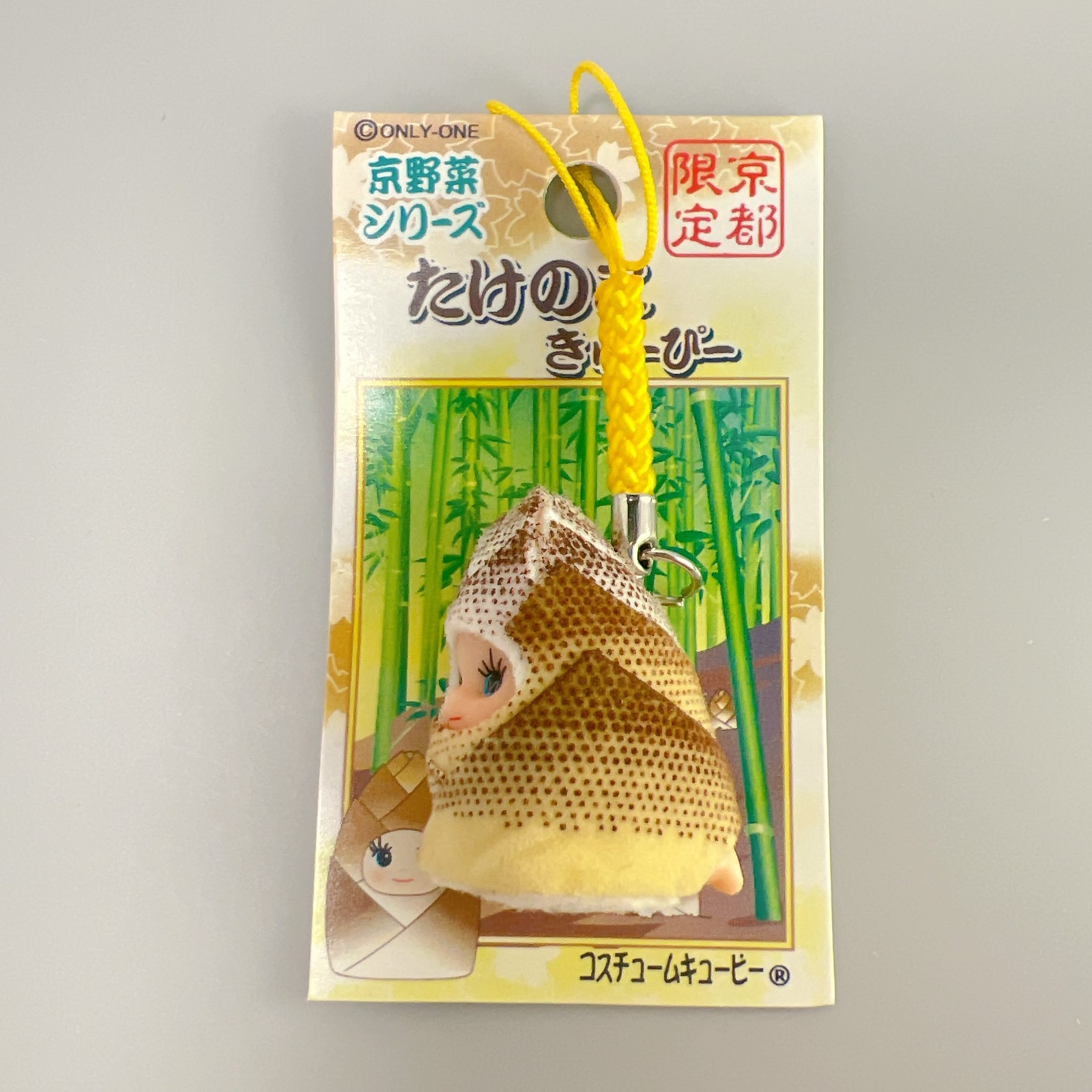
Kewpie Bamboo Shoot Costume Mascot Strap, Kyoto Vegetable Series

A Character with Roots on Two Continents
Kewpie began not in Japan but in the United States. In 1909, American illustrator Rose O’Neill created the character — a round-bodied infant figure with a single tuft of hair, bright blue eyes, and an immediately recognizable silhouette — for a Columbia University publication. Kewpie dolls spread internationally over the following decades, eventually reaching Japan, where the character developed a second, distinct cultural identity: Kewpie Corporation, the food company established in 1919 and widely known for its mayonnaise, adopted the doll as its brand mascot. That connection embedded Kewpie deeply into everyday Japanese life, making the figure recognizable to generations of consumers well beyond the toy aisle.
The Costume Kewpie line channels that familiarity into regional collectibles. Licensed and produced by the Japanese company ONLY-ONE — whose copyright marking appears on the packaging — the series dresses the standard Kewpie form in themed costumes, leaving the characteristic head and upper body visible while the lower half becomes the outfit itself. In this piece, that costume is a bamboo shoot, or takenoko: a fitting subject for a Kyoto-exclusive item. The strap attaches via a yellow braided cord to a silver-tone keyring, the format typical of Japanese mascot accessories of this kind.
Takenoko and the Kyo-yasai Tradition
Bamboo shoots occupy a prominent place in what Kyoto officially recognizes as its traditional vegetables, collectively known as Kyo-yasai. The shoots grown in the Nishiyama region west of Kyoto — particularly around Nagaokakyo and Oyamazaki — are widely considered among the finest in Japan. Specific soil conditions and traditional cultivation practices produce a paler, more tender shoot each spring that has been central to Kyoto cooking for centuries. Kyoto Prefecture actively promotes these vegetables as a formal branded agricultural category, and takenoko stands near the top of that list.
As a cultural motif, the bamboo shoot carries immediate geographic meaning. For Japanese audiences and for international visitors familiar with Kyoto’s culinary reputation, it functions as shorthand for the city and its seasonal food culture — much as imagery of temples or traditional textiles might. Pairing it with the globally legible Kewpie form creates something that reads as distinctly local and immediately understandable at the same time.
Japan’s Regional Souvenir Tradition and the Collector Context
Mascot straps — small figure accessories on a braided cord designed to hang from bags, phone cases, or keys — became a fixture of Japanese souvenir culture through the 2000s. This format, sold individually in retail packaging at gift shops and tourist locations, is distinct from capsule machine toys (gashapon). The “Kyoto Limited” designation on this strap’s packaging reflects a genuine category in Japanese consumer culture: goods distributed exclusively within a specific location carry that exclusivity as a meaningful product attribute, tied to the deeply rooted Japanese custom of bringing back a local specialty that cannot be found anywhere else.
For collectors, the Costume Kewpie line offers several angles of interest. Kewpie itself is a character with documented international recognition, with collector communities in both Japan and the West that extend into vintage and antique Kewpie doll collecting. The regional and thematic variety within the series — different cities, foods, and cultural subjects — gives the line a structure that naturally supports collection-building across many pieces. And the format itself, a packaged Japanese mascot strap tied to a specific location and run, represents a category of goods that is straightforwardly difficult to acquire outside Japan.


Listed in our eBay store and sent from Japan
$14.07
International shipping available • Ask us anything before you buy