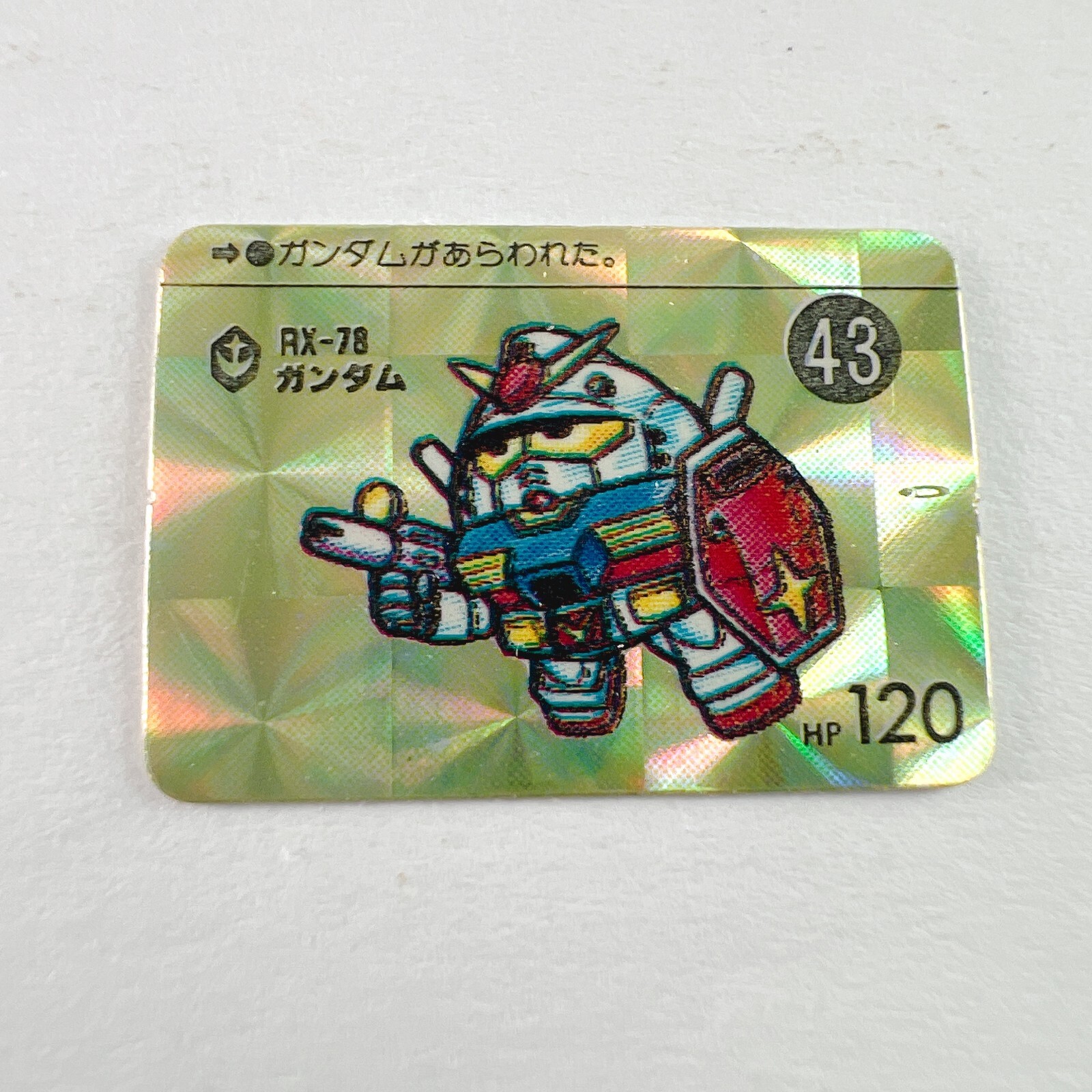
Bandai Mini Carddas SD Gundam RX-78-2 Holo Card, 1989

The Gundam Icon in Super-Deformed Form
The front of this card features RX-78-2 Gundam in the SD, or Super Deformed, style — the exaggerated chibi proportions, beam rifle, and shield that became a pop-culture language of their own in 1980s Japan. Alongside the illustration, text reads something close to “A Gundam has appeared,” accompanied by a stat line: HP 120, card number 43. That phrasing deliberately mimics the enemy-encounter screen of a JRPG, a piece of design shorthand that Bandai leaned into during this period of its Carddas lineup.
RX-78-2 is the flagship mobile suit of Mobile Suit Gundam, director Yoshiyuki Tomino’s 1979 television series produced by Sunrise. That series established what became known as the “real robot” genre — science-fiction anime treating large-scale mecha warfare with political and emotional weight rather than pure spectacle. The protagonist Amuro Ray pilots the RX-78-2 throughout, and its silhouette has remained the franchise’s defining image across every decade since. By 1989, the IP had expanded through Zeta Gundam (1985), Gundam ZZ (1986), and the theatrical film Char’s Counterattack (1988). The SD Gundam spin-off had also become its own creative tradition, spreading through eraser figures, gum inserts, manga, and OVA releases — making both the chibi design and the original mobile suit simultaneously familiar to Japanese children of this era.
Carddas — Bandai’s Vending Machine Card Culture
Carddas launched in 1988, just a year before this card was produced. Bandai placed vending machines in toy shops and convenience stores that dispensed one randomly selected card per play for roughly ten to twenty yen. The Mini Carddas format was a smaller variant of the same system. Holographic — or “kira” — cards were produced in lower numbers than standard cards and carried real prestige among young collectors. This card’s radiating sunburst holo background places it in that more coveted category.
Gundam was one of the Carddas format’s major early licenses, with cards spanning the original series, SD continuity, and theatrical releases running in parallel. The Comic BonBon connection referenced in this card’s listing points to Kodansha’s monthly manga magazine, published from 1981 to 2007, which served as the primary venue for SD Gundam comics and a regular distribution channel for promotional and supplemental cards. Whether this specific card arrived as a magazine insert, a reader-mail prize, or a retail promotional item cannot be determined from the card alone — but its association with BonBon places it firmly within that mid-Showa-era children’s media ecosystem.
Why International Collectors Pay Attention
Gundam has sustained active fan communities in North America, Europe, and across Southeast Asia for decades, and RX-78-2 is the machine most people encounter first. The SD aesthetic has its own separate following, particularly among fans of the SD Gundam G Generation video game series — the chibi designs are not a watered-down version of the franchise but a parallel creative tradition with documented roots in the late 1980s.
Carddas cards circulated through Japanese vending machines and were never officially exported. A card produced in 1989 — at the transitional moment between the Showa and Heisei eras, and during the very first years of the Carddas brand — represents a tangible piece of everyday Japanese toy culture from that specific window. The RPG-style stats printed on the front add a layer of period texture: by 1989, JRPG conventions had become standard shorthand for game-adjacent merchandise aimed at Japanese schoolchildren, and HP values on a Gundam card capture exactly how those two pop-culture worlds overlapped in a single, small object.


Listed in our eBay store and sent from Japan
$8.82
International shipping available • Ask us anything before you buy