Time Slip Glico Electric Fan Miniature (1936 Matsushita)

A Candy Toy Built Around Showa Nostalgia
This figure is one entry in Time Slip Glico, a shokugan series — a miniature toy included with candy — produced by Ezaki Glico and sculpted by Kaiyodo. The series launched around 2001, at the peak of Japan’s food-toy boom, with a premise that distinguished it from typical candy premiums: instead of fictional characters, it reproduced real objects from Japan’s Showa era with the precision of a display collectible.
Ezaki Glico, the Osaka confectionery company best known internationally for Pocky and Pretz, has been including small toys with its candy since 1927. Time Slip Glico continued that tradition while aiming firmly at adult collectors. Kaiyodo — an Osaka-based figure maker founded in 1964, working simultaneously on the celebrated animal figures in Morinaga’s Choco Egg series — brought a sculptural standard that made the adult-collector positioning credible.
The 1936 Matsushita Fan and Its Summer Companion
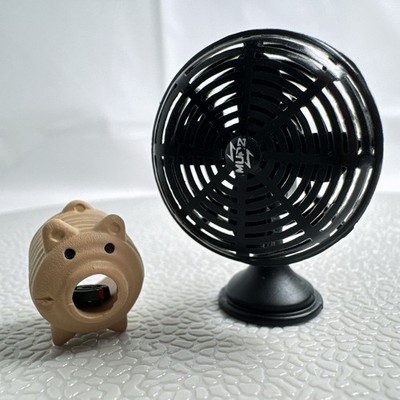
The figure reproduces an electric fan made by Matsushita Electric Industrial Co., Ltd. in 1936 — the eleventh year of the Showa period, when household appliances were still a luxury in most Japanese homes. Matsushita, founded by Konosuke Matsushita in 1918 and eventually rebranded as Panasonic, was producing fans as one of its core lines well before the war. The black upright design with a spherical cage grille is characteristic of prewar industrial styling. The inscription visible on the grille center has been read as “MUDZ,” though this likely represents the Matsushita name or a period product logo rendered at miniature scale rather than independent text.
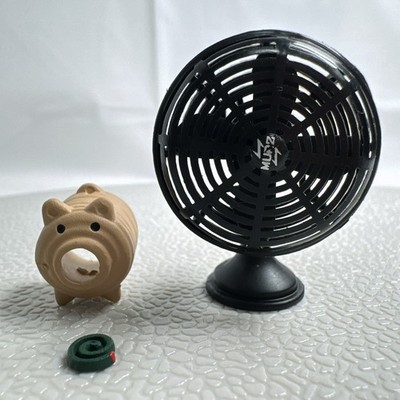
The set pairs the fan with a katori buta, a pig-shaped holder used for mosquito coils throughout Japan’s Showa decades. Ceramic pigs with a mouth opening for incense smoke became so common in Japanese households that they eventually crossed from practical object into cultural shorthand for the era itself. Together, the fan and the katori buta construct a small, coherent scene: a Japanese interior on a hot summer day, somewhere in the middle of the twentieth century.
Kaiyodo’s Craft and the Appeal for Collectors Beyond Japan
Time Slip Glico used a blind-box structure — buyers could not see which figure they were getting before opening the package — and ran across multiple series, each covering a different slice of Showa material culture. The combination of assorted figures and genuine sculptural quality made completism an ongoing project for the collectors the series attracted.
For collectors outside Japan, the interest works on several levels. Kaiyodo’s involvement is a recognized quality signal in the international figure community. The subject matter — a prewar Matsushita appliance, a piece of Japanese domestic life without close equivalent in Western households — gives the pieces historical specificity beyond generic nostalgia. And shokugan from this era were distributed primarily through Japanese convenience stores and supermarkets, keeping their circulation abroad limited from the start. The figures that did leave Japan tend to stay in circulation among collectors who understand what they represent.



Boxed and cushioned for the trip from Japan
$14.07
Ships internationally • More photos on the eBay listing