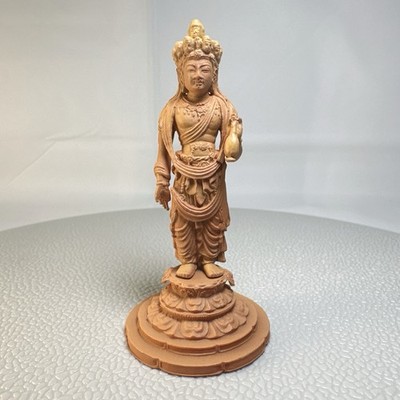
Juichimen Kannon Figure, Capsule Q Museum Series by Kaiyodo

A Buddhist Icon in Eleven Faces
Juichimen Kannon — literally “Eleven-Faced Kannon” — is one of the most widely venerated bodhisattva forms in Japanese Buddhism, particularly within Tendai and Shingon traditions. The Sanskrit name Ekadaśamukha refers to its defining feature: a crown of eleven faces arranged above the central head. Each face carries a distinct expression — compassion, fury, open laughter — understood as the deity’s capacity to perceive and respond to every kind of human suffering, in any direction and in any state. In canonical depictions, Juichimen Kannon stands on a lotus pedestal and holds a water vessel; both attributes appear throughout the classical sculptural tradition this figure draws from. Japan’s most celebrated examples include a Hakuho-period National Treasure standing image in Shiga Prefecture and an eighth-century dry lacquer figure at Shorin-ji in Nara. Which specific historical sculpture this Kaiyodo figure references cannot be confirmed from the listing information alone, but the iconography is consistent with the established tradition.
Kaiyodo’s Capsule Q Museum and Cultural-Heritage Collecting
Founded in 1964 and based in Moriguchi, Osaka, Kaiyodo is widely regarded within Japan’s figure industry as one of the country’s foremost sculptural houses. The Capsule Q Museum line — produced specifically for gashapon vending machines — takes Japan’s cultural heritage, rather than anime or game characters, as its subject matter. The series covers museum artifacts, historical craft objects, temple sculptures, and natural history specimens; the Buddhist statue sub-series has run across multiple releases since the brand’s expansion in the mid-2000s, drawing particular collector attention around 2010. Kaiyodo’s sculptors reference actual measurements and photographs of originals, and the results are consistently cited for proportional accuracy and fidelity to fine detail. This figure’s uniform light-brown molding is a deliberate choice, replicating the surface quality of aged wood and placing the piece visually alongside the historical carvings it miniaturizes. Certain editions of the Buddhist statue series have been stocked in museum shops and temple gift areas in Nara and Kyoto, displayed alongside the actual works they represent.
Gashapon’s Place in Japanese Culture and Its Reach Abroad
Gashapon — capsule toys dispensed from coin-operated vending machines — has been embedded in Japanese daily life since the 1960s and 1970s. The format evolved considerably after 2010, when premium adult-collector lines began occupying their own space in toy shops and department stores, targeting buyers interested in craft and cultural subject matter rather than children’s play. Capsule Q Museum fits squarely in this premium tier: the typical buyer is an informed collector with an interest in art history or traditional culture, not a casual toy consumer. For collectors outside Japan, gashapon products present a straightforward access barrier — distribution is almost entirely domestic, running through vending machine networks in shops, museums, and tourist areas, with very little reaching formal international retail. A figure like this Juichimen Kannon — produced by a respected Japanese sculptural house, modeled on a canonical Buddhist form, and finished in a style that reads more as miniature sculpture than toy — is precisely the kind of cultural object that reaches overseas buyers almost exclusively through individual sellers.


Boxed and cushioned for the trip from Japan
$16.09
International shipping available • Ask us anything before you buy