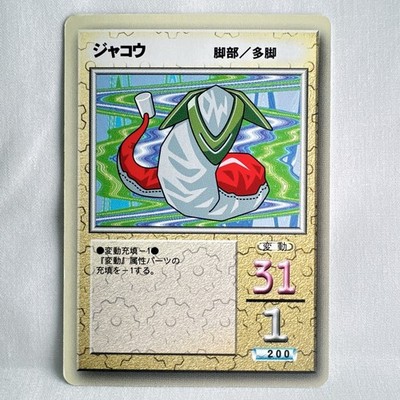
Jakou Leg Parts Card from the Medarot Card Game

A Franchise Built on Interchangeable Robot Parts
The Medarot franchise — known internationally as Medabots — launched in 1997 as a Game Boy RPG developed by Natsume. Its central mechanic was straightforward and compelling: robots called Medarots are built from four interchangeable components — head, right arm, left arm, and legs. Players could swap parts from different robots to shape their battling strategy. That modular logic defined the series and carried through into every medium it expanded into.
An anime adaptation began airing in 1999 on TV Tokyo, produced by Bee Train. Canadian company Nelvana produced an English dub that reached audiences in North America, the United Kingdom, and Australia around 2001 and 2002. For that generation, Medabots sits alongside Digimon and early Yu-Gi-Oh — a robot-battle franchise that ran in Pokemon’s orbit without reaching its scale, giving it a distinct cult following rather than mainstream saturation.
Cards, Arthropods, and Japan’s Late-1990s TCG Boom
Pokemon’s card game ignited a wave of TCG expansions across Japanese children’s entertainment from 1996 onward, and Medarot was among the franchises that followed. The Medarot Card Game was most likely produced between 1999 and 2002, in line with the anime’s broadcast window, though the exact release year and manufacturer have not been confirmed. Packs were sold through convenience stores, toy shops, and candy stores — the standard retail channel for children’s TCGs of that era.
The cards have a recognizable look: a puzzle-piece-textured border that appears to be specific to this game. Individual cards represent components rather than whole robots, staying true to the franchise’s own design logic. This card covers Jakou’s leg unit — designated as a multi-legged type — with printed stats of 31, 1, and 200, and ability text describing “variable fill” and “variable attribute parts,” pointing to a flexible role within the game system.
Jakou’s Design and What It Means for Franchise Collectors
Jakou’s leg parts show a segmented red-and-white body, a green headpiece, and white tube-like protrusions at the rear — a design that calls to mind centipedes, millipedes, or similar multi-legged arthropods. This places Jakou in a visual category well apart from the humanoid or vehicle-inspired robots more common in the genre. The name “Escarocket” may combine “escargot” and “rocket,” though that reading is speculative. Whether Jakou appeared in the main games or anime has not been confirmed; the character may have been introduced specifically for the card game rather than adapted from the primary storyline.
The Medarot Card Game was a Japan-only release with no known international distribution. Fans who watched Medabots outside Japan had no access to this product line at the time, which gives surviving cards a particular obscurity for franchise collectors. The intact game text — mechanics, stats, and attribute descriptions — also provides a direct record of how Medarot’s part-based design philosophy was translated into TCG form, something of documentary interest to anyone tracing the history of Japanese card game design from this period.


Sleeved and rigid-mailed before it leaves Japan
$8.82
Worldwide delivery from Japan • See the listing for condition and size