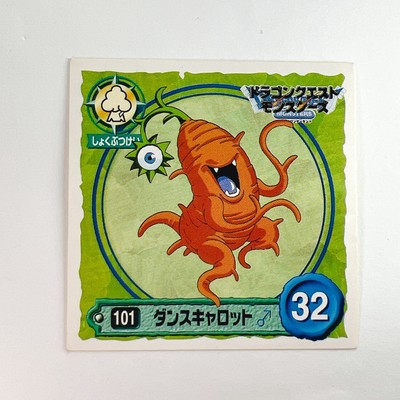
Dancing Carrot No. 101 — Dragon Quest Monsters Character Sticker, 1998 Japan

The Game Behind the Sticker
Dragon Quest Monsters: Terry’s Wonderland was published by Enix — now Square Enix — for the Game Boy Color, releasing in Japan on January 23, 1998. A spin-off from the mainline Dragon Quest series, it let players recruit wild monsters and breed them together to create new species. The format shared ground with the Pocket Monsters phenomenon that had swept Japan since 1996, though DQM distinguished itself by drawing on Dragon Quest’s established monster roster, giving it its own fanbase among longtime DQ players. Enix brought the game to North America the same year as Dragon Warrior Monsters, so an English-speaking audience for this franchise has existed almost from its launch.
Dancing Carrot: Plant Monster No. 101
Dancing Carrot holds encyclopedia number 101 in DQM’s monster catalog — a plant-type, male creature with a design that lives up to its name. The character takes the form of an orange root vegetable given human proportions, with vine-like protrusions ending in eyeballs extending from its head, caught in an expressive mid-dance pose. Its in-game abilities relate to dancing. Among a cast of more than 215 monsters, it has one of the more immediately recognizable silhouettes.
The design fits the visual style of Akira Toriyama, who handled monster and character design for the Dragon Quest series overall. The sticker’s listing references “Toriyama” because the artwork traces directly to his creative work — though as a licensed product, it was manufactured under Enix’s authorization rather than made by Toriyama himself. Toriyama passed away in 2024, and his contributions across Dragon Ball and Dragon Quest have drawn renewed international attention since.
Japan’s Numbered Sticker Collections of the 1990s
The sticker’s layout follows the standard design of Japanese character sticker series from the period: a rectangular card, oval frame, textured green border, and the Dragon Quest Monsters logo in the upper right. A badge in the lower left identifies the character by name and in-game number (No. 101); a separate blue wax-seal-style badge in the lower right reads “32,” which appears to mark its position within the sticker series itself. That dual numbering — one for the game’s monster encyclopedia, one for the collection — was typical of how these sets were structured.
Stickers like this circulated widely in Japan in the late 1990s through candy packaging extras, stationery store packet sales, and prize novelties. The numbered, complete-the-set format was a proven sales model, and with DQM’s roster running past 215 monsters, a full sticker series had considerable range to draw from. This card dates from approximately 27 years ago, at the height of Japan’s character goods market.


Comes straight from Japan — no middleman
$7.86
Ships internationally • More photos on the eBay listing