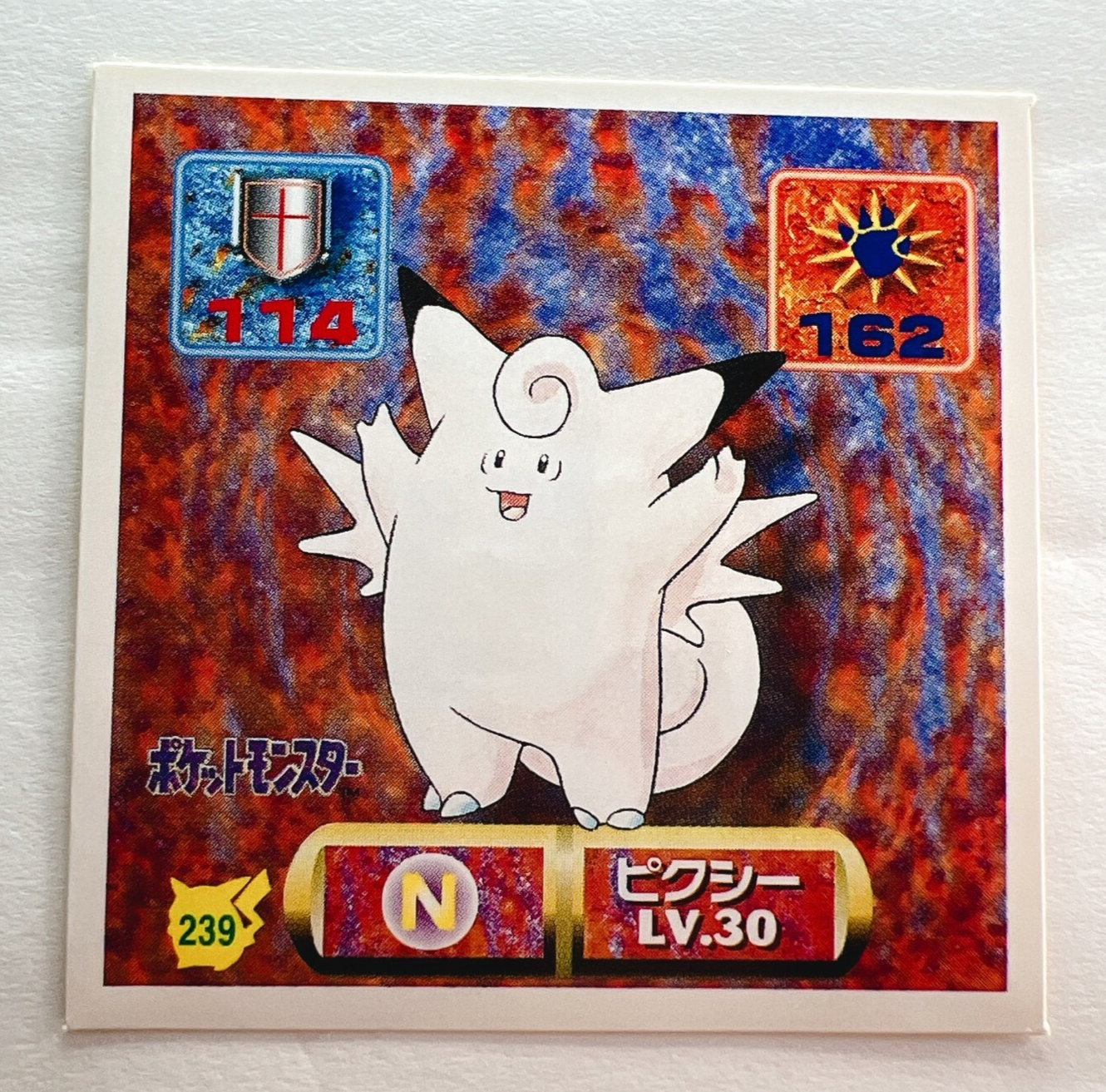
Clefable No.239 Pokemon Sticker by Amada, 1997

A Sticker Built for Battle
Before Pokemon trading cards went global, Japan had its own ecosystem of licensed goods — and Amada’s stickers were a notable part of it. This piece is a rectangular sticker with a white border, produced by Amada under official Pokemon license. It features Clefable — known in Japan as Pikushii — along with the Pokemon logo and series number No.239 printed on the face.
What distinguishes Amada stickers from simple decorative ones is the game data printed directly on each piece. This sticker shows “LV.30,” a blue-framed number “114” in the upper left, and an orange-framed “162” in the upper right. These don’t correspond to Clefable’s official in-game statistics, which points toward them being parameters for Amada’s own sticker battle game — though the exact mechanics of that system haven’t been fully documented. A gold-framed “N” symbol also appears; it may indicate a rarity tier or category designation within the series, but Amada used different notation systems across its Pokemon sticker runs, so the precise meaning isn’t confirmed. A Pikachu silhouette mark completes the design.
Clefable’s Place in the First Generation
Clefable is National Pokedex No.036 — a Normal-type (Fairy type was added in the sixth generation) and the final evolution of Clefairy, reached by using a Moon Stone. In the original games it’s a balanced battler with strong HP and Special stats, and it became associated with the move Metronome, which randomly executes any other move in the game.
The series number on this sticker — 239 — is Amada’s internal numbering and has no relation to the Pokedex. That figure being this high hints at a substantial lineup, though whether it spans one Amada series or several isn’t fully confirmed. Clefairy, Clefable’s pre-evolution, has been discussed in fan communities as an early candidate alongside Pikachu for the franchise’s mascot role — though official confirmation of that history is limited — and Clefable carries some of that recognition among collectors focused on the first generation.
The Year Before Pokemon Went Global
This sticker was made at a specific turning point. Pokemon Red and Green launched in Japan in February 1996. The anime debuted on April 1, 1997. North America didn’t see Pokemon Red and Blue until 1998. This sticker dates to that gap year, when the franchise had already transformed Japanese popular culture but hadn’t yet reached the rest of the world.
Collector stickers had deep roots in Japan by then. The Bikkuri Man stickers of the late 1980s established the model of stickers as both collectibles and game tokens, sold through toy shops, stationery stores, and convenience stores across the country. Amada carried that format into the Pokemon era with officially licensed sets distributed through similar retail channels. Because these stickers were produced for the Japanese domestic market, the text on the face — including the character name Pikushii and the Pokemon logo in Japanese — was never adapted for international sale. For collectors interested in early Pokemon history, that makes pieces like this a tangible record of the franchise at its origins, before its global expansion reshaped everything that followed.


Listed in our eBay store and sent from Japan
$7.86
International shipping available • Ask us anything before you buy

