A 1950s Round Menko Card Featuring Captain Tsuntsun

Japan’s Game Cards from the Dagashiya Era
Menko are traditional Japanese game cards with roots reaching back to the Edo period. By the postwar 1950s, they had settled into their definitive form: thick cardboard discs or rectangles, printed with bold character imagery, sold at dagashiya — the small candy-and-toy shops that functioned as social hubs for Showa-era children. A single card cost just a few yen.
The game was direct: slam your card against a surface next to an opponent’s, and if the air pressure or impact flipped it over, you won it. But character menko were also collected for the imagery itself — precursors, in a real sense, to modern trading cards.
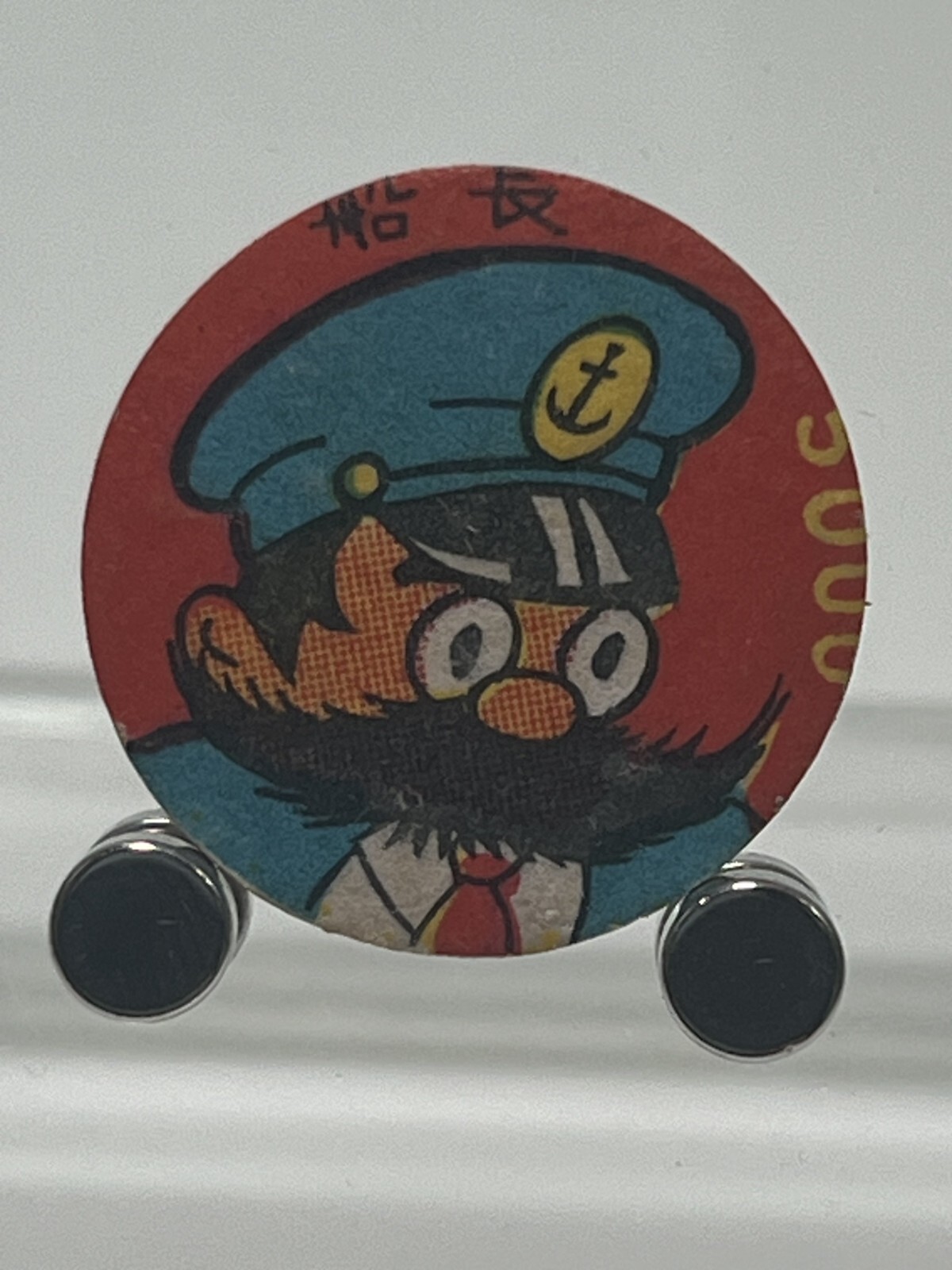
This piece is a maru menko — the circular format. Its vivid red background, large face close-up, and Japanese text labeling the character as “Captain” and “Tsuntsun” are signature features of the 1950s character menko style. The dot-matrix printing pattern visible on the card surface is consistent with the letterpress offset technology of that decade.
Captain Tsuntsun and the Probable Golden Bat Connection
The figure depicted is Captain Tsuntsun: black mustache, round glasses, a blue captain’s hat bearing an anchor emblem, white shirt, red tie. The name “tsuntsun” is a Japanese onomatopoeic word meaning roughly “prickly” or “brusque” — a naming convention frequently used for comical antagonists or eccentric side characters in Showa children’s media. The visual type — a sea-captain figure with a rogue’s bearing — appears throughout the era’s kamishibai stories and illustrated serials, though the exact narrative role of this character cannot be confirmed from the card alone.
Image analysis points to the Golden Bat (Ogon Bat) franchise as the most likely source, though this cannot be confirmed; other contemporary kamishibai or manga series remain plausible origins. Golden Bat is one of Japan’s earliest superhero characters, originating in the 1930s in kamishibai — live street picture-story performances — and credited to creators Suzuki Ichiro and Nagamatsu Takeo. A gold-skulled warrior of justice battling evil, the character continued to circulate as kamishibai, picture books, and toys through the 1950s. It received a television anime adaptation in 1966–1967, but this card predates that broadcast by roughly a decade, placing it firmly in the kamishibai and print-media phase of the franchise’s life.
What Makes This Era of Character Merchandise Distinctive
Television animation in Japan effectively began with Astro Boy in 1963. Everything before that represents a distinct layer of character culture — one built on live kamishibai performances, manga magazines, and the paper toy ecosystem surrounding them. Menko cards from the 1950s are among the few surviving artifacts of that pre-anime world.
Cardboard toys made to be played with rarely survived decades intact, making well-preserved examples of early Showa kamimono (Japanese vintage paper goods) uncommon. Golden Bat holds particular international interest as one of Japan’s pioneering superhero concepts; the 1966 anime version was broadcast in Italy, giving the franchise a foothold in European collecting circles. A menko card from the decade before that animation represents an earlier chapter in the franchise’s history, and its readable Japanese text — identifying both the character name and title — provides useful reference information for researchers tracing pre-anime character merchandise.


Shipped directly from Japan by a small shop
$9.59
Ships worldwide from Japan • Full photos and details on the listing