The Dog Artlist Collection Clear Purple Puppy Mini Figure

A Brand Built Around Dogs and Kawaii Culture
The Dog Artlist Collection was one of the defining character goods brands of early-2000s Japan. Its identity rested on a specific combination: photographic realism applied to dog imagery, softened into a deformed, super-cute aesthetic that made the brand instantly recognizable. Rather than inventing fictional mascots, The Dog worked entirely with real breeds — Golden Retrievers, Basset Hounds, Beagles, and others — each rendered with affectionate exaggeration that stopped just short of cartoon.
The brand began in stationery: postcards, stickers, notebooks. From there it expanded into figures, plushies, and a broad range of lifestyle goods. In Japan, The Dog products filled shelves at Loft, Plaza (then operating as Sony Plaza), and independent goods shops nationwide. Between roughly 2000 and 2003, the brand reached the level of a genuine social phenomenon, particularly popular with women and teenage shoppers. It became one of the most visible commercial expressions of kawaii culture during that period — woven into the same Harajuku and Shibuya goods scene that defined the era.
The Figure: Super-Deformed, Hard Plastic, Translucent Violet
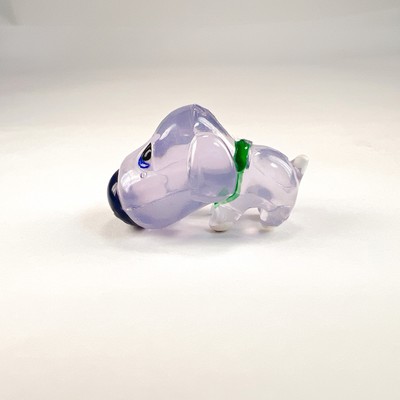
This mini figure is cast in hard plastic in the super-deformed (SD) style: proportions pushed toward a large round head over a compact, low body — the visual shorthand for cute that ran through Japanese collectibles of this era. The sculpt shows a small dog at rest, with large drooping ears, small white front paws, blue eyes with white highlights, a dark spherical nose, and a green molded collar. The ear shape and body type suggest a small-to-medium breed in the Basset or Cocker family, though the exact breed cannot be confirmed from the available information.
The defining feature of this particular version is the clear purple body. Translucent violet plastic forms the main figure, with opaque paint applied only to the facial details and collar. Clear color variants were a standard strategy in the Japanese capsule toy (gashapon) and food toy (shokugan) market of this period. Manufacturers treated these translucent versions as visually distinct alternatives to standard-color releases, designed to appeal to collectors tracking down the full run of a given set. Whether this figure originated in a gashapon machine or as a shokugan item is not confirmed from the available information, though both formats were used to distribute The Dog merchandise. Manufacturers with documented involvement in related lines include Yujin, Bandai, and Takara, though the maker of this specific piece cannot be verified without visible markings.
Why International Collectors Follow This Brand
The Dog Artlist Collection was not limited to Japan. Official licensed products reached markets across East and Southeast Asia — Taiwan, Hong Kong, and Korea among them — which gave the brand a cross-regional footprint unusual for character goods of its type. Collectors outside Japan often have existing familiarity with The Dog before encountering Japanese-origin examples.
More broadly, this figure sits at the intersection of several collecting interests that remain active today: early-2000s Japanese mini figures, kawaii character goods, specialty color variants, and the Y2K-era Japanese toy market as a whole — a period remembered for significant improvements in both gashapon and shokugan manufacturing quality, in terms of paint precision and molding detail alike. The clear purple coloring positions this piece as a visually distinct entry within the figure range, the kind of variant that reads differently from a standard-color version even at a glance.


Boxed and cushioned for the trip from Japan
$14.07
Ships internationally • More photos on the eBay listing