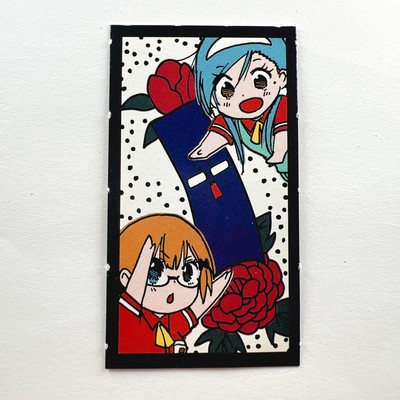
We Never Learn Jump Hanafuda Card (Rizu Ogata & Fumino Furuhashi)

Hanafuda: Japan’s Traditional Card Game, Reimagined
Hanafuda — “flower cards” in Japanese — is one of Japan’s oldest card-game traditions, with roots in the Edo period. A standard deck contains 48 cards split into twelve suits, each representing a month through a signature plant: pine for January, plum for February, cherry blossoms for March, and so on through paulownia in December. Games like Koi-Koi and Hachi-Hachi have kept the format in circulation for centuries. Nintendo itself began as a hanafuda manufacturer in the Meiji era before the company shifted toward electronics — a piece of context that gives the format an unusually long cultural shadow.
Shueisha’s Jump Hanafuda series keeps the traditional 48-card, twelve-suit structure intact while replacing the botanical motifs with characters from Weekly Shonen Jump properties. Naruto, One Piece, and Dragon Ball have all been given the treatment. This particular card appears to reference the November “willow” suit, specifically the design known as the Rain Man — in which a figure beneath a willow in the rain is the central image — reinterpreted here through Bokuben character art, with a small chibi-style figure, a red rose motif, and a blue rectangular element. Fine perforations along the card’s edges suggest it was punched out from a larger printed sheet, consistent with a magazine supplement, event giveaway, or boxed-product bonus, though the specific distribution format has not been confirmed. This is an officially licensed Shueisha product, not a fan-made or third-party item.
The Series and Its Characters
Bokutachi wa Benkyou ga Dekinai — published internationally by Viz Media as We Never Learn — ran in Weekly Shonen Jump from February 2017 to August 2020, collected into 21 volumes. Writer-artist Taishi Tsutsui built the story around Nariyuki Yuiga, a hard-working high school student who becomes tutor to two academically one-sided geniuses: Rizu Ogata, a math prodigy determined to study psychology instead, and Fumino Furuhashi, a gifted literature student with dreams of astrophysics. The comedy and romance come directly from the gap between where each character naturally excels and what she is actually chasing.
The series became widely discussed for its ending structure. Its final arc ran simultaneous “route” chapters, each concluding with a different heroine’s outcome in rotating installments — a format with almost no precedent in weekly serialized manga. Two anime seasons aired in 2019, produced by Brains Base and Studio Silver respectively, with multiple OVA releases also reaching audiences. The anime streamed internationally on Crunchyroll and related platforms.
Rizu Ogata — recognizable by her blue hair and characteristically neutral expression — and Fumino Furuhashi — orange-haired, bespectacled, with a poetic sensibility and a love of stars — were both central to that multi-route structure, and each carries a distinct fanbase. Having both characters together on a single card is an uncommon configuration for official merchandise tied to this title.
A Crossover With Its Own Cultural Logic
Jump Hanafuda occupies a specific position as merchandise that bridges traditional Japanese material culture and contemporary anime fandom. For collectors outside Japan, the hanafuda format carries cultural specificity with no direct Western equivalent, while the anime characters make the object immediately legible to anyone familiar with the series. The Bokuben merchandise window broadly aligned with the anime run in 2019 and 2020. With the series concluded and no longer in active publication, new official items are no longer entering production, and what circulated during that window reflects a specific, finished chapter in the title’s lifespan.


Shipped directly from Japan by a small shop
$10.78
Ships worldwide from Japan • Full photos and details on the listing