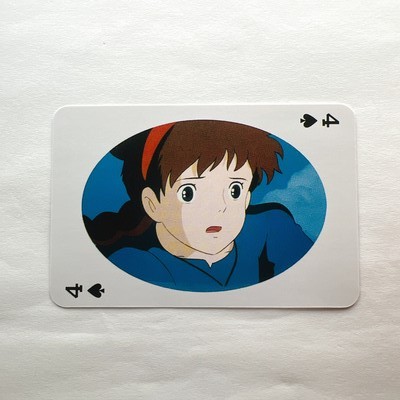
The Laputa Four of Spades Playing Card from Animage's 1986 Summer Issue

What This Card Is and the Film It Comes From
This is a single playing card — the Four of Spades (♠4) — from a deck produced in connection with Animage magazine’s 1986 summer issue. Animage was one of Japan’s leading monthly anime publications, launched in 1978 by Tokuma Shoten, and by the mid-1980s it sat at the center of Japanese anime fan culture. The card carries an illustration of Pazu, the male protagonist of Laputa: Castle in the Sky, shown with a surprised or concerned expression within an oval frame set against a blue background — the film’s visual character captured in the compact dimensions of a standard playing card.
The film was released in Japanese cinemas on August 2, 1986, directed by Hayao Miyazaki and produced by Studio Ghibli. It holds a specific place in Ghibli’s history: it was the studio’s first theatrical feature, given that Ghibli had only been founded the year before in 1985. (Miyazaki’s earlier Nausicaä of the Valley of the Wind was produced under a different studio.) This card’s connection to Animage’s 1986 summer issue puts it squarely in step with that theatrical release.
Playing Cards, Anime Magazines, and 1980s Japanese Fan Culture
In the 1980s, Japan’s anime magazines operated as full merchandise ecosystems, not just editorial publications. Animage ran reader giveaways, mail-order exclusives, and supplementary goods that gave fans tangible connections to the series they followed. Playing card sets were a practical and popular format in this era — affordable to produce, easy to distribute, and usable as everyday objects. Titles including Dragon Ball, Mobile Suit Gundam, and Saint Seiya all saw playing card sets during this period.
Whether this particular deck circulated as a magazine supplement, a reader prize, or a separately purchased item is not confirmed from the available information. What is established is that Tokuma Shoten — as both the publisher of Animage and the primary rights holder for Ghibli productions at the time — was the entity behind merchandise of this kind. Official overseas distribution for these goods did not exist; the Japan-exclusive nature of the item reflects the actual distribution reality of the period, not just a label.
Pazu and the Story Behind the Card
Pazu is a young mechanic’s apprentice living in a mining town, whose defining conviction is his belief in his late father’s photograph of a floating castle. When a girl named Sheeta falls from the sky at the story’s opening, the two are drawn into a shared adventure that leads them toward the legendary sky fortress of Laputa. He is the kind of protagonist that travels across cultural boundaries — resourceful, determined, and driven by personal loyalty rather than abstract heroism.
Laputa: Castle in the Sky had a modest initial box office performance in Japan, but built a lasting reputation through television broadcasts, home video, and international distribution. Disney released it in North America in 2003, bringing it to a wide English-speaking audience. It is now regarded internationally as a foundational Miyazaki work, and a card like this one — produced in its release year for a domestic Japanese readership — sits at the beginning of that long arc of recognition.


Comes straight from Japan — no middleman
$8.82
Ships internationally • More photos on the eBay listing