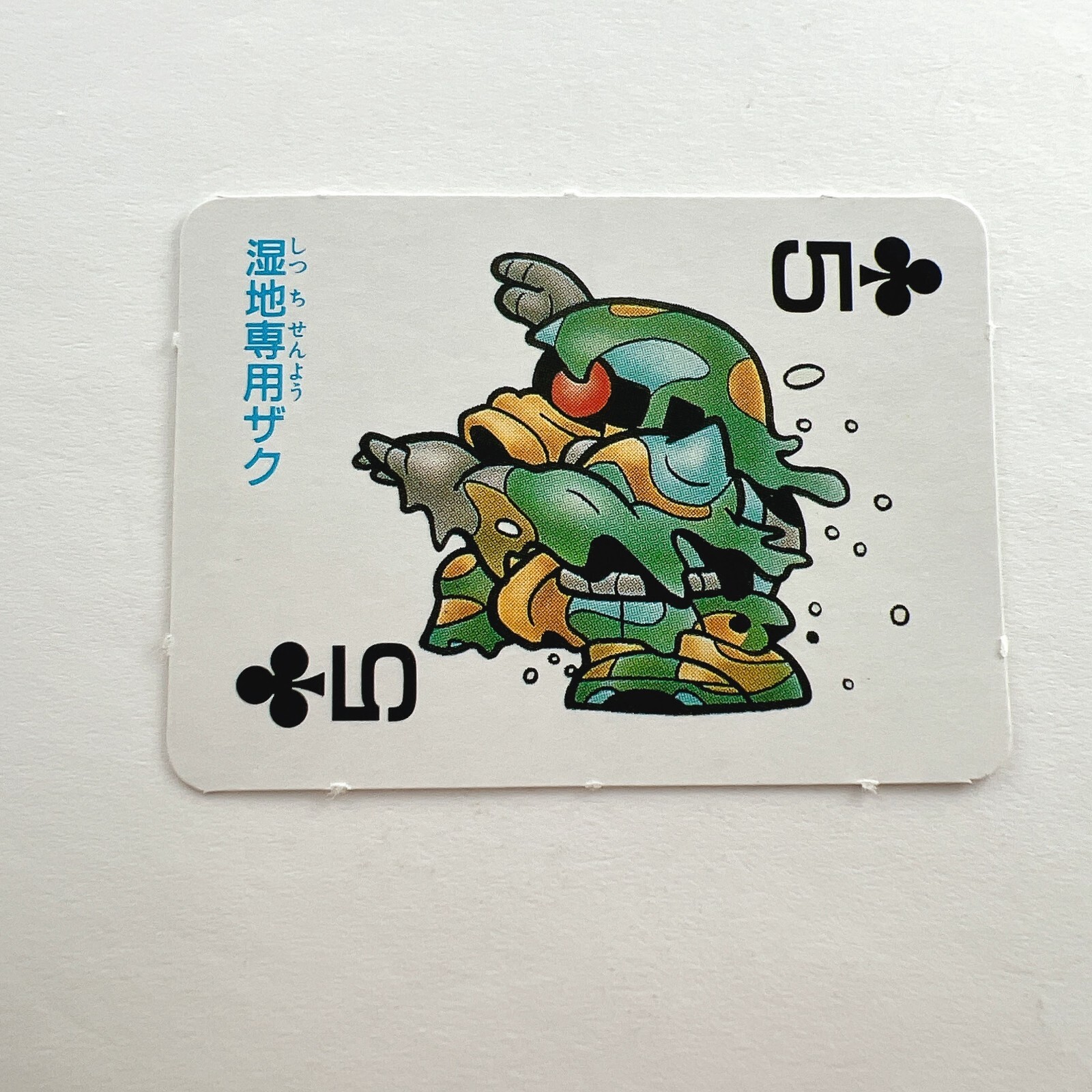
SD Gundam Swamp Type Zaku Playing Card, Comic BomBom 1990

A Free Insert at the Height of the SD Gundam Boom
This card is one piece from a playing-card deck sealed inside the February 1990 issue of Comic BomBom, a monthly children’s manga magazine published by Kodansha. It was never sold separately — only readers who bought that issue received the full set. A perforation mark along one edge shows it was bound into the magazine and meant to be punched out. The card is the five of clubs in what would have been a 52-to-54-card deck, depicting a Swamp Type Zaku in the SD Gundam style.
By 1990, SD Gundam — Bandai’s super-deformed spin-off of the Mobile Suit Gundam franchise — was at one of its commercial peaks. Bandai’s Carddass vending-machine cards had launched in 1988 and were enormously popular with children, and the BB Senshi model kit line was well established. Comic BomBom was the primary print home for SD Gundam manga, making a playing-card bonus featuring these characters a natural fit for the magazine’s audience.
The Zaku’s Swamp Variant and Gundam’s MSV Tradition
The Zaku is one of the most recognized designs in all of Gundam, first appearing in the original 1979 Sunrise television series as the mass-produced mobile suit of the Zeon military — the enemy faction. Over the decades, dozens of Zaku variants have been defined for specific environments and mission types.
The Swamp Type is one of those specialized variants, built for operation in wetlands and marshy terrain. Its exact model designation and origin are not fully certain, but the design fits squarely within the MSV (Mobile Suit Variation) tradition: a body of non-animated Gundam lore developed through model-kit releases and design documents in the 1980s that introduced many environment-adapted units never seen on screen. On this card, the suit appears in SD form with green and orange-yellow coloring and the red monoeye characteristic of Zaku-family designs.
Japanese Magazine Bonuses and How They Circulated
Through the 1980s and 1990s, Japanese children’s magazines competed intensely for readers, and the quality of a given issue’s bonus insert was a genuine selling point. Comic BomBom and its rival Corocoro Comic both bundled stickers, cards, and small toys alongside their manga pages. Playing cards made a practical bonus format because a single deck could feature dozens of different characters at once, giving readers a broad snapshot of an entire franchise’s cast.
Because these decks came free with a magazine rather than as standalone purchases, individual cards often became separated from sets over time, and complete decks are rarely preserved intact. The SD Gundam franchise in 1990 was also almost entirely domestic — the style had not yet been seriously exported — giving surviving pieces a distinctly Japan-origin character. For fans of Gundam’s mecha design tradition, particularly the Zaku’s many lesser-known variants, a card like this is a small, tangible document of the franchise’s most commercially active years.


Shipped directly from Japan by a small shop
$8.82
Ships worldwide from Japan • Full photos and details on the listing