Kinnikuman Vintage Menko Card from the 1983–1986 Anime Era

A Traditional Japanese Game Card from the Anime Boom
Before trading cards ruled schoolyard culture, Japanese children played menko — thick paper cards hurled against the ground, the goal being to flip an opponent’s card face-up. The game has roots in the Edo period, but during the 1980s it found a second life when manufacturers began producing character menko printed with popular anime and manga figures. These were sold at dagashi-ya, the small neighborhood candy-and-toy shops that were central to childhood in Showa-era Japan. They were cheap, made to be played with, and designed with no thought of preservation — which is why examples that survived the decade in good condition are relatively uncommon.
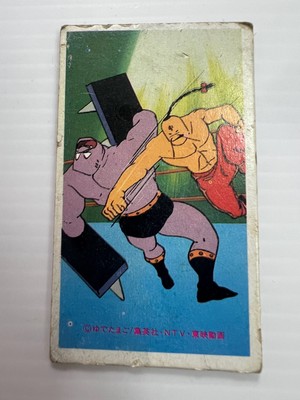
This card’s copyright notice — © Yudetamago / Shueisha / NTV / Toei Doga — places it clearly within the Kinnikuman television anime period, which ran from 1983 to 1986 on Nippon Television. That credit line is the standard marking on officially licensed Kinnikuman merchandise from those years. The specific printing manufacturer is not identifiable from the card face alone; the menko market of the 1980s involved multiple small printing and toy firms alongside better-known names like Amada, and determining the maker would require examining the card’s reverse.
Kinnikuman, Buffaloman, and the Arc That Defined a Generation
Kinnikuman began in 1979 as a manga in Weekly Shonen Jump, created by the pair known as Yudetamago. Its setup — a bumbling alien superhero who discovers his calling in professional wrestling — leaned into absurdist comedy, but the story evolved into increasingly intense tournament drama. The Toei Doga anime adaptation, airing 1983 to 1986, brought the series to a far wider audience and drove the wave of merchandise this card was part of.
The two characters depicted here sit at the center of one of the series’ most remembered rivalries. Kinnikuman is recognizable by his orange complexion and topknot; Buffaloman — one of the most formidable of the Demon Supermen — is the imposing figure bearing buffalo horns, credited with a power rating of 10 million, a number so extreme it became a defining part of his legend. Their confrontation stands as one of the high points of the Twenty Demon Supermen arc, which played out across both manga and anime. The pairing was reproduced frequently on menko, erasers, and other goods of the period. Buffaloman carries particular weight for longtime fans because his role in the story doesn’t stay fixed: introduced as a pure antagonist, his later appearances in the narrative give him a more complicated position — part of what makes him one of the series’ most discussed characters.
A Menko Card and Its Place in Showa Collector Culture
Kinnikuman reached international audiences from the mid-1980s onward through M.U.S.C.L.E., the Mattel toy line that adapted the franchise’s rubber eraser figures — known in Japan as Kinkeshi — for North American children starting in 1985. A later anime series also aired in English-speaking markets as Ultimate Muscle. The result is an international fanbase for whom characters like Buffaloman carry genuine recognition, not just as curiosities but as figures from a story they already know.
Menko occupy a distinct space within that collecting world. Unlike Kinkeshi or later trading cards, they are straightforwardly paper — printed on simple card stock, sold for pocket change at dagashi-ya, and built to be played rough. The edge fraying, rounded corners, and surface wear visible on a card like this are the natural outcome of a card that was actually used during the 1980s. For collectors of Showa-era anime goods, those signs of age and play are part of the context that makes a piece like this legible as a genuine artifact of that time rather than a reproduction of it.

Found in Japan, packed by hand, sent worldwide
$8.15
Worldwide delivery from Japan • See the listing for condition and size