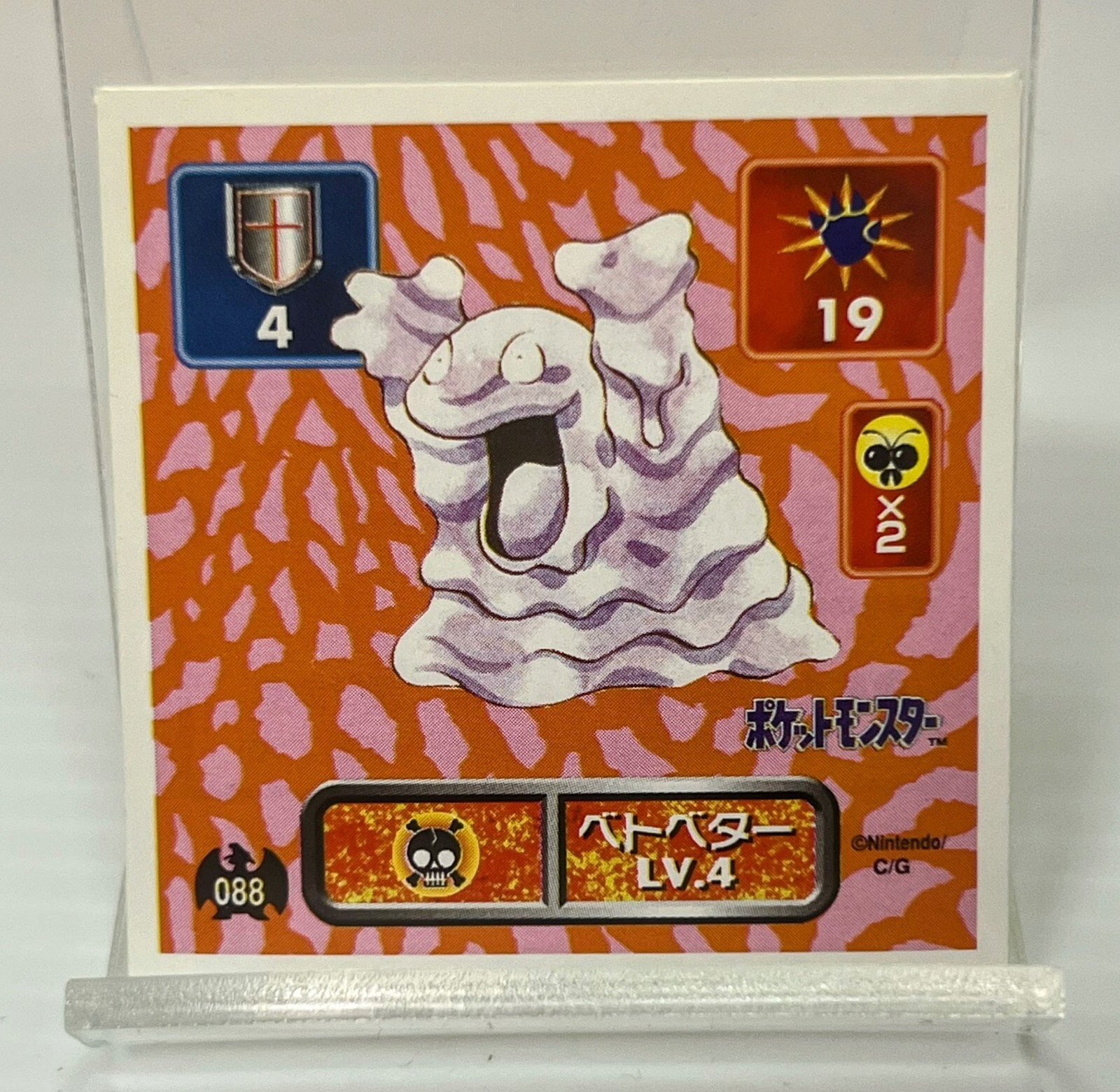
Grimer No.88 Amada Pokemon Sticker (1996)

A Sticker Designed Like a Battle Card
This is a licensed character sticker produced by the Japanese toy and stationery company Amada in 1996. It depicts Grimer — Pokedex No.088 — and sits within a numbered series that follows the original Pokemon Pokedex order, so No.88 corresponds directly to Grimer’s entry in the games.
What distinguishes this from a simple illustrated sticker is the layout. The design incorporates a level indicator (LV.4), a shield icon, a skull icon, a starburst, and an image of a small winged creature, all arranged around the central Grimer illustration. The effect is closer to a miniature game card than a decorative label — a visual approach that deliberately echoes the battle mechanics players were exploring in the Game Boy games at the same time. The copyright line reads ©Nintendo/C/G, the standard notation for the three-way partnership between Nintendo, Creatures Inc., and Game Freak that authorized all official Pokemon merchandise from the franchise’s earliest days.
Amada and Pokemon’s First Merchandise Wave
Pokemon arrived in Japan on February 27, 1996, as a pair of Game Boy RPGs — Pokemon Red and Green — developed by Game Freak and published by Nintendo. Merchandise began reaching stores almost immediately, though whether this particular sticker was on shelves before, alongside, or shortly after the game launch is not something the available information allows us to state with certainty.
What is documented is that 1996-dated Amada stickers belong to the earliest known wave of Pokemon merchandise. Amada had been producing licensed sticker and mini-card products for major Japanese franchises through the 1980s and into the 1990s — Dragon Ball, Saint Seiya, and others — and was well-positioned to enter the Pokemon market from the start. Their numbered Pokemon sticker series assigned each entry a number matching its Pokedex position, making the full set of 151 naturally appealing to completionist collectors.
This was all happening before the Pokemon anime began airing in April 1997, before the trading card game launched in October 1996, and long before Pokemon reached Western markets with the 1998–1999 international release of Red and Blue. At the time these stickers were made, Pokemon existed only in Japan. The merchandise reflected that context — domestic products made for a domestic audience, before global distribution and standardization reshaped the franchise’s visual identity into the form the rest of the world came to know.
Grimer’s Place in the Generation I Lineup
Grimer is a Poison-type Pokemon from the original 151, depicted as a formless purple slime said to have emerged from urban waste and industrial runoff. It evolves into Muk (#089). In the Game Boy titles, Grimer appeared in areas like Cinnabar Island and near Lavender Town as a wild encounter — not rare, not story-critical, but a consistent presence in the original games. The anime gave it supporting appearances without placing it at the center of any storyline.
Within collector culture, Grimer’s appeal is bound up in the completeness of the Generation I roster. For anyone who grew up with the international release of Pokemon, the original 151 carry a particular weight, and Japanese-market merchandise from 1996 represents a phase of the franchise that Western audiences never directly experienced. Items from that window — before the anime, before the card game, before the overseas launch — carry the specific character of that moment: busy, energetic graphic design with layered icons and game-stat references, a visual aesthetic that belonged entirely to the first year Pokemon existed.

Listed in our eBay store and sent from Japan
$8.15
International shipping available • Ask us anything before you buy