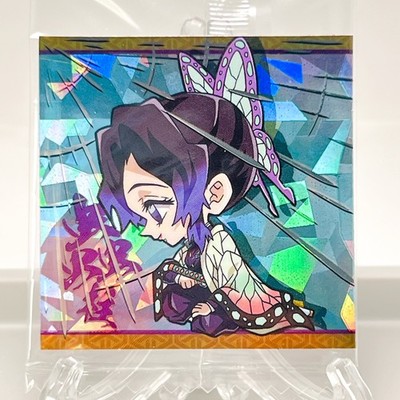
Shinobu Kocho Niformation Deformed Sticker (6-16) from Demon Slayer: Kimetsu no Yaiba

What the Niformation Series Is
The Niformation line is a series of holographic deformed stickers — in Japanese collecting culture, “deformed” (or chibi) describes an art style that compresses a character down to roughly two or three heads tall, producing a compact, exaggerated version of the original design. Each sticker in the series is finished with a holographic film that produces shifting rainbow and geometric patterns depending on the angle of the light. The code “6-16” identifies this piece as the sixteenth release in the sixth wave of the series — a numbered structure common to Japanese collectible lines that gives collectors a clear framework for tracking what exists across each wave. The manufacturer behind the Niformation series is widely understood to be Bandai, Japan’s largest character goods producer, though that attribution has not been confirmed from the listing alone.
This kind of product sits within a collecting tradition that stretches back to Bikkuriman stickers, first released by Lotte around 1977, which laid the groundwork for the hologram foil, rarity tiers, and wave-based collecting logic still visible in products today. Modern deformed stickers reach collectors through several channels — food toy inserts, gashapon capsule machines, or single-unit retail — though the exact distribution format for the Niformation series is not confirmed from the listing. The sticker is stored in a clear protective sleeve, the standard handling method among Japanese collectors for keeping the surface intact.
The Character and the Franchise Behind It
Demon Slayer: Kimetsu no Yaiba, the manga by Koyoharu Gotouge, ran in Weekly Shonen Jump from February 2016 through May 2020, concluding at 23 volumes. The anime adaptation by ufotable began airing in 2019, and the 2020 theatrical film Mugen Train broke Japanese box-office records with earnings of approximately 40.4 billion yen. At its peak between 2020 and 2021 the franchise reached social-phenomenon status in Japan, with character merchandise from multiple manufacturers filling convenience stores, toy shops, and checkout displays nationwide. International audiences have come to know it through streaming platforms including Netflix and Crunchyroll.
Shinobu Kocho holds the rank of Insect Hashira (Mushi Hashira), one of the elite Pillars of the Demon Slayer Corps — the highest tier a slayer can reach. Her fighting method is unlike any other Pillar’s: rather than severing a demon’s head, she injects them with a poison derived from wisteria flowers, a technique she developed precisely because her physical strength alone cannot deliver a killing blow by conventional means. Visually she is one of the most distinctive figures in the series — purple-black hair, butterfly hair ornaments, and a haori in a gradient of white, blue-green, and pink with butterfly patterning that represents her Insect Breathing style. She is almost always shown with a quiet, composed smile. This sticker’s background incorporates the kanji for Mushi Hashira, reinforcing her identity within the design itself.
Why the Character and Format Appeal to Collectors Worldwide
Shinobu Kocho ranks consistently among the most popular characters in the franchise across fan polls, and her butterfly-driven visual design transfers well into collectible formats. In fan communities across North America, Europe, and Southeast Asia she is one of the most recognizable figures from the series, with a strong presence in cosplay and fan art. The holographic sticker format is familiar territory for collectors outside Japan who follow foil-finish trading cards in sports or gaming — the shift-with-light effect is immediately understood as a quality finish. Products like this one were produced for the Japanese domestic market during the height of the Demon Slayer boom, most likely somewhere in the 2020–2023 window, though the precise release date for this particular wave has not been officially confirmed. The numbered series structure — wave six, piece sixteen — reflects the systematic logic that leads collectors to seek out every entry in a run.


Found in Japan, packed by hand, sent worldwide
$9.65
Worldwide delivery from Japan • See the listing for condition and size