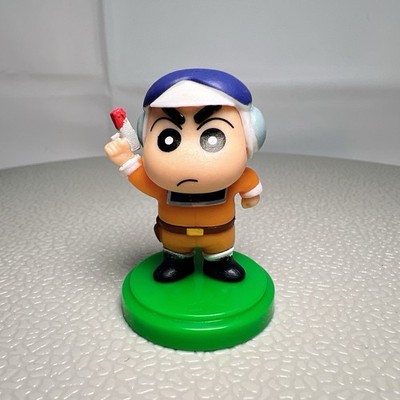
Shinnosuke Nohara in the Kasukabe Defense Uniform — Furuta Choco Egg Figure

The Series, the Hero, and the Film That Made History
Crayon Shin-chan follows Shinnosuke Nohara, a five-year-old living in Kasukabe, Saitama, whose cheerfully reckless approach to life has made him one of Japan’s most enduring animated characters. Manga artist Yoshito Usui launched the series in 1990 in the weekly magazine Weekly Manga Action, and the television anime began airing on TV Asahi in April 1992 — a run that has continued for more than thirty years. Annual theatrical films, released each spring since 1993, became a fixture of the Japanese holiday calendar.
This figure is tied to the ninth of those theatrical films, released on April 21, 2001, and directed by Keiichi Hara. The story pits Shinnosuke and his young friends against a secretive adult organization fixated on pulling Japan back into a nostalgic recreation of the Showa era. To fight back, the children form the Kasukabe Defense Force and don their now-iconic uniforms: orange jumpsuits with brown belts, black boots, blue-and-white caps, light-blue earmuffs, and white toy rifles tipped in red. That is precisely the costume this Furuta figure recreates, right down to the expressive face that has always defined Shinnosuke’s look.
The film is widely regarded in Japan — and increasingly by anime fans abroad — as a work that far exceeds its surface appearance as a children’s comedy. Its themes of Showa nostalgia, high-growth-era mythology, and the emotional distance between childhood and adult memory have placed it near the top of Japanese animation rankings for over two decades. It regularly appears alongside titles aimed squarely at adult audiences, treated as a serious work of cinema on its own terms.
Choco Egg and Japan’s Shokugan Collecting Culture
Shokugan — short for shokuhin gangu, or “food toy” — refers to small collectibles sold alongside a piece of candy or snack. The format developed in Japan into its own distinct collecting genre, with an emphasis on careful sculpting at a very small scale. Furuta Seika, an Osaka-based confectionery company, made Choco Egg its flagship product in this space: each egg-shaped chocolate contained a sealed capsule, and the figure inside was unknown until the egg was opened. This blind-box approach produced completionist collectors who sought out every variant in a set, and it built a lively secondary market for individual pieces.
Furuta’s figure work earned genuine respect within the hobby. The round, bright-green base is a recognizable signature across the Choco Egg line, and the level of facial detail the sculptors achieved at this scale became a benchmark for what food-toy production could accomplish. Furuta produced multiple Crayon Shin-chan series under license, and this figure is believed to date from around the time of the 2001 film’s release — though the exact series number and month cannot be confirmed from available information alone.
The peak of the Choco Egg boom fell roughly between 1999 and 2001, a period when Furuta and competitors including Bandai were producing food-toy lines at a remarkable pace. Distribution was almost entirely domestic, which means that original Japanese examples now reach international collectors primarily through individual sellers rather than organized export channels. Crayon Shin-chan’s long broadcast history across East and Southeast Asia — and its growing visibility elsewhere through streaming — gives this figure a recognizable context well beyond Japan.


Boxed and cushioned for the trip from Japan
$14.07
Ships worldwide from Japan • Full photos and details on the listing
