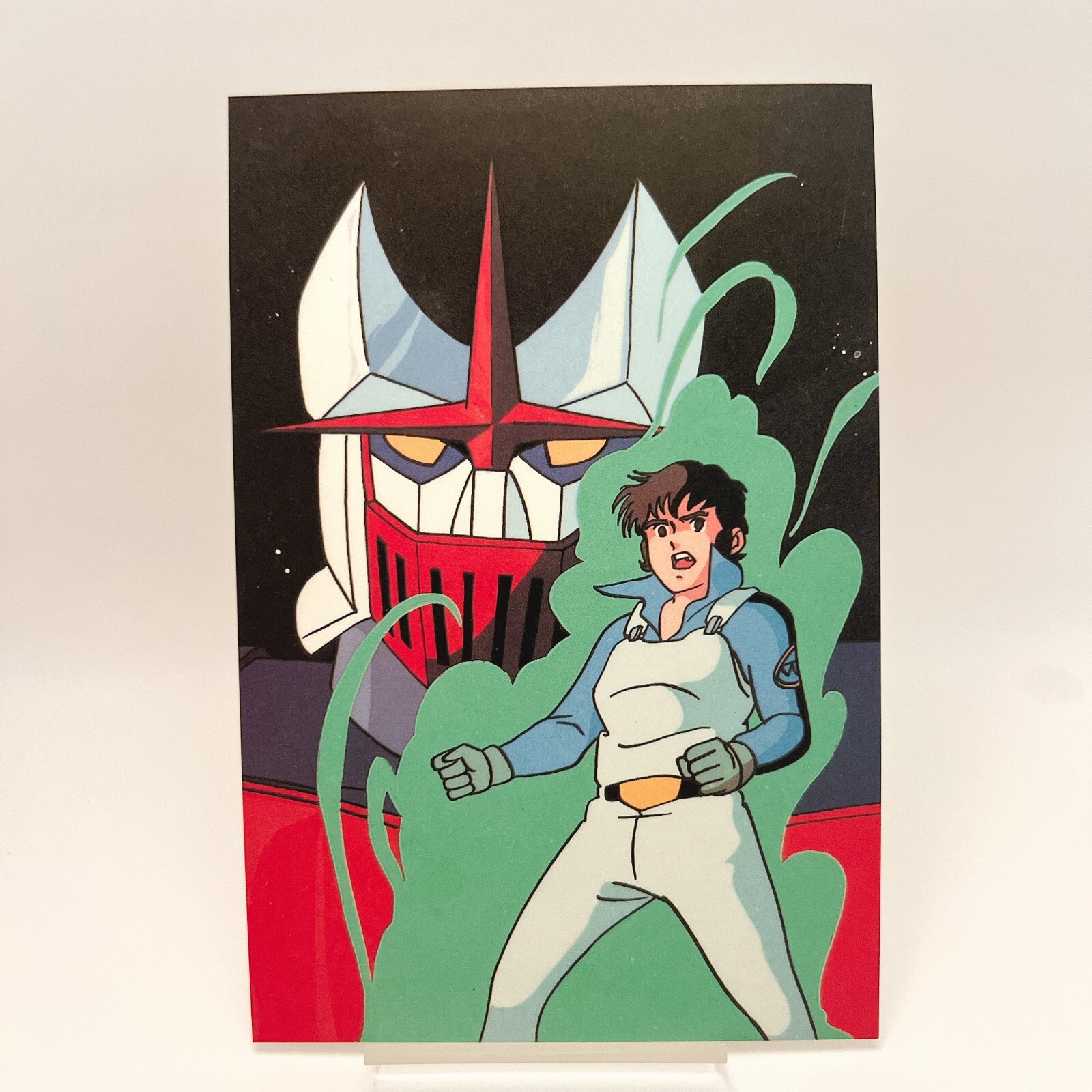
Psycho Armor Govarian — 1984 Animage Furoku Postcard

A Psychic Robot and Its Magazine Origins
Psycho Armor Govarian was a television anime that aired on TV Tokyo from July to December 1983, running for 26 episodes. Produced by Knack Productions, it told the story of Isato Kusanagi, a boy with extraordinary psychic abilities who uses those powers to summon and pilot Govarian — a giant humanoid mecha — against the invading Galadian Empire. What set the show apart from other robot anime of the era was its central premise: rather than operating the robot through conventional controls, Isato mentally manifests Govarian through sheer psychic force. The mecha itself, rendered in red, white, and blue with distinctive red spikes on its head and a grid-pattern face, became the visual signature of a series that blended science fiction, psychic powers, and Earth-defense action into a self-contained 26-episode run.
This postcard was distributed in 1984 as a furoku — a physical supplement bundled with an issue of Animage magazine — roughly half a year after the series concluded. It was never sold separately. Animage, published by Tokuma Shoten and launched in 1978, was already one of Japan’s most widely-read anime magazines by the mid-1980s. The postcard carries artwork from the series in the hand-drawn cel illustration style that defined anime production before digital tools changed the medium.
Furoku and the Culture of the Magazine Supplement
The furoku tradition is deeply rooted in Japanese publishing: for generations, magazines across every genre bundled free physical extras into their issues, and readers came to expect them. For anime fans in the 1980s, the quality of a magazine’s furoku was often the deciding factor in which issue they bought. Animage and its rivals ran a competitive arms race with these inserts — producing postcards, sticker sheets, bromide photo cards, posters, and desk mats week after week throughout the decade.
The 1984 Govarian postcard sits squarely in this tradition. It is a magazine-exclusive in the strictest sense: no retail equivalent existed, no standalone version was released, and no reprint followed. A reader who wanted it had to have the right issue of Animage in hand. Once the magazine was passed on or discarded — which happened to most of them — the postcard typically went with it.
Why This Era and This Item Draw Collectors
For collectors focused on 1980s Japanese animation, the appeal here works on several levels. Govarian is a complete, 26-episode series — a bounded object, unlike sprawling long-running franchises that can feel impossible to collect in any meaningful way. The show belongs to the robot anime boom of the early-to-mid 1980s, a period when Macross and Dunbine were commanding major attention, and dozens of other series were simultaneously shaping the era alongside them. Govarian occupies that landscape as its own distinct voice.
Animage itself carries additional weight internationally: it is the publication that serialized Hayao Miyazaki’s Nausicaa of the Valley of the Wind manga and played a central role in championing the film adaptation. That history has made the magazine’s name recognizable well beyond Japan, and it lends the magazine’s associated ephemera — including its furoku — a degree of crossover recognition among fans who might otherwise be unfamiliar with Govarian specifically.
The artwork on items like this postcard is also increasingly appreciated on its own terms. The dense, warm visual language of Showa-era hand-drawn anime illustration is a style that predates and differs substantially from digital production, and physical print items carrying that artwork are considered difficult to find in good condition — they were stored folded inside magazines, shelved, and more often than not eventually lost.

Shipped directly from Japan by a small shop
$9.65
Ships worldwide from Japan • Full photos and details on the listing