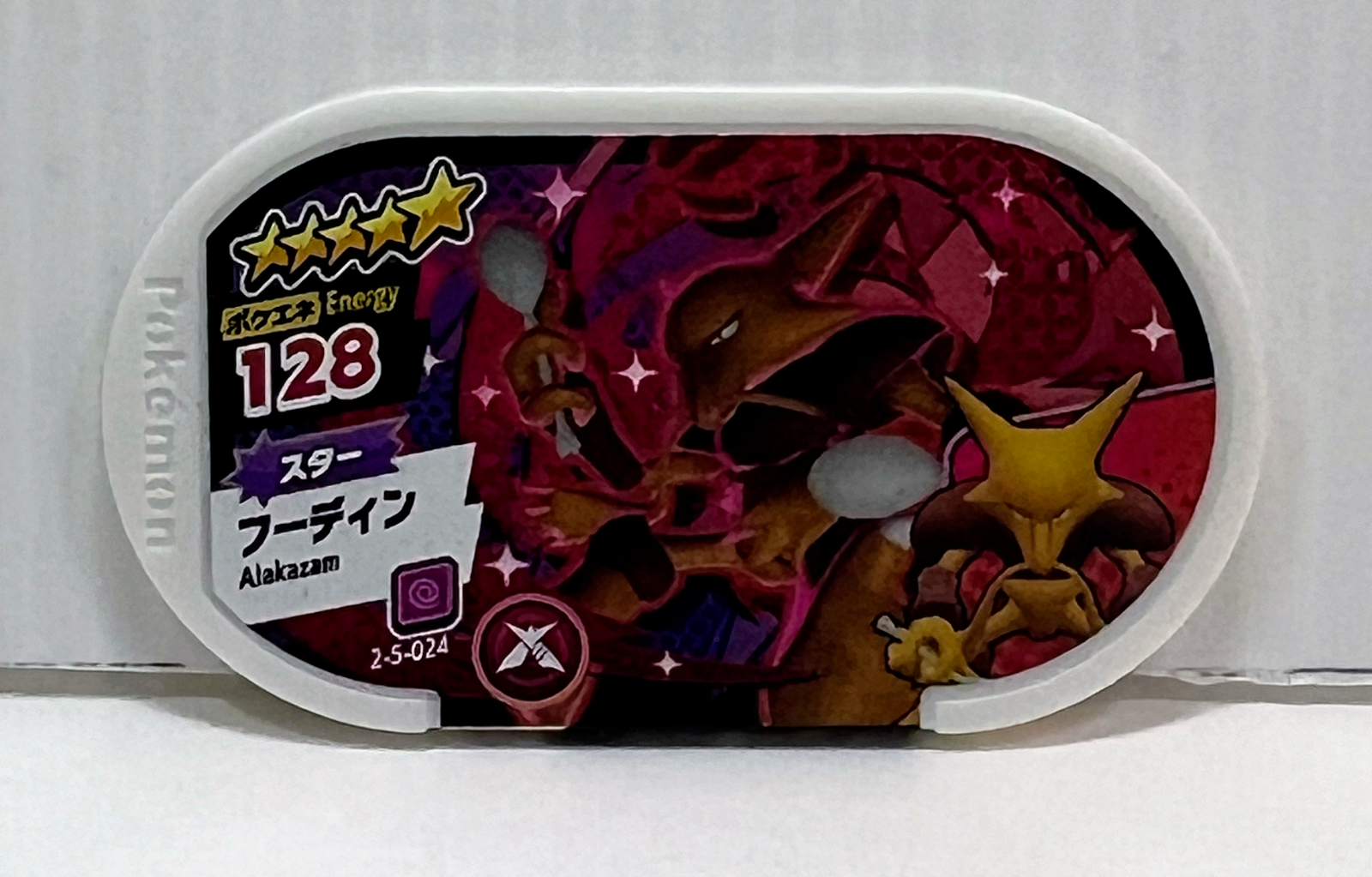
Alakazam Pokemon Mezastar Tag, 5 Star — Japan Arcade Collectible Explained

What Is a Pokemon Mezastar Tag?
Pokemon Mezastar is a Japanese arcade game series developed by Takaratomy A.R.T.S. under license from The Pokemon Company. Launched in July 2020, it built on the foundations of its predecessor, Pokemon Ga-Ole (which began in 2016), while introducing higher-resolution artwork and expanded battle mechanics. Players insert coins at arcade machines found in Japanese game centers and amusement facilities, play a round, and receive a physical plastic tag as output — part gameplay token, part collectible object.
Each tag is oval-shaped, durable plastic, and printed with in-game stats: this Alakazam tag displays a Psychic-type icon in purple, an attack icon, and a Poke Energy value of 128. The code 2-5-024 identifies it as belonging to the second series of Mezastar releases, placing it approximately in the 2021–2022 period, though the exact release month cannot be confirmed from available information. The 5-star (5★) rating represents the highest rarity tier within the Mezastar system. Tags at this level are produced at lower rates from arcade machines, and they feature distinctively bold, large-scale artwork that sets them apart from standard-rarity tags.
Because Mezastar machines exist only in Japan, there is no official distribution channel outside the country. Everything that reaches international collectors passes through the Japanese secondary market.
Alakazam: A First-Generation Icon
Alakazam is National Pokedex No. 065, a Psychic-type Pokemon introduced in the original Pocket Monsters Red and Green (Nintendo / Game Freak, 1996). It is the final stage of a three-part evolution line: Abra evolves into Kadabra, and Kadabra evolves into Alakazam — but only through an in-game trade with another player, a mechanic that has kept this Pokemon relatively hard to obtain throughout the series’ history. Its signature look — twin spoons, a commanding posture, and a design built around raw mental power — made it one of the standout characters of the Kanto generation alongside names like Gengar and Arbok.
In 2013, Pokemon X and Y introduced Mega Alakazam, a form that substantially raises its Speed and Special Attack stats, giving the character renewed prominence in competitive play. The artwork on this 5-star Mezastar tag depicts Alakazam in an imposing, large-scale composition typical of high-rarity tags. The research notes flag a possibility that the pose may reference a Gigantamax form, but no official Gigantamax Alakazam has been confirmed in the mainline games — the dramatic scale is most likely a stylistic choice specific to Mezastar’s premium-tier art direction.
Why International Pokemon Collectors Pay Attention to Mezastar
The Mezastar format occupies a genuinely distinct space in Pokemon collecting. It is not a trading card, not a figure, and not a capsule toy — it sits at the intersection of arcade gaming culture and physical collectibles, a combination that has deep roots in Japan but very little presence elsewhere. For collectors who grew up with Alakazam in the late 1990s and early 2000s, a Japan-exclusive arcade item featuring one of the original 151 Pokemon in a high-rarity format represents a category of object that simply cannot be acquired through any domestic retail channel. That structural inaccessibility, combined with the Psychic-type’s enduring reputation in the Pokemon franchise, is what drives sustained interest from collectors outside Japan.

Price: $9.59 | View on eBay