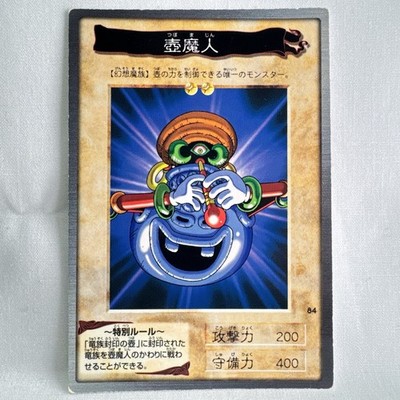
Bandai Carddass Yu-Gi-Oh Part 3, No. 84: Morinphen

A Trading Card That Predates the Game You Know
Before Konami’s Yu-Gi-Oh Official Card Game became the globally recognized phenomenon most fans know today, Bandai held the franchise license and produced their own Yu-Gi-Oh trading cards through Carddass — their vending machine card brand that had been running since 1988. Dragon Ball and Saint Seiya were early pillars of the format; Yu-Gi-Oh arrived near its peak. This card, No. 84 from Part 3, features the monster Morinphen and dates to approximately 1999.
The Bandai Yu-Gi-Oh Carddass series ran across several waves — Part 1, Part 2, Part 3, and later EX sets — spanning roughly 1998 to 1999. Konami’s OCG launched in Japan in February 1999, briefly overlapping before Bandai exited the market entirely. Despite sharing a franchise name and artwork, these are separate games with different rules and no cross-compatibility. The Carddass format itself was straightforward: dedicated vending machines at convenience stores, toy shops, and candy stores across Japan dispensed one card per coin, with rarity randomized to fuel the collect-them-all impulse.
Morinphen: A Monster From the Franchise’s Earliest Chapters
Morinphen is classified in Bandai’s system as an Illusionary Fiend. Visually, it’s a round, compact creature with a bluish tint, three eyes, a wide grin, a striped brown hat, white gloves, green ring-shaped armbands, and a red pipe — whimsical and slightly unsettling in the way many early Yu-Gi-Oh monsters tend to be. Its stats are modest at 200 attack and 400 defense, placing it firmly among the weaker monsters in any context. The card also notes a specific interaction with a spell called “Dragon Sealing Scroll,” which restricts Dragon-type monsters. Rather than leaving such rules to a separate rulebook, Bandai printed combo notes like this directly onto individual cards — one of many ways the system differed from what Konami later built.
Morinphen appears in Kazuki Takahashi’s original manga, which ran in Weekly Shonen Jump from 1996 to 2004, establishing it as one of the monsters present in the franchise’s earliest chapters.
What Sets the Bandai Series Apart for Collectors
The Bandai Yu-Gi-Oh Carddass cards were sold exclusively in Japan with no official international release and no English-language versions. For collectors outside Japan, acquiring one means sourcing directly from the Japanese market. The silver metallic border on this card corresponds to an upper rarity tier within the Bandai series, visually distinguishing it from standard cards in the same set. Part 3 being the third wave of the run gives anyone assembling a complete series a precise sense of where this card belongs in the lineup.
For Yu-Gi-Oh enthusiasts, the Bandai cards represent the franchise before Konami established the rules, formats, and worldwide competitive structure that define the game today. They capture a brief, specific moment in 1990s Japanese pop culture — when a manga still in its early years was already being translated into vending machine cards at corner stores across the country, years before the rest of the world had any idea the franchise existed.


Sleeved and rigid-mailed before it leaves Japan
$8.82
Worldwide delivery from Japan • See the listing for condition and size