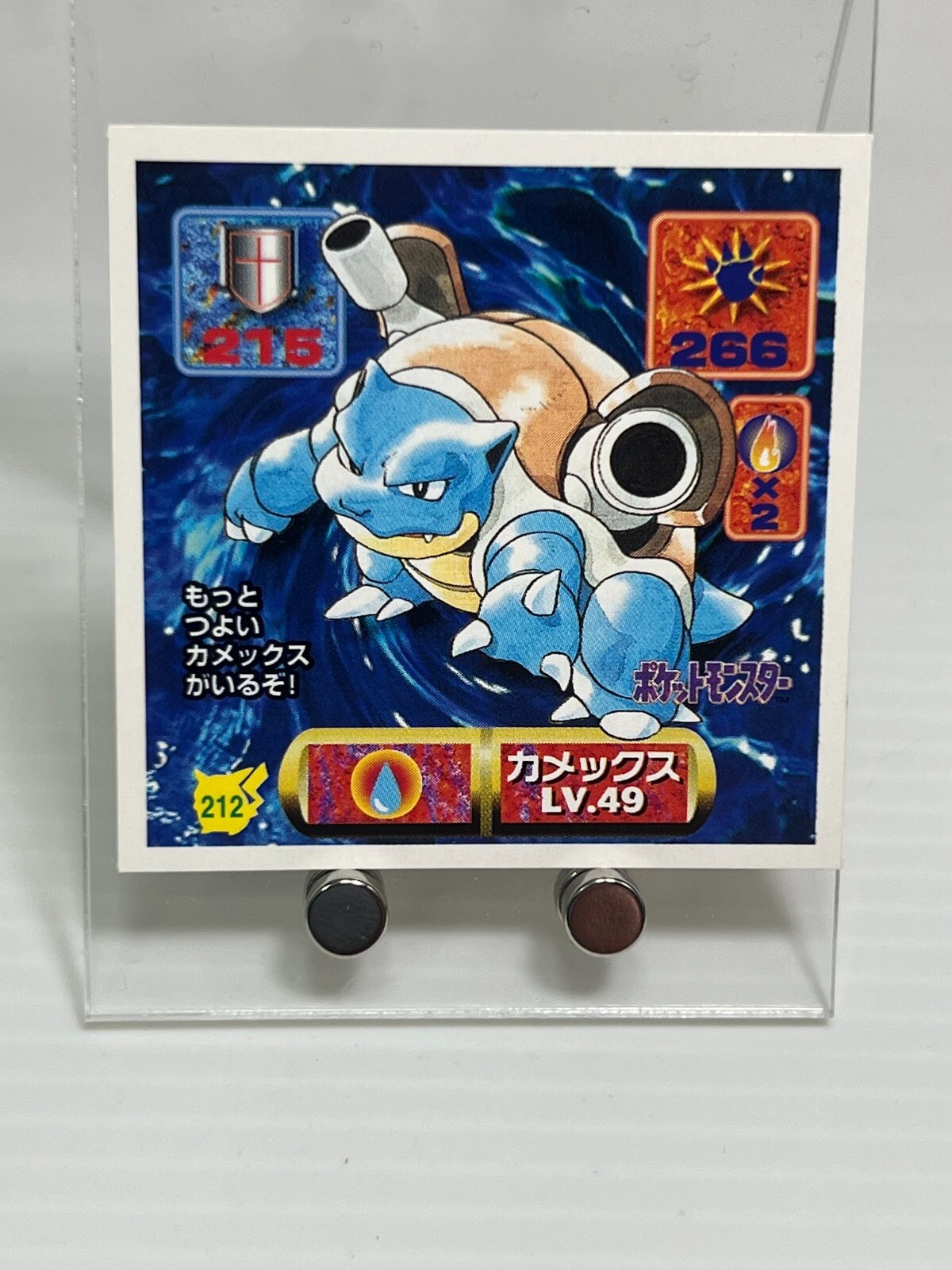
Blastoise No.212 — Amada Pokemon PP Card Sticker (1997)

A PP Card From the Year Pokemon Went National
In February 1996, Game Freak’s Pokemon Red and Green launched on the Game Boy in Japan. By April 1997, the anime was airing on TV Tokyo, and a full wave of licensed merchandise had already spread through corner shops, convenience stores, and candy stalls across the country. This sticker is a direct product of that moment.
Amada — formally Amada Co., Ltd. — was a Japanese printing and sticker specialist that spent the 1990s licensing major anime properties, including Dragon Ball, Sailor Moon, and Pokemon. Their Pokemon PP Card series ran from roughly 1996 through 1999, producing individual sticker cards numbered well into the hundreds. The “PP” likely abbreviates “Pocket Pocket” or “Pocket Monsters Premium,” though the full meaning was never officially confirmed. No.212 places this card in the extended middle of that run, squarely within the first generation’s peak commercial years.
These stickers belonged to Japan’s shokugan tradition — small collectibles sold alongside candy or gum at shops and kiosks. The PP Cards specifically took the form of vinyl stickers formatted to resemble game stat cards: each one shows a character portrait, level, type icon, weakness indicator, and a short flavor text caption in Japanese. The format is entirely separate from the official Pokemon Trading Card Game that Wizards of the Coast later brought to the West; Amada’s line was a parallel, independently conceived collectible series.
Blastoise: The Water Cannon Starter
Blastoise — Kamex in Japanese — is the final evolution of Squirtle, one of the three partner Pokemon available at the start of Red and Green. Its defining design feature, a pair of high-pressure water cannons built into its shell, made it one of the iconic images of the first generation alongside Charizard and Pikachu.
On this sticker, Blastoise is displayed at Level 49, the standard level Amada assigned to Kamex across the PP Card format. The weakness listed is “Fire x2” — which doesn’t match the mainline game mechanics, where Blastoise as a Water type is actually vulnerable to Grass and Electric moves. This appears to be a quirk of Amada’s own internal format rather than an error, and it’s exactly the kind of detail that distinguishes PP Cards as artifacts in their own right rather than simple spin-offs of the TCG.
The flavor text on the card reads “Motto tsuyoi Kamex ga iru zo!” — roughly, “There’s an even stronger Blastoise out there!” — a punchy caption style typical of the PP Card line.
Why First-Generation Collectors Pay Attention
The 1997 manufacture date is meaningful in context. North American audiences received Pokemon Red and Blue in 1998, and the anime the same year — meaning this sticker predates the Western launch of the franchise entirely. For collectors focused on first-generation merchandise, that gap matters. This is a product of the original Japanese Pokemon boom, made for a domestic market before the IP became a global institution.
Within the international Pokemon collecting community, Amada PP Cards are recognized as a distinct category. Communities like Reddit’s r/pkmncollectors treat the series as a standalone collecting genre, valued for its unusual card-like format, its Japanese-language aesthetic, and its place in the earliest and most frenetic period of Pokemon merchandising — when the phenomenon was still entirely Japanese and the rest of the world hadn’t yet caught on.

Shipped directly from Japan by a small shop
$7.86
Ships worldwide from Japan • Full photos and details on the listing