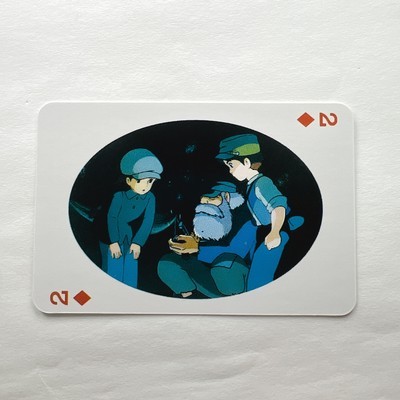
The 2 of Diamonds from the 1986 Laputa Animage Playing Card Set

This is a single playing card — the 2 of Diamonds — from an official set produced in connection with the Japanese anime magazine Animage during the summer of 1986. The card follows standard playing card layout: suit mark and numeral in the corners, and a piece of original character artwork centered within an oval frame. The franchise it comes from is Laputa: Castle in the Sky, and the timing of its production places it directly alongside the film’s original theatrical release.
Uncle Pom and the Flying Stone, Framed in an Oval
The illustration on this card shows a white-bearded elderly man seated at the center, with two younger men standing on either side of him, all set against a dark, enclosed underground space. This composition matches closely with a scene involving Uncle Pom — a solitary old miner who lives deep underground and, in one of the film’s quieter and more memorable moments, makes a flying stone glow in the darkness to show Pazu and Sheeta what it truly is. The dark confined setting and the white beard align with that character and that scene. One of the standing figures is most likely Pazu, the film’s young male lead; the second figure is harder to identify with certainty. Whether the artwork directly recreates a moment from the film or was drawn as original merchandise art is not confirmed, but it is clearly rendered in the hand-drawn animation style characteristic of 1980s Miyazaki-era production.
The Film That Launched Studio Ghibli
Laputa: Castle in the Sky (Japanese title: Tenkuu no Shiro Laputa) was directed by Hayao Miyazaki and distributed by Toho, opening in Japanese theaters on April 2, 1986. It holds a specific historical distinction: it was the first feature-length theatrical film produced by Studio Ghibli, which had been founded only the previous year, in June 1985. The score was composed by Joe Hisaishi. The story follows two children — Pazu and Sheeta — searching for a legendary floating island, drawing on Jonathan Swift’s flying island from Gulliver’s Travels as a departure point for an entirely original adventure. The film became the commercial and creative foundation on which the Ghibli brand was built, and English-speaking audiences gained wider access to it after a Disney/Tokuma DVD release in North America in 2003.
The Animage connection is not incidental. Animage was launched in 1978 by Tokuma Shoten and ranked among Japan’s highest-circulation anime magazines throughout the 1980s. Miyazaki’s manga Nausicaa of the Valley of the Wind ran in its pages, and Tokuma Shoten had a direct corporate relationship with Studio Ghibli in its early years — making the studio, in effect, a Tokuma affiliate in 1986. An official Laputa goods set issued under the Animage banner that summer sits squarely at the center of that relationship.
Animage and the Culture of 1980s Anime Magazine Goods
Throughout the 1970s and into the 1990s, Japanese anime magazines built a distinctive tradition of offering tangible goods to readers — playing cards, shitajiki desk underlays, posters, and similar items — either as bundled supplements (furoku) or through mail-order exclusives. Whether this particular card set was distributed one way or the other is not confirmed by available information, but the format was well established long before 1986. Playing cards occupied a particular niche within this world: functional enough to actually use, and substantial enough to preserve as character goods.
What this card represents in a broader sense is a Ghibli artifact from before the studio had built the large-scale merchandise infrastructure it operates today. In 1986, anime goods were produced under individual licenses by publishers, toy makers, and stationery companies working separately — a decentralized model very different from the coordinated official output of later decades. For collectors with an interest in the early history of Ghibli or in the Animage magazine’s cultural role in shaping 1980s anime fandom, that context is part of what this kind of object carries.


Comes straight from Japan — no middleman
$8.82
Ships internationally • More photos on the eBay listing