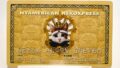
Laputa: Castle in the Sky Playing Card, 8 of Diamonds — Animage 1986

A Playing Card Tied to Ghibli’s Opening Act
This is a single card — the 8 of Diamonds — from a Castle in the Sky character playing card release produced in connection with Animage, the anime magazine published by Tokuma Shoten. Animage had been one of Japan’s most widely read anime publications since its launch in 1978, and by 1986 it held a deep institutional relationship with Studio Ghibli: Tokuma Shoten was the studio’s primary financial backer in its earliest years, and the magazine was simultaneously serializing Hayao Miyazaki’s manga Nausicaa of the Valley of the Wind while Ghibli’s first film went into production.
The card’s production aligns with the theatrical release of Laputa: Castle in the Sky on August 2, 1986 — Studio Ghibli’s debut feature. Whether it was included as a supplement in Animage’s 1986 summer issue or offered as a separately sold tie-in item is not entirely clear from available records. Either way, it belongs to a category of goods that moved through anime magazine channels rather than general retail, and it circulated within Japan only.
Sheeta: Heroine of the Floating Kingdom
The card depicts Sheeta, the heroine at the center of Castle in the Sky. Her full name is Lusheeta Toel Ul Laputa — she is the last surviving member of the ancient royal bloodline of Laputa, the airborne kingdom that gives the film its name. For most of the story she goes simply by “Sheeta,” a name adopted while living in hiding, unaware of her own heritage.
She is immediately recognizable: dark braided hair, an orange headband, and around her neck a luminous crystal pendant known as the hikoseki, or flying stone. This heirloom is both a navigation key to Laputa and the object that every antagonist in the film is trying to seize. Sheeta’s journey alongside the young miner Pazu forms the emotional and narrative core of the movie. She was voiced in Japanese by Keiko Yokozawa.
Castle in the Sky was directed and written by Hayao Miyazaki. Studio Ghibli had been established only in June 1985 — just over a year before the film opened — meaning this card dates to the very first wave of merchandise produced under the Ghibli name.
Character Trump and the Animage Tie-In Tradition
Character trump — standard playing card decks printed with anime or manga artwork — were a mainstream form of licensed merchandise in Japan throughout the 1970s, 1980s, and 1990s. They occupied a distinct space from food-toy premiums (shokugan) and capsule-machine toys (gashapon): a card deck was a functional object with a parallel life as a collectible, typically produced for a specific launch window rather than as part of an ongoing retail line.
Animage’s tie-in goods often reached fans exclusively through the magazine’s own distribution — as bound-in supplements, items accompanying special issues, or limited edition releases outside ordinary toy-store channels. This narrowed the initial audience significantly compared to goods placed in nationwide retail. The Tokuma Shoten–Ghibli relationship meant that Laputa merchandise appeared in Animage from the moment the film was announced, making 1986 items part of the earliest documented layer of commercial goods associated with a studio that would go on to define Japanese animation for the following four decades.


Listed in our eBay store and sent from Japan
$8.82
International shipping available • Ask us anything before you buy