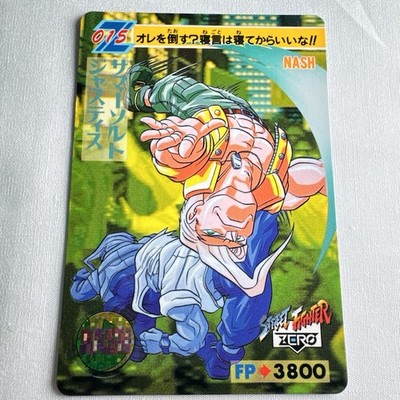
Charlie Nash Street Fighter Zero Carddass No.15 by Bandai

Japan’s Carddass Vending Machine Cards
Carddass is a trading card format Bandai developed in 1988 around a distinctly Japanese idea: a dedicated vending machine that dispensed a single card per 20–25 yen coin. No sealed packs, no randomized bundles — just one card at a time, from machines installed in candy stores, supermarkets, and game centers across Japan. This made collecting accessible to children with pocket change, and it turned the Carddass machine into a fixture of 1990s Japanese childhood in a way that had no real equivalent overseas.
The cards themselves were slightly smaller than a standard modern trading card and often mixed glossy foil “kira” (shiny) variants with regular prints. Unlike shokugan (food toys), which came bundled with candy, Carddass was a vending-machine-only product with no food component. Bandai applied the format to a vast range of licenses — Dragon Ball, Gundam, Sailor Moon, Kamen Rider — and from around 1992 onward, multiple Capcom fighting game titles, Street Fighter among them.
Street Fighter Zero and the Story of Charlie Nash
Street Fighter Zero — known in Western markets as Street Fighter Alpha — launched in arcades in 1995 as a prequel to Street Fighter II (1991), filling in the timeline before that game’s events. It introduced an anime-influenced art style and new mechanics partly borrowed from Capcom’s own Darkstalkers series, including the V-Gauge and Alpha Counter systems. The series continued through Zero 2 (1996) and Zero 3 (1998) and earned wide recognition in both Japan and internationally. The ZERO logo on this card places it within the first game’s Carddass run.
The character depicted is Charlie Nash, making his debut as a playable fighter in this very game. In Street Fighter II lore, Nash had already died before that story began — referenced only as Guile’s senior training partner and closest friend, a US special forces soldier whose fate was left in the past. Street Fighter Zero gave him a full role as a living character, showing the events leading up to that end. His moveset overlaps with Guile’s — both use the Sonic Boom and Somersault Kick — but the execution and properties differ. The card depicts his super combo, the Justice Sword, and includes a character catchphrase at the top that translates roughly as “Beat me? Say that after you wake up!” — an in-character quote format common across Carddass cards of the era. The stat FP♦ 3800 is a fighting power value, a crossover design element that linked the card visually to the game’s own numerical logic.
Why Nash and This Series Resonate with Fans
Nash occupies an unusual place in Street Fighter history: a character introduced to explain a dead man, whose arc carries genuine narrative weight across the entire Zero sub-series. He returned decades later in Street Fighter V (2016) with a dramatic redesign, drawing renewed attention from fans who remembered him from his Zero-era origins.
This Carddass card — No.15 in its series — is a Japan-domestic product, officially licensed by Capcom and manufactured by Bandai, with distribution running entirely through Japanese vending machines. Cards like this did not travel through standard retail channels outside Japan. For fans of the franchise and collectors of 1990s Japanese arcade culture, it represents a specific moment: the official Bandai–Capcom collaboration at the height of the fighting game boom, preserved in the format that defined casual collecting in Japan that decade.


Sleeved and rigid-mailed before it leaves Japan
$8.82
International shipping available • Ask us anything before you buy