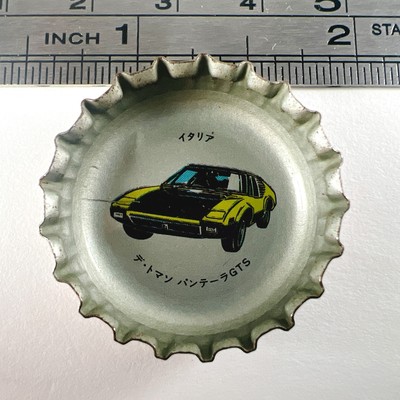
De Tomaso Pantera GTS Bottle Cap: A Relic of Japan's 1970s Supercar Craze

A Coca-Cola Crown Cap Turned Collectible
This small metal disc — roughly 26mm across, the standard diameter of a glass-bottle crown cap — is a surviving artifact from a Coca-Cola Japan promotional series dedicated to the world’s most exciting sports cars. The inner face of the stamped metal cap is printed with an illustration of the De Tomaso Pantera GTS, rendered in a striking yellow-and-black color scheme from a front-quarter angle, along with the car’s name and country of origin (“Italia”) printed in Japanese. Rather than a toy or food premium in the tradition of gashapon or shokugan, this belongs to a distinct category of Japanese collectible: the beverage bottle-cap series, where the cap itself — normally discarded after opening — became the prize.
Coca-Cola Japan produced supercar-themed crown cap series that spanned multiple European and American performance cars, each identified by name and country in Japanese script. Whether the Coca-Cola logo appeared on the printed face of this particular cap is uncertain from available sources, but the promotional context is clear: these caps were distributed alongside glass-bottled Coca-Cola, and collecting a full set of car models was the draw.
The Car on the Cap: De Tomaso Pantera GTS
De Tomaso was founded in Modena, Italy, in 1959 by Argentine-born Alessandro de Tomaso. The Pantera, introduced in 1971, was the company’s most ambitious project: a mid-engined sports car powered by a Ford V8 (5.8 liters) that undercut the price of rival Italian exotics while matching them in visual drama. Ford sold it through its own U.S. dealer network, giving the Pantera unusual reach for an Italian manufacturer.
The GTS (Gran Turismo Sport) variant appeared around 1973 and brought a widened body with flared fenders and a more aggressive stance — the silhouette most associated with the Pantera in collector circles today. Production of the Pantera eventually ended around 1993, cementing its status as a closed chapter in automotive history and a subject of enduring enthusiasm among car enthusiasts in North America, Europe, and beyond.
Japan’s Supercar Boom and the Culture of Crown Cap Collecting
To understand why this cap exists, it helps to know about two overlapping cultural phenomena in 1970s Japan. The first is the Supercar Boom (roughly 1975–1979), a period when Ferraris, Lamborghinis, Porsches, and De Tomasos became objects of intense fascination among Japanese children and adults alike, fueled by magazines, television, and traveling supercar exhibitions. Model cars, cards, stickers, and bottle caps featuring these cars became a booming market.
The second is Japan’s long tradition of crown cap collecting, particularly active from the 1950s through the 1970s. In an era of glass-bottled soft drinks, children routinely saved, traded, and even used bottle caps as playing pieces — a culture beverage companies encouraged by issuing illustrated series designed for set completion. The synergy between these two phenomena made supercar crown caps especially popular: kids had reason to buy another Coca-Cola, and the goal of collecting every car in the series kept the hobby going. The items sit in their own niche, distinct from candy premiums like Glico prizes or Meiji chocolate stickers, because their distribution ran through the beverage channel rather than confectionery.
For collectors today with interests spanning Coca-Cola memorabilia, vintage Japanese pop culture, or the De Tomaso marque itself, a cap like this touches all three worlds in a format small enough to fit in a palm.


Price: $16.64 | View on eBay